


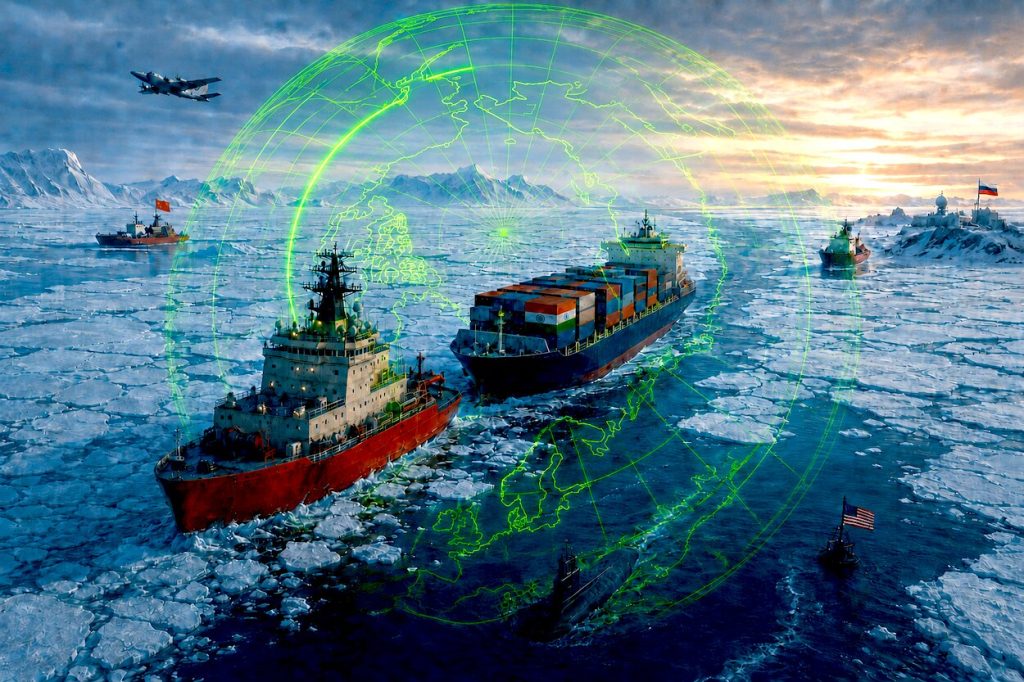
New Delhi: Russia’s president, Vladimir Putin, has invited India to deepen cooperation on the Northern Sea Route, placing New Delhi among the countries Moscow considers important to the development of its Arctic shipping and logistics network. The proposal comes as retreating sea ice, competition over energy and minerals, and a growing military presence turn the Arctic into a new geopolitical frontier involving Russia, the United States, China and Nato.
Speaking aboard the Russian missile cruiser Varyag during Pacific Fleet exercises on Wednesday, Putin said China and India were among the “friends” actively discussing participation in the corridor. Moscow would welcome cooperation with these countries and any other state prepared to help expand global logistics, he said, according to the Kremlin’s official account.
Putin said such cooperation would be conducted within existing international maritime law and warned that “artificial tensions” were growing in the Arctic. His comments reflected Moscow’s concern over Nato’s expanding northern posture and western efforts to restrict Russian shipping after the invasion of Ukraine.
The published Kremlin transcript does not record Putin accusing western countries of seeking to monopolize the Northern Sea Route itself. His separate warning concerned European interceptions of Russia-linked commercial vessels and proposals to confiscate ships suspected of helping Moscow circumvent sanctions, actions he described as violations of maritime law.
The Northern Sea Route runs through Arctic waters along Russia’s northern coast, linking the seas of northern Europe with the Bering Strait and the Pacific Ocean. For voyages between northeast Asia and northern Europe, it can reduce sailing distances by between 30 and 50 per cent and save 14 to 20 days compared with a journey through the South China Sea, Indian Ocean, Suez Canal and Mediterranean.
The corridor also avoids several congested or politically vulnerable waterways, including the Strait of Malacca, Bab el-Mandeb and Suez Canal. Its attraction has increased after attacks on commercial shipping in the Red Sea, restrictions imposed on Russian vessels in European waters and continuing uncertainty around other global maritime chokepoints.
China moves first
China has moved furthest among the non-Arctic powers seeking commercial access to the corridor, with the shipping company Sea Legend planning eight weekly sailings between Ningbo and Felixstowe from mid-August to early October. The first departure has been adjusted because of weather, illustrating the operational uncertainty that still surrounds even a scheduled Arctic service.
The programme follows the 2025 voyage of the Istanbul Bridge, which reached Felixstowe from Ningbo in about 20 days while carrying approximately 4,000 twenty-foot equivalent units. China’s state media compared that with about 40 days through Suez and 50 days around the Cape of Good Hope, although those figures depend on port calls, weather and vessel speed.
China has called its larger Arctic connectivity vision the “Polar Silk Road” and has encouraged Chinese companies to invest in shipping, energy, mining and infrastructure. Its 2018 Arctic policy describes China as a “near-Arctic state” and argues that access to emerging routes should be protected under international law.
Russia has also accelerated the movement of crude oil through the corridor during the 2026 navigation season, with at least seven tankers carrying about six million barrels towards Asian markets by August 11. That was already nearly half the volume transported through the route during the whole of the 2025 season, according to shipping data and trade sources cited by Reuters.
India already laid groundwork
Putin’s remarks build on commitments made during recent India-Russia summits rather than introducing an entirely new proposal. At their July 2024 summit, the prime minister, Narendra Modi, and Putin supported cooperation in developing shipping between the two countries through the Northern Sea Route and proposed a joint mechanism to take the discussions forward.
The process advanced during Putin’s visit to New Delhi in December 2025, when the two sides agreed to strengthen the Northern Sea Route, Chennai-Vladivostok Eastern Maritime Corridor and International North-South Transport Corridor. They also signed a memorandum on training Indian specialists for ships operating in polar waters, opening opportunities for Indian seafarers in ice navigation and Arctic maritime operations.
The December 2025 joint statement recorded India’s readiness to intensify trade and investment in Russia’s Arctic zone, hold regular consultations on Arctic affairs and play an active role as an observer in the Arctic Council. The identified sectors included energy, mining, manpower, maritime transport, agriculture, pharmaceuticals and diamonds.
India is not a newcomer to the Arctic, although its presence has primarily been scientific rather than commercial or military. It began Arctic expeditions in 2007, established the Himadri research station at Svalbard in 2008, became an Arctic Council observer in 2013 and released a national Arctic policy in 2022.
Indian researchers operate the IndARC ocean-observation system and an atmospheric laboratory to examine Arctic climate processes and their possible connections with the Indian monsoon and Himalayan cryosphere. India also launched its first winter Arctic expedition in 2023 and has since expanded research into the East Greenland Sea, according to the Ministry of Earth Sciences. [pdf]
For India, the most realistic early gains are likely to come from access to Russian energy and mineral projects, polar-maritime training, ice-class shipbuilding, port services, logistics and scientific collaboration. The Northern Sea Route could also connect with the Chennai-Vladivostok corridor and Russia’s rail and inland-waterway network, giving Indian businesses better access to Siberia, the Russian Far East and Arctic production centres.
However, the corridor does not provide India with the same geographical advantage that it offers China, Japan or South Korea. An Indian ship bound for Europe would normally find Suez considerably more direct, meaning New Delhi’s principal commercial interest lies in access to Russian Arctic cargo and infrastructure rather than rerouting ordinary India–Europe trade through the Bering Strait.
A Suez-like possibility
The comparison with the opening of the Suez Canal captures the Northern Sea Route’s potential to change trade geography and create new centres of strategic influence. It remains a forward-looking analogy, however, because the Arctic corridor is still far from matching Suez in traffic, reliability, infrastructure or global reach.
About 37.02 million tonnes of cargo moved along the Northern Sea Route in 2025, but only 3.2 million tonnes consisted of through-transit cargo travelling between the Pacific and Atlantic ends. By comparison, the Suez Canal handled about 1.57 billion tonnes in 2023 before the Red Sea security crisis sharply reduced traffic, underlining the enormous gap between an established global artery and a developing Arctic corridor.
Most Northern Sea Route traffic continues to serve Russian LNG, oil, mining and construction projects rather than international container trade. The 103 complete transit voyages recorded in 2025 were an improvement over previous years but remained marginal compared with the thousands of ships using Suez annually.
Commercial shipping depends on fixed arrival dates, predictable speeds and the ability to reposition vessels and containers across integrated port networks. The Arctic presents drifting ice, fog, extreme weather, shallow passages, limited repair and rescue facilities, higher insurance costs and a shortage of ice-class vessels and experienced crews.
Its navigation season is lengthening but remains heavily dependent on local ice conditions, with much of the non-ice-class traffic concentrated between July and October. Year-round sailing generally requires specialized ships and icebreaker support, making the corridor more suitable at present for high-value, time-sensitive consignments and bulk Russian exports than mass container shipping.
The environmental costs are equally significant because an oil spill in icy, remote waters would be exceptionally difficult to contain. Ship emissions also include black carbon, which darkens snow and ice and accelerates melting, while increased noise and traffic threaten marine ecosystems and the livelihoods of Indigenous communities.
The International Maritime Organization’s Polar Code imposes additional requirements covering vessel design, equipment, operations, crew training and environmental protection. A prohibition on using or carrying heavy fuel oil as fuel in Arctic waters began on July 1, 2024, although some exemptions and waivers can continue until 2029, according to the IMO.
Why Arctic becoming new geopolitical frontier
Climate change is the immediate physical driver of the Arctic transformation, even though reduced ice does not make the region safe or consistently accessible. The Arctic has warmed nearly three times faster than the global average since 1980, while its March 2025 winter sea-ice maximum was the lowest in the 47-year satellite record, according to the US National Oceanic and Atmospheric Administration.
The end-of-summer ice cover in 2025 was 28 per cent smaller than in 2005 and consisted of substantially younger and thinner ice. That decline is opening longer seasonal windows for shipping, resource surveys, fishing, naval movement, surveillance and undersea infrastructure.
Resources constitute the second major attraction, although frequently repeated estimates require careful qualification. A 2008 US Geological Survey assessment calculated that the region north of the Arctic Circle could contain about 90 billion barrels of oil, 1,669 trillion cubic feet of natural gas and 44 billion barrels of natural-gas liquids, with approximately 84 per cent offshore.
These figures describe undiscovered and technically recoverable resources rather than proven, commercially viable reserves. Nevertheless, the Arctic’s oil, gas, nickel, cobalt, copper, rare-earth elements and other critical minerals have acquired greater importance as major powers seek energy security and supply chains less dependent on geopolitical competitors.
The region is also central to nuclear deterrence and continental defence because the shortest air and missile routes between Russia and North America cross the Arctic. It hosts ballistic-missile submarines, early-warning radars, space-surveillance facilities, strategic airfields and maritime approaches connecting the North Atlantic and Pacific.
After Finland and Sweden joined Nato, seven of the eight Arctic states became members of the alliance, leaving Russia as the only Arctic country outside it. Nato launched Arctic Sentry in February 2026 to coordinate allied air, maritime, land, space and surveillance activities, while multinational forward land forces began operating in Finland in June.
Russia controls more than half the Arctic Ocean coastline and regards the region as both an economic base and a defensive barrier protecting its northern territory and strategic submarine forces. It has restored or expanded military bases, airfields, radar installations and ports while operating the world’s only fleet of nuclear-powered icebreakers.
Western governments argue that some of this infrastructure allows Moscow to control access to the Northern Sea Route and project military power beyond the Russian Arctic. Moscow says the deployments defend its sovereignty, commercial infrastructure and an increasingly exposed northern coastline.
What the US is doing
The United States is already an Arctic power through Alaska and maintains the Pituffik Space Base in Greenland for missile warning, missile defence support and space surveillance. Its 2024 defence strategy called for better Arctic communications, intelligence, surveillance, reconnaissance, infrastructure and cold-weather mobility, alongside more exercises and operations with allies.
The US president, Donald Trump, elevated Greenland to the centre of American Arctic policy by pressing for control of the autonomous Danish territory, citing missile defence, shipping access, minerals and the danger of Russian or Chinese influence. After a confrontation with European allies in January this year, Trump said Washington and Nato had developed a framework giving the US permanent access, although the details remained under negotiation and no transfer of sovereignty was announced.
Washington is also trying to overcome its severe icebreaker deficit relative to Russia. The US Coast Guard completed contract awards in February for as many as 11 Arctic Security Cutters, with the first two expected to be delivered by the end of 2028 and based in Alaska, according to the coast guard.
That programme supplements plans for three larger Polar Security Cutters and the acquisition of the medium icebreaker Storis. Until those vessels arrive, the US remains dependent on a small operational fleet that includes the ageing heavy icebreaker Polar Star, commissioned in 1976.
Denmark, Greenland and the Faroe Islands are simultaneously strengthening surveillance and defence to demonstrate that Copenhagen and Nuuk can secure the territory without surrendering control. Their 2025 agreements allocated money for Arctic ships, long-range drones, satellites, air operations, surveillance and facilities for constructing larger vessels.
Canada is investing in over-the-horizon radar, northern operational support hubs, maritime surveillance, icebreakers and the modernization of the North American Aerospace Defense Command (Norad). Norway, Sweden and Finland have also increased cold-weather exercises, maritime patrols, ground deployments and infrastructure across Nato’s northern flank.
Maritime law could be tested
The legal status of passages within the Northern Sea Route remains contested because Moscow treats several of them as internal Russian waters and requires foreign ships to obtain permission. Western governments maintain that some passages should qualify as international straits where wider navigation rights apply.
Article 234 of the UN Convention on the Law of the Sea allows coastal states to enforce non-discriminatory pollution-control regulations in ice-covered areas of their exclusive economic zones when severe conditions create exceptional navigational hazards. Continued ice loss could intensify arguments over how far that provision permits Russia to regulate navigation and whether its broader restrictions remain justified.
Diplomatic mechanisms are struggling to keep pace with these changes because the Arctic Council’s mandate explicitly excludes military security. Political-level meetings involving all eight Arctic states have been suspended since 2022, although scientific and working-group meetings have resumed virtually, according to a 2026 council update.
For India, the emerging opening is therefore both commercial and strategic, but it is not risk-free. New Delhi can work with Russia on shipping, resources and polar skills while retaining scientific partnerships with other Arctic states and supporting freedom of navigation, environmental safeguards and the rights of Indigenous communities.
The Northern Sea Route is unlikely to replace Suez in the foreseeable future, but that does not make it geopolitically unimportant. Its value lies in providing an additional seasonal corridor, unlocking Russian Arctic resources and determining who will shape the rules, infrastructure and security architecture of a region becoming steadily more accessible.