


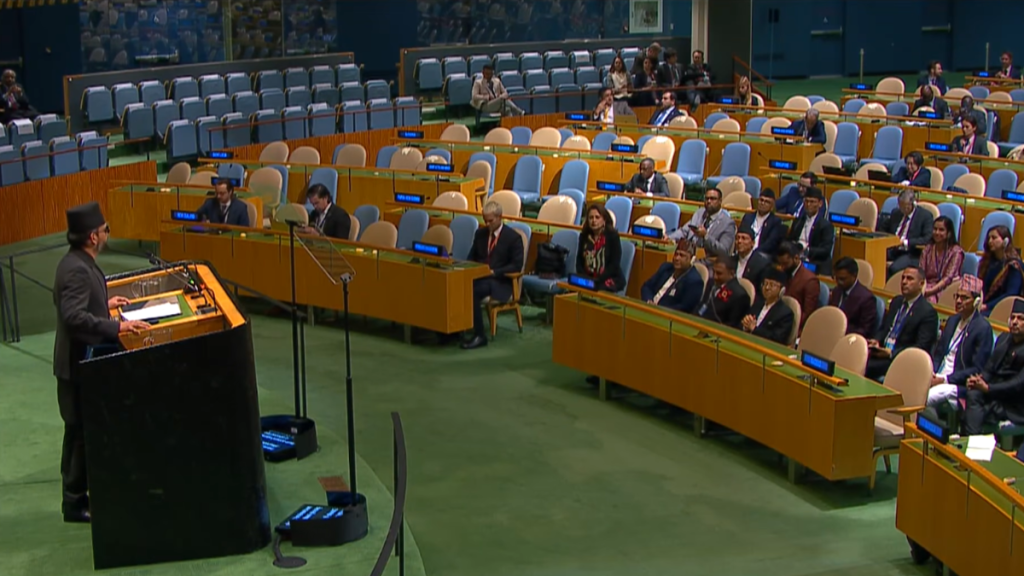
New Delhi: The Nepal prime minister, Balendra Shah, thanked India and China for standing by Nepal after the devastating Bhotekoshi-Trishuli floods and urged the international community to help the country rebuild. Speaking at the 81st session of the United Nations general assembly in New York, Shah said Nepal was facing a huge recovery challenge after a disaster that killed at least 1,400 people and left more than 6,000 missing.
Shah said a rapid assessment had put Nepal’s physical recovery needs at around 10 per cent of its GDP. As RNA Media had earlier reported, citing Reuters, Nepal’s finance minister Swarnim Wagle estimated that the country could need $4 billion to $5 billion for reconstruction after the disaster.
Shah thanked India and China for their prompt and generous help, along with other countries, UN agencies, humanitarian organizations and people around the world who supported Nepal. He said Nepal now needs the same international solidarity for the long process of recovery and rebuilding.
The Nepali prime minister said the disaster was not only a crisis for Nepal but also a warning about what climate change could mean for the Himalayas. He pointed to retreating glaciers, unstable mountain slopes, unpredictable rivers and increasingly severe weather, saying disasters are destroying roads, bridges, schools, homes, farms, livelihoods and clean-energy infrastructure.
Shah said Nepal contributes less than 0.1 per cent of global greenhouse gas emissions but is paying a heavy price for climate change. He called for the principle of common but differentiated responsibilities to be turned into greater support for vulnerable countries that have contributed less to the climate crisis.
As part of that effort, Shah proposed a Himalayan climate-resilience mechanism involving Nepal, India and China. He said the three countries could share satellite data and expertise, monitor dangerous glacial lakes, strengthen early-warning systems and coordinate help when disasters cross borders.
He said the Hindu Kush Himalaya is home to nearly two billion people and provides water, agriculture, ecosystems and livelihoods across the region. Shah called for the Himalayas to become a place for international cooperation, where countries share information and prepare together for climate disasters.
Shah also called for greater grant-based climate finance, saying vulnerable countries should not have to take on more debt to recover from disasters they did little to cause. He said the loss and damage fund, global environment facility and other financing mechanisms remain inadequate and called for faster and simpler access to climate funds.
He said Nepal also needs to invest in resilience before disasters happen, including stronger infrastructure, better institutions, insurance, innovation and early-warning systems. Shah also called for lower dependence on fossil fuels as the country prepares for more extreme climate events.
The Nepali prime minister then turned to the wider global system, questioning why weapons and military supplies can move quickly across borders while poorer countries struggle to secure basic goods such as fertiliser, fuel and bitumen. He said countries such as Nepal that are being affected by climate change did little to cause them, as well as wars they did not start.
Shah called for a fairer global economic order and stronger multilateralism, with small and vulnerable countries having a greater voice in international decision-making. He said climate justice is not only about money but also about who bears the cost of climate change and who gets a say in decisions affecting their future.
Shah also highlighted Nepal’s own climate efforts, saying the country has restored forest cover to nearly half of its territory, expanded hydropower, promoted electric mobility and strengthened climate adaptation at the local level.
He linked Nepal’s recent political transition with a wider demand among young people for integrity, accountability and better opportunities. Shah said his government wants to build a state that provides decent jobs, social protection and opportunities for Nepal to build their future at home.
Shah said the floods had shown that Nepal must move from ad hoc disaster response to a culture of preparedness. He called for stronger infrastructure and institutions, better warning systems and greater investment in resilience so that the next climate disaster does not again erase years of development.