


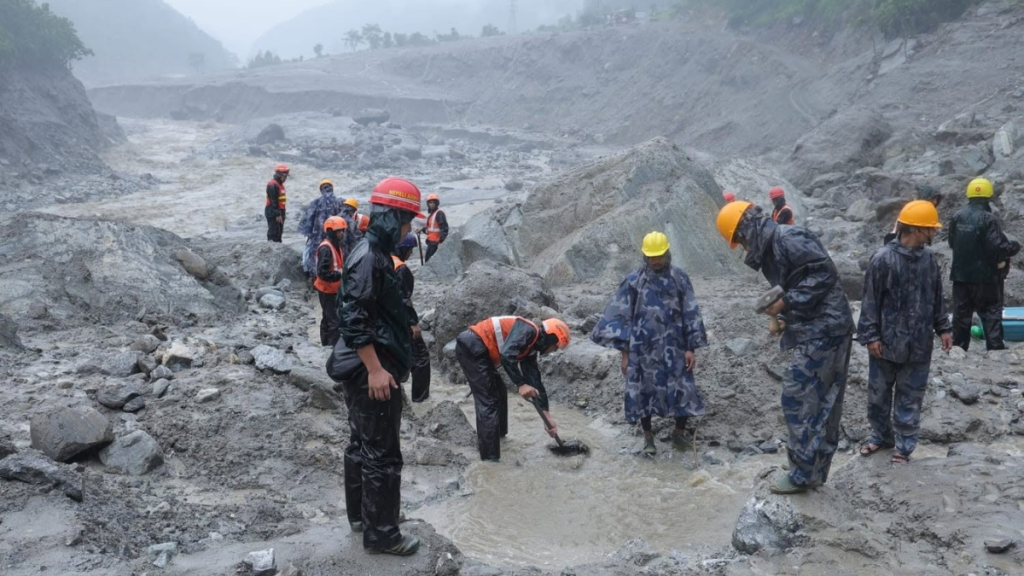
New Delhi: The death toll from the deadly floods that swept across Nepal and neighbouring Tibet has crossed 1,300, while nearly 5,000 people remain missing, as rescue teams continue searching through vast stretches of mud, debris and collapsed structures. The scale of the disaster has also brought fresh restrictions on foreign media reporting in Nepal.
On the Chinese side, 12 more bodies were recovered from the devastated Gyirong border crossing, taking the confirmed death toll there to 43, according to Reuters. As of Saturday, 519 people remained missing in Tibet, including 261 foreign nationals from 23 countries, with 49 Indian citizens among those still unaccounted for and many believed to have been travelling as pilgrims towards Mount Kailash.
The Gyirong crossing, a major trade and travel route between Nepal and Tibet, was buried under a massive mudslide following the August 26 disaster. Rescue teams are using excavators, shovels and ground-penetrating radar to search the site, while officials are collecting fingerprints, documenting identifying marks such as tattoos and preserving personal belongings to help establish the identities of victims.
Nepal tightens rules for foreign journalists
As rescue operations continue, Nepal’s department of information and broadcasting has introduced a new requirement for foreign journalists seeking to report from flood-affected areas along the Bhotekoshi and Trishuli rivers. Under an official notice issued, foreign journalists must obtain a Press Accreditation and Journalist Identity Card before collecting news from the affected areas, with applications to be submitted through the department’s online service.
Applicants are required to provide a passport copy carrying a valid visa or entry permit, a recommendation letter from their media organization addressed to the Nepal department of information and broadcasting, and a recommendation letter from their embassy, consular office or foreign ministry. The accreditation will be issued by the department’s director general and remain valid for 15 days, while a help desk has also been established to assist foreign journalists with the process.
The new restrictions come as authorities confront another flood threat in Nepal’s mountainous regions, where several areas remain vulnerable following the August 26 devastation. A flood in the Therang river in Gorkha district on Sunday swept away four houses and a suspension bridge in Chumanubri rural municipality, although no casualties were reported as residents moved to safer areas after noticing the rising water, ANI reported.
The latest incident has underscored the continuing risks in areas already affected by the disaster, with authorities monitoring water levels in major rivers while rescue and relief operations remain underway.
60-year-old woman rescued after 10 days
Amid the devastation, rescuers made a remarkable discovery in Nuwakot district, where 60-year-old Chandika Kumari Shrestha was found alive after spending 10 days beneath the remains of her collapsed home in Betrawati. Her family had already begun mourning her, believing she had died in the floods, when rescue workers searching through the debris heard a faint voice calling for help and discovered her trapped inside a narrow pocket of air.
Her rescue came as authorities continued searching for thousands of people still unaccounted for, including those believed to be trapped beneath debris and inside tunnels at hydropower projects.