


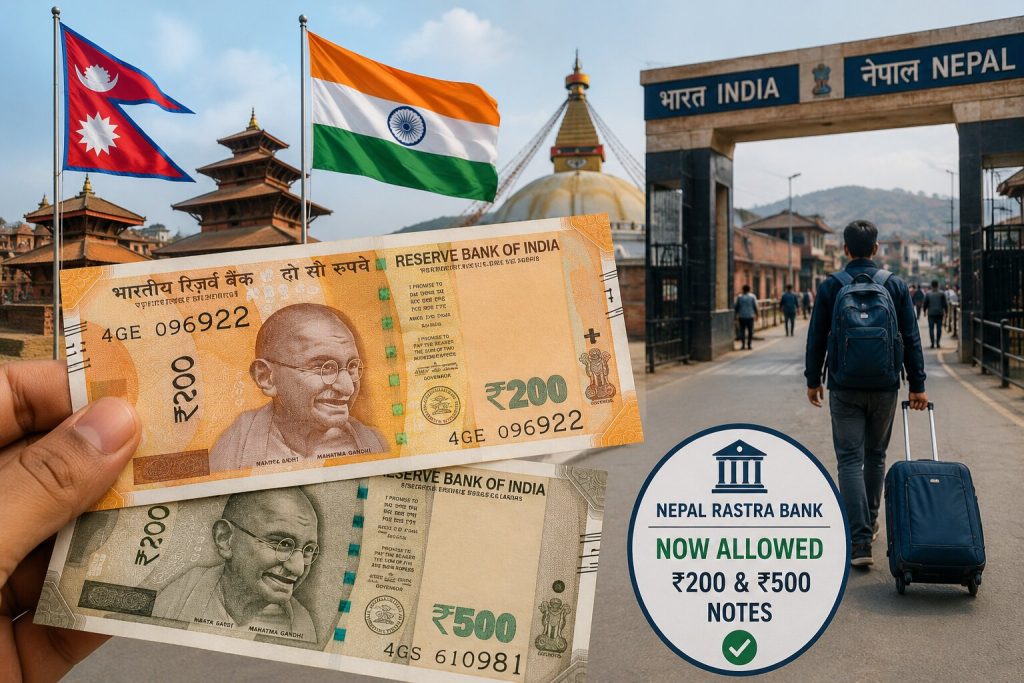
New Delhi: Nepal has relaxed its rules on carrying Indian currency, allowing ₹200 and ₹500 banknotes to be brought into, taken out of, or exchanged within the country for the first time since a near-decade-long restriction that had complicated life for tourists, migrant workers and traders along the open border.
Nepal Rastra Bank, the country’s central bank, issued a directive on Thursday, implementing a decision by the Nepali government to permit the use of these two denominations, provided the notes were issued after November 9, 2016 – the date on which India demonetised its old ₹500 and ₹1,000 notes. Commercial banks in Nepal have been authorized to exchange the notes without difficulty, and the same limit of ₹25,000 per person that already applied to smaller denominations will now cover the newly permitted notes as well.
Until this week, only Indian notes of ₹100 or less could be legally carried across the border in that quantity, a restriction that had left travellers and returning workers scrambling for change or resorting to informal, and often unfavourable, currency exchanges. ₹500 and ₹1,000 notes printed before the 2016 demonetisation remain prohibited, as does the ₹2,000 note altogether.
The move follows an amendment last year to the Reserve Bank of India’s Foreign Exchange Management Regulations, 2015, which permitted high-denomination Indian notes to move between India and Nepal. Under the revised rules, any quantity of notes up to Rs 100 may be carried freely, while higher denominations, now including ₹200 and ₹500, fall under the ₹25,000 cap.
According to an NRB spokesperson, Guru Paudel, the restrictions could only be lifted once a formal mechanism was in place for handling the notes: commercial banks will collect eligible Indian currency from the public and forward it to the central bank, which will in turn deposit the funds into its account with the RBI.
The relaxation closes a chapter that began in the chaos of India’s 2016 demonetisation, when Nepali banks were left holding a large stock of old high-denomination Indian notes that New Delhi initially declined to exchange. Kathmandu banned the use of Indian currency above ₹100 outright in early 2018, a step that hit Nepali labourers working in India and Indian tourists in Nepal alike, given how deeply Indian currency is woven into everyday transactions in the Himalayan republic.
Nepal subsequently pressed India for years, through diplomatic channels and formal requests to the RBI, to recognise the newer notes as legal tender – appeals that went unanswered until last year’s regulatory amendment paved the way for this week’s directive.
The central bank also clarified that foreign nationals other than Indian citizens, as well as Nepali citizens themselves, may carry up to US $5,000, or its equivalent in other foreign currencies, into or out of Nepal without a customs declaration. Nepali citizens, however, remain barred from carrying Indian currency to or from any country other than India.
India remains Nepal’s largest trading partner and the principal source of its consumer goods, and the two countries share an open border across which millions of people, goods and remittances move each year. NRB said the revised provisions were intended to remove ambiguity around foreign exchange transactions, ease travel for Indian tourists, and strengthen compliance with anti-money laundering norms.