


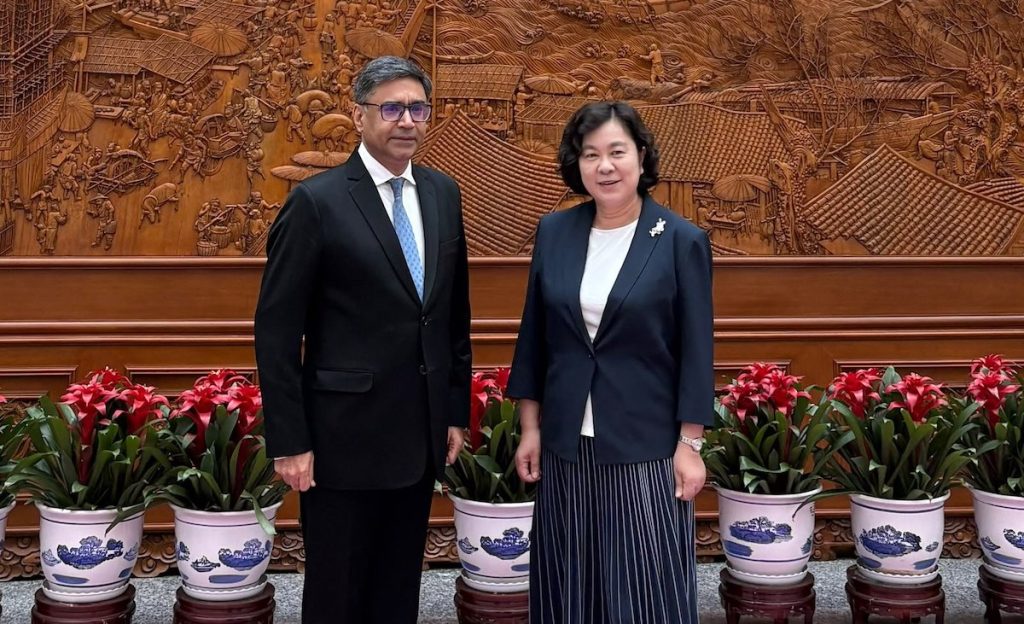
New Delhi: With the historic Nathu-la trade route in Sikkim set to reopen within days after a six-year suspension, the foreign secretary, Vikram Misri, met China’s vice-foreign minister, Hua Chunying, in Beijing on Monday for talks spanning the entire breadth of the India-China relationship. Both sides once again underlined the need to preserve peace and tranquillity along the disputed border even as the two neighbours press ahead with a slow, deliberate normalisation of ties.
According to a statement from the Indian embassy in Beijing, Misri and Hua reviewed the entire gamut of bilateral relations and discussed means of advancing the vision of the two leaders that India and China are partners rather than rivals, with development opportunities for each other, including in trade, culture and people-to-people contact. Both sides acknowledged the importance of maintaining peace and tranquillity in the India-China border areas, the embassy added.
That reference to border trade carries fresh weight this week. Cross-border commerce through Nathu-la, one of the Himalayas’ oldest trading corridors, is scheduled to resume on August 1, ending a suspension of more than six years that followed the 2020 pandemic and the military standoff in eastern Ladakh.
The decision stems from the 24th round of the India-China special representatives’ dialogue held in August 2025, co-chaired by the national security adviser, Ajit Doval, and the Chinese foreign minister, Wang Yi. Alongside Nathu-la in Sikkim, trade is also being revived through Shipki-la in Himachal Pradesh and Lipulekh in Uttarakhand.
Earlier on Monday, Misri held separate talks with Hong Liang, deputy secretary general of the 14th National Committee of the Chinese People’s Political Consultative Conference. The discussions focused on deepening exchanges at the political and people-to-people levels.
He also met Sun Haiyan, vice minister of the International Department of the Communist Party of China’s Central Committee, on strengthening bilateral coordination more broadly. Misri, who previously served as India’s ambassador in Beijing, is expected to hold further meetings with Chinese officials on Tuesday.
Follows Jaishankar-Wang Manila meeting
Monday’s talks came days after the external affairs minister, S Jaishankar, met his Chinese counterpart, Wang Yi, on the sidelines of the Asean foreign ministers’ meetings in Manila, as reported earlier by RNA Media. Jaishankar noted that relations had been gradually normalising since the leaders’ meeting in Kazan in October 2024, a direction further affirmed when they met in Tianjin last August.
He reiterated that a stable, cooperative relationship between the two countries ought to rest on mutual respect, mutual interest and mutual sensitivity. Peace along the line of actual control (LAC), he said, remains the non-negotiable precondition for any return to normalcy.
Jaishankar also pressed China on more prosaic but persistent irritants in the relationship, citing fair market access, the widening trade balance and predictability in supply chains. He welcomed recent confidence-building steps, including restored direct flights, an eased visa regime and the revived Kailash Manasarovar Yatra.
The Manila engagement was not without friction on the messaging front, however. Beijing’s own readout suggested Jaishankar had assured Wang Yi of India’s respect for Chinese sovereignty over Taiwan and Tibet.
New Delhi swiftly disputed that account. The ministry of external affairs clarified that no such assurance was made, and that Jaishankar had instead raised India’s own concerns about China’s occupation of Indian territory since 1963.
A cautious thaw
The broader relationship is still climbing out of the trough it fell into after the 2020 Galwan valley clashes, the most serious military confrontation between the two countries in decades. Engagement has picked up steadily since the prime minister, Narendra Modi, and the Chinese president, Xi Jinping, met on the sidelines of the BRICS summit in Kazan in October 2024.
That meeting is credited with unlocking troop disengagement at remaining friction points in eastern Ladakh and, subsequently, a resumption of the foreign secretary-vice-minister mechanism itself. The mechanism was last used in January 2025, and again in January this year when Sun Haiyan visited New Delhi to discuss the stabilisation of ties. Monday’s meeting, coming just days before trade resumes at Nathu-la, suggests both capitals are keen to keep that momentum alive. Unresolved boundary questions, trade imbalances and periodic disputes over messaging, however, continue to test the limits of the reset.