


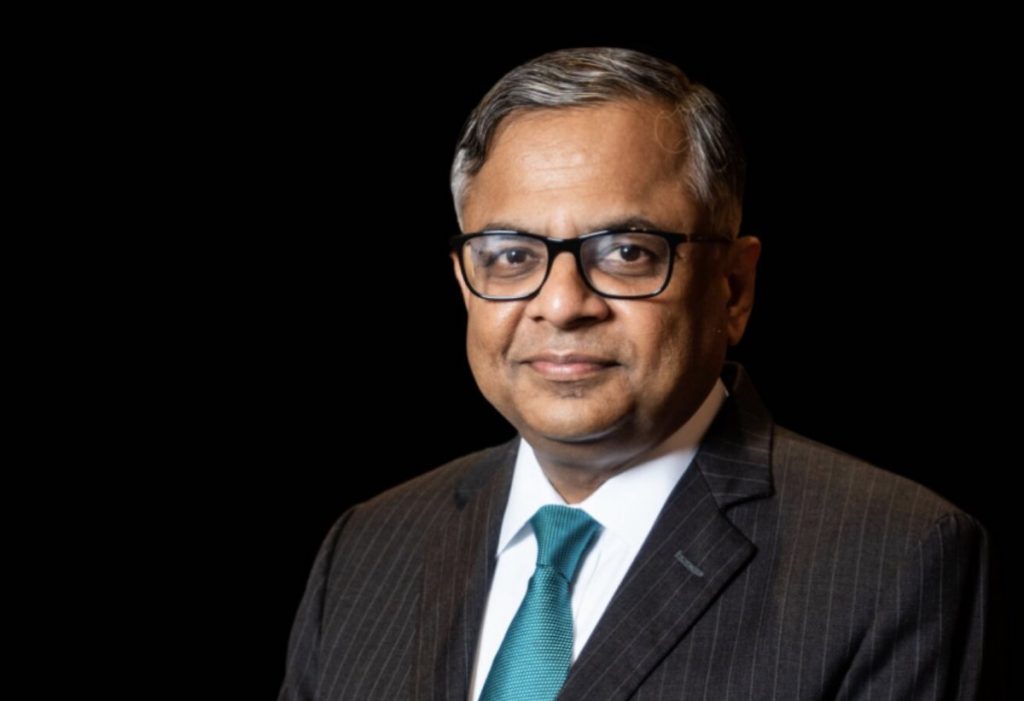
New Delhi: The chairman of Tata Sons, N Chandrasekaran, has submitted his resignation after nearly a decade at the helm of India’s largest business conglomerate, days before a crucial annual general meeting that was expected to determine his continuation on the company’s board. Chandrasekaran, however, is expected to remain in office until his current term expires in February 2027, making his decision a planned exit rather than an immediate departure from Bombay House.
The development on Wednesday marks an extraordinary turn in a leadership and governance dispute that has been building within the Tata establishment for months. Tata Sons and Chandrasekaran had not immediately issued detailed public statements explaining the reasons for his resignation when the news broke, leaving reports based on people familiar with the discussions to provide the first account of events.
The timing is particularly significant because Tata Sons is due to hold its AGM (annual general meeting) on August 18, when Chandrasekaran was expected to retire by rotation as a director and seek shareholders’ approval for reappointment to the board. Although his second five-year term as chairman technically continues until February 2027, remaining a director is necessary for him to continue at the head of Tata Sons.
Earlier on Wednesday, the Economic Times reported that Chandrasekaran had discussed with close associates the possibility of stepping down rather than face an uncertain and potentially contentious vote at the AGM. Reuters subsequently reported, citing a person with direct knowledge of the matter, that he had submitted his resignation but intended to serve out the remainder of his term.
Possible reasons to quit
No formal explanation has yet established a single reason for Chandrasekaran’s decision, but reporting by several publications points to an increasingly difficult relationship between the leadership of Tata Sons and Tata Trusts, which controls about 66 per cent of the holding company. The Financial Times described his resignation as coming against the backdrop of an escalating succession and power struggle involving the chairman of Tata Trusts, Noel Tata, while Reuters has highlighted differences over governance, Tata Sons’ future ownership structure and board representation.
One of the most consequential differences concerns the possibility of Tata Sons eventually being listed on the stock exchanges, an issue that acquired urgency after the Reserve Bank of India classified it as an upper-layer non-banking financial company. Reuters reported that Noel Tata opposed a listing and had sought a commitment that Tata Sons would remain privately held, while Chandrasekaran resisted such a condition.
The issue goes well beyond a potential initial public offering because control of Tata Sons ultimately determines the strategic direction of a business group spanning technology, steel, automobiles, aviation, power, hotels, consumer products, electronics, semiconductors and defence. The Tata Trusts’ controlling shareholding gives their position considerable weight in decisions affecting the holding company and, through it, dozens of operating businesses.
Differences between Chandrasekaran and the trusts became publicly evident in February, when a decision on extending his tenure beyond February 2027 was deferred. Reuters Breakingviews said the subsequent governance dispute had begun affecting decision-making across the conglomerate and argued that uncertainty surrounding the chairman had become increasingly difficult to sustain at a group of Tata’s scale.
The immediate problem, however, was the August 18 AGM and the vote on Chandrasekaran’s reappointment as a director. The Economic Times reported that Noel Tata was seen as opposing his continuation and that uncertainty over how Tata Trusts would vote created the possibility that what would ordinarily have been a routine reappointment could instead turn into a bruising contest.
Complicating matters further, the Maharashtra charity commissioner has suspended the Sir Ratan Tata Trust from decision-making, creating additional uncertainty over the trust structure and the AGM. Corporate law specialists cited by The Economic Times said questions over whether the AGM could be postponed and how Chandrasekaran’s directorship would be treated in such circumstances added another layer of complexity to the confrontation.
Analytical commentary has also pointed to mounting business pressures within parts of the group, although there is no evidence that any individual operational problem directly caused Chandrasekaran’s resignation. Reuters Breakingviews noted slowing growth at Tata Consultancy Services – the group’s principal cash generator – while the wider Tata portfolio has faced challenges involving Air India and Jaguar Land Rover alongside substantial investments in new industries.
Taken together, the available accounts suggest that the resignation is primarily a governance and succession decision rather than a response to one company’s financial performance. By signalling his departure before the AGM while remaining until February, Chandrasekaran appears to have reduced the possibility of an abrupt removal while giving Tata Sons several months to organize a leadership transition – an inference consistent with the circumstances reported by several business media outlets.
Tata stocks tumble
Investors reacted sharply as reports of Chandrasekaran’s resignation reached the market, sending several listed Tata Group companies lower in Wednesday trading. Tata Sons is privately held and has no publicly traded shares of its own, meaning the sell-off was concentrated in listed operating companies whose investors were assessing the consequences of fresh uncertainty at the group’s apex holding company.
Shares of Tata Consultancy Services, India’s largest information-technology services exporter and the Tata Group’s most valuable listed company, fell as much as 4.1 per cent after the news. Tata Motors Passenger Vehicles, the parent of Jaguar Land Rover, dropped 2.8 per cent, while Tata Group shares broadly came under selling pressure as investors digested the prospect of a leadership change.
The reaction was significant because Chandrasekaran has for years provided a common strategic centre to a sprawling collection of businesses that otherwise operate with considerable autonomy. TCS is particularly important to Tata Sons’ finances, with Reuters Breakingviews noting that the IT company accounts for about 87 per cent of the holding company’s dividend income.
The initial fall in shares, however, should not by itself be read as a verdict on the underlying businesses, particularly since Chandrasekaran is expected to remain in charge for several more months. Markets frequently respond quickly to unexpected leadership changes, and attention is likely to shift towards the succession process, the resolution of the dispute between Tata Sons and Tata Trusts and whether the transition affects major investment decisions across the group.
Who is N Chandrasekaran?
Born in 1963, Natarajan Chandrasekaran is one of India’s best-known professional corporate executives and a Tata veteran who joined Tata Consultancy Services in 1987. He rose through the company over three decades, becoming its chief executive officer and managing director in 2009 before joining the Tata Sons board in October 2016.
Chandrasekaran was appointed executive chairman of Tata Sons on January 12, 2017, and formally took charge on February 21 that year following the turbulent removal of his predecessor, Cyrus Mistry. His appointment was notable because he emerged from the professional management ranks rather than the Tata family and arrived at the group headquarters after establishing his reputation during TCS’s rapid global expansion.
Under Chandrasekaran, the group pursued what it called the “One Tata” strategy, emphasizing simplification, scale and greater coordination among Tata companies. His tenure also saw Tata enter or substantially expand businesses in semiconductors, electronics manufacturing, consumer internet services, mobile technology and battery manufacturing, while the acquisition of Air India brought the former national carrier back under Tata ownership.
He also chairs or has chaired several major Tata companies, including Tata Steel, Tata Motors, Tata Power, Air India, Tata Consumer Products and Indian Hotels. The breadth of those responsibilities made Chandrasekaran more than the head of the holding company as he became the principal executive figure overseeing the strategic transformation of a conglomerate with operations across much of the Indian economy.
Chandrasekaran holds a bachelor’s degree in applied sciences and a master’s degree in computer applications and has received several major honours during his career. He was awarded the Padma Bhushan in 2022, received France’s Legion d’Honneur in 2023 and was conferred an honorary knighthood in the Order of the British Empire in 2025.
His departure therefore opens one of the most consequential corporate succession questions in India, particularly because Tata Group businesses are closely tied to the country’s ambitions in areas ranging from semiconductor manufacturing and electronics to aviation, clean energy and defence. The immediate question is no longer merely whether Chandrasekaran can survive the August 18 AGM, but who Tata Sons and its controlling trusts can agree upon to lead the conglomerate after his term ends in February 2027.