


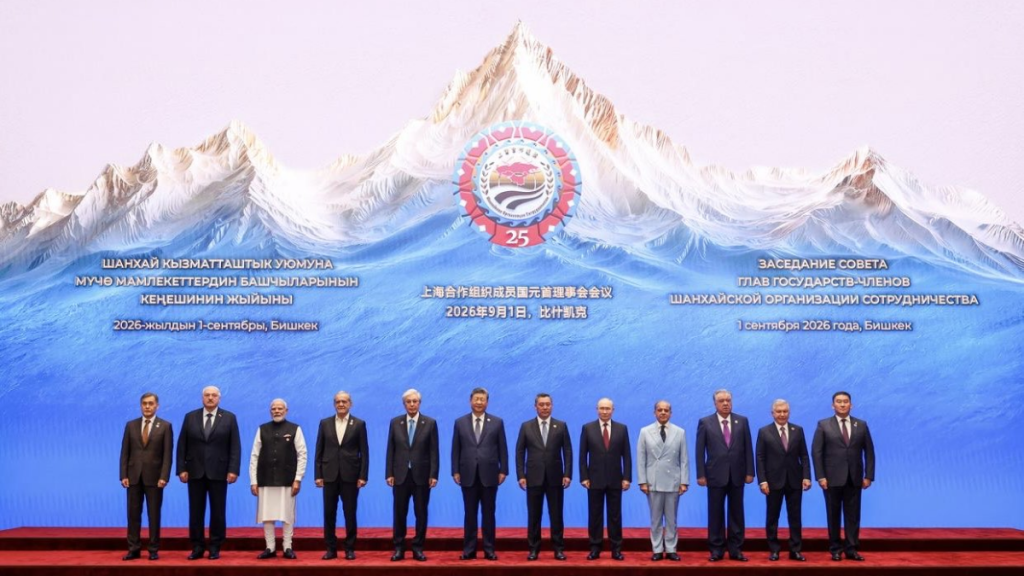
New Delhi: A brief handshake between the prime minister, Narendra Modi, and Chinese president, Xi Jinping, ahead of the SCO family photograph became one of the key moments at the 26th Shanghai Cooperation Organisation (SCO) Summit in Bishkek on Tuesday. The two leaders were joined by the Russian president, Vladimir Putin, at the Yrys Ordo Congress Hall, where Kyrgyzstan president, Sadyr Japarov, hosted the summit.
The Kyrgyzstan president, Sadyr Japarov, who is hosting the summit and serving as the SCO chair, led the gathering. The family photograph also featured the Pakistan prime minister, Shehbaz Sharif; Iranian president, Masoud Pezeshkian; Belarusian president, Alexander Lukashenko; Kazakhstan president, Kassym Jomart Tokayev; Uzbek president, Shavkat Mirziyoyev; and Tajik president, Emomali Rahmon.
The summit is being held as the SCO marks 25th years of its establishment, with India focusing on the organization’s agenda for the next 25 years. In his address, Modi said the time had come to turn the SCO’s long standing cooperation into concrete outcomes and identified security, connectivity and opportunity as the three pillars of India’s vision.
Modi said India wants the SCO to turn its shared geography into shared opportunities and ensure that cooperation produces direct benefits for people. According to a post by the Ministry of External affairs on X, the prime minister stressed that the organization must move from vision to outcomes and make its cooperation more people driven.
Security and the fight against terrorism remained a major part A India’s position at the summit. Modi called for the entire ecosystem of terrorism to be dismantled, including terrorist financing, recruitment, radicalization and safe havens. He said there could be no double standards in the fight against terrorism and that countries which use terrorism as an instrument of policy or provide shelter and support to terrorists must receive a strong message that terrorism cannot become a strategic asset.
Modi also linked peace and security in Eurasia with stability in Afghanistan and said India would continue its development and humanitarian assistance to the Afghan people. On the West Asia crisis, he said conflicts in one region can affect energy security, maritime trade and supply chains across the world, with the Global South facing a major impact. He reiterated India’s position that lasting solutions to conflicts require dialogue and diplomacy.
The prime minister said the benefits of SCO cooperation should reach people directly, with greater emphasis on young people, entrepreneurs and farmers. He highlighted India’s start up forum, young authors’ conclave and young scientists’ forum and said cooperation within the organization should increasingly become people driven rather than being limited to governments.
First session of the SCO Civilizational Dialogue Forum, which was proposed by India last year, will be organized in India this year. Modi referred to Kyrgyz writer Chingiz Aitmatov and said his message about focusing on what unites people rather than what divides them was particularly relevant for the SCO.
The summit also saw Modi sign the SCO declaration along with the leaders of other member states. India became a full member of the SCO in 2017, and the organization now has 10 member states. The summit is also being held in the expanded SCO Plus format, bringing together leaders from associated countries.
On the sidelines of the summit, Modi met Tajikistan president, Emomali Rahmon, and Lao president, Thongloun Sisoulith. After his meeting with Rahmon, Modi said in a post on X that India looked forward to boosting cooperation with Tajikistan across diverse sectors. Following his meeting with Sisoulith, he said the two sides discussed strengthening bilateral linkages between India and Laos.