


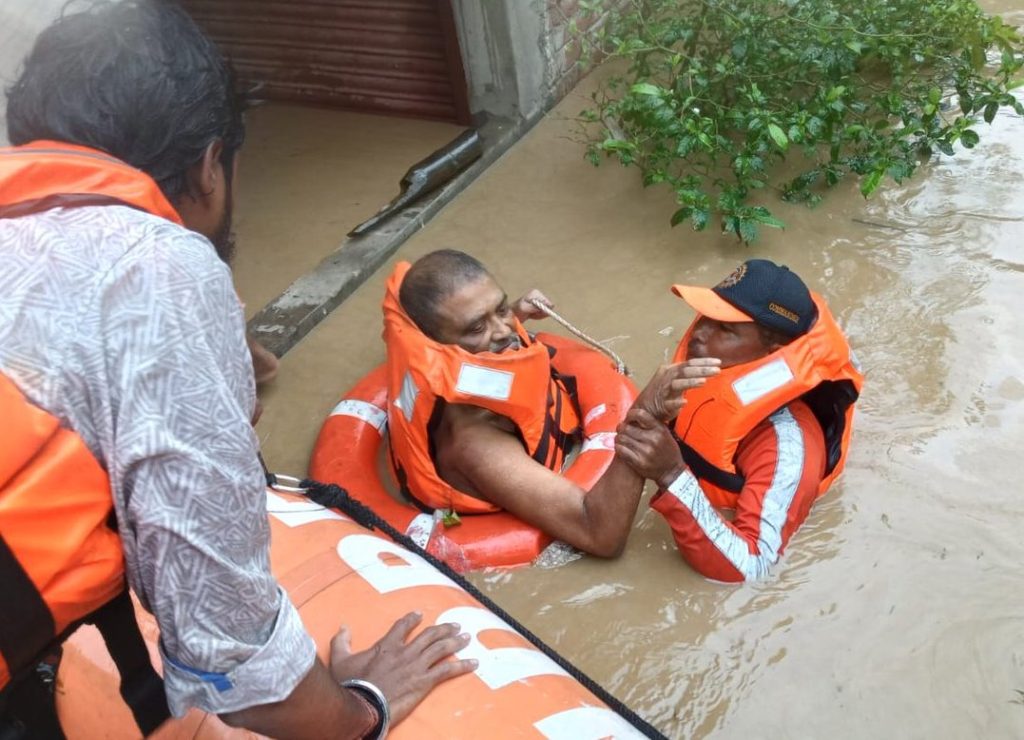
New Delhi: The prime minister, Narendra Modi, on Tuesday reviewed the flood situation in Assam with members of parliament from the state, as the death toll from this year’s deluge held at 68 with no fresh fatalities reported in the preceding 24 hours. The meeting, held in Modi’s chamber in Parliament House following a gathering of the National Democratic Alliance’s parliamentary party, brought together Lok Sabha and Rajya Sabha members from Assam.
Among those present were the Union minister, Sarbananda Sonowal, the Union minister of state, Pabitra Margherita, and the Assam unit chief of the BJP, Dilip Saikia.
Saikia presented damage estimates to the gathering, telling the meeting that the floods this season have affected over 11.4 lakh people across 25 districts since they began. Modi is reported to have suggested the state draw on the model used in Gujarat for the distribution of relief kits to displaced families, and later shared photographs of the interaction on social media. The discussion covered both immediate relief measures and longer-term rehabilitation for the affected population.
The review followed two earlier interventions by Modi in the space of a week. As RNA Media had reported, on July 25, he spoke by phone with the chief minister, Himanta Biswa Sarma, to take stock of the crisis, and held a further review with Sonowal on July 26, when he reiterated that the Centre had accorded the floods in Upper Assam its highest priority.
Scale of the deluge
According to the latest bulletin from the Assam State Disaster Management Authority, more than 4.5 lakh people remain affected across six districts – Sivasagar, Golaghat, Charaideo, Jorhat, Nagaon and Kamrup (Metropolitan) – down from a peak of over 6.5 lakh across 10 districts a week earlier. Charaideo has borne the brunt, with close to 1.9 lakh residents affected, followed by Sivasagar and Jorhat.
Officials have attributed the flooding to intense, cloudburst-driven rainfall in the foothills of Nagaland, which sent a sudden surge of water into Charaideo before it swept through Sivasagar, Jorhat and other parts of southern Assam. Nearly 750 villages remain inundated and close to 49,000 hectares of cropland lie submerged, according to disaster management figures. Roads, bridges and embankments have also sustained damage across the affected districts.
A central inter-ministerial team has been deployed to the state to assess losses on the ground and interact with affected families, alongside rescue and relief operations being carried out by the National Disaster Response Force, the Assam State Disaster Response Force, the Indian Army, Indian Air Force and the police. More than 350 relief camps and distribution centres across the worst-hit districts are currently sheltering upward of 37,000 displaced people.
Boy’s last act of compassion
Amid the scale of the disaster, one death has drawn particular attention as emblematic of its human cost. Hridip Panika, a 13-year-old boy from Bamun Pukhuri village under Nazira, died while trying to rescue his three-month-old pet puppy from the rising floodwaters.
His death has come to be seen locally as symbolic of the toll the floods have taken on ordinary families across Upper Assam, many of whom have lost not only homes and livelihoods but also livestock and pets to the deluge.
Sivasagar’s long road back
In Sivasagar district, the worst affected in this year’s floods, survivors are only now beginning to reckon with the scale of the damage as they return to homes buried under silt and debris.
Mukul Bezbora, a retired professor at Gargaon College, and his wife, Bonti, spent nearly 12 hours perched atop a floating wooden divan inside their home in Nazira town before they were rescued by boat on July 20. The couple told reporters that they heard the roar of the incoming water around 8pm on July 19, and climbed onto the divan as their refrigerator and cupboards were overturned by the current.
With their mobile phones dead, they remained cut off from the outside world until the rescue team reached them. They returned to find their house filled with mud and debris, and much of their belongings destroyed.
Elsewhere in Sivasagar’s ONGC Colony, Madhusmita Borthakur faced a similarly anxious ordeal. With her husband away on field duty and unable to return for another week, she found herself alone with her nine-year-old and three-year-old daughters as the water rose rapidly around their home. She eventually secured passage in an open van and took shelter at a friend’s house in an unaffected area.
Families outside the flood zone endured their own anxieties. A police officer posted in Guwahati said he lost contact with relatives near Simaluguri railway station after communication links failed, and only learned they were safe when a call finally came through two days later.
Rehabilitation ahead
Officials in Sivasagar and the surrounding districts say the clearing of debris, repair of homes and restoration of livelihoods will take considerably longer than the immediate rescue effort. The state government has said ministers have been assigned to oversee recovery in the worst-hit areas, with food supplies, medical teams and air-dropped essentials being directed to places still cut off.
With river levels easing in most of the affected districts, though the Dhansiri (South) at Numaligarh remains above the danger mark, attention is now shifting from rescue to the considerably longer task of rehabilitation for hundreds of thousands of displaced Assamese families.