


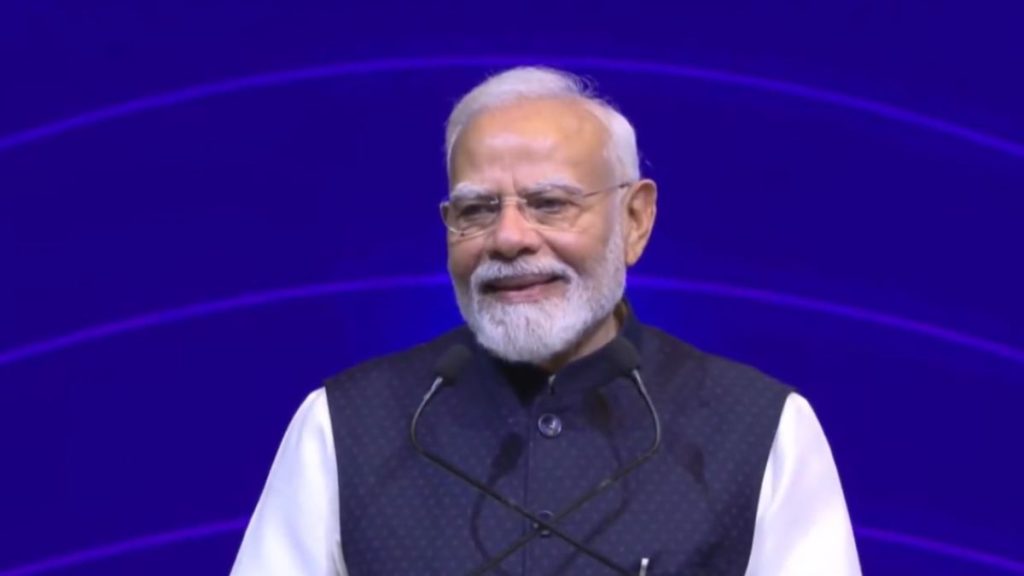
New Delhi: The prime minister, Narendra Modi, on Thursday inaugurated Semicon India 2026 at Yashobhoomi in New Delhi, pitching India’s expanding semiconductor and electronics ecosystem to global companies, investors and technology partners. The fifth edition, being held from Thursday to Sunday, comes as several projects approved under India’s semiconductor programme move from construction into commercial production.
More than 600 companies and representatives from 52 countries are participating in the event, being held under the theme “Silicon to Systems: Building the Ecosystem”. It covers the semiconductor value chain from materials, equipment and chip design to fabrication, advanced packaging, electronics and systems.
According to media reports, India is currently investigating about $30 billion in its chipmaking push. New Delhi had earlier launched an initial $10 billion semiconductor fund and, in July this year, pledged a further ₹1.9 trillion, or about $19.8 billion, in subsidies for chip and electronics manufacturing
Government records show that the July approvals comprised (hyperlink) two separate schemes. Semicon 2.0 carries a budgetary outlay of ₹127,500 crore, while the mobile phone manufacturing scheme has an outlay of ₹62,500 crore. Together they amount to ₹1.9 lakh crore, but only the first is specifically a semiconductor programme.
Under Semicon 1.0, 12 manufacturing projects across six states have been approved with committed investment exceeding ₹1.64 lakh crore. Three projects, Micron, Kaynes and CG Semi, have begun commercial production.
Tata Electronics’ ₹91,526 crore semiconductor fabrication plant at Dholera in Gujarat remains under development, while its ₹27,120 crore semiconductor assembly and test facility in Assam is also being built. Micron’s Sanand facility, which opened in February, expects to assemble and test tens of millions of chips this year before scaling to hundreds of millions in 2027.
Semicon 2.0 widens focus
Semicon 2.0 extends the policy beyond fabrication to six areas covering chip design, equipment and materials, additional fabrication plants, advanced packaging, research and development and talent development. The first semiconductor programme, approved in 2021, carried an outlay of ₹76,000 crore.
Modi said India’s semiconductor programme was moving from project announcements and construction towards commercial manufacturing and called for greater private sector participation, particularly in research and development. A day earlier, he met executives and representatives from Micron, ASML, Infineon, Applied Materials, Tokyo Electron, AMD, Intel, Tata Electronics and several other semiconductor companies.
Applied Materials announced plans to invest $5 billion in India through 2035 under its India vision 2035 programme. The plan includes a proposed 140-acre advanced semiconductor research park in Bengaluru, expansion of its supplier network and a substantial increase in its India research and development operations.
Lam Research has separately outlined an investment of about ₹10,000 crore to establish its first silicon component manufacturing facility in India and expand advanced research and development operations. Together with projects already entering production, the announcements shift the focus of India’s semiconductor programme towards building manufacturing capacity, equipment supply chains, packaging, research and commercially scalable production.