


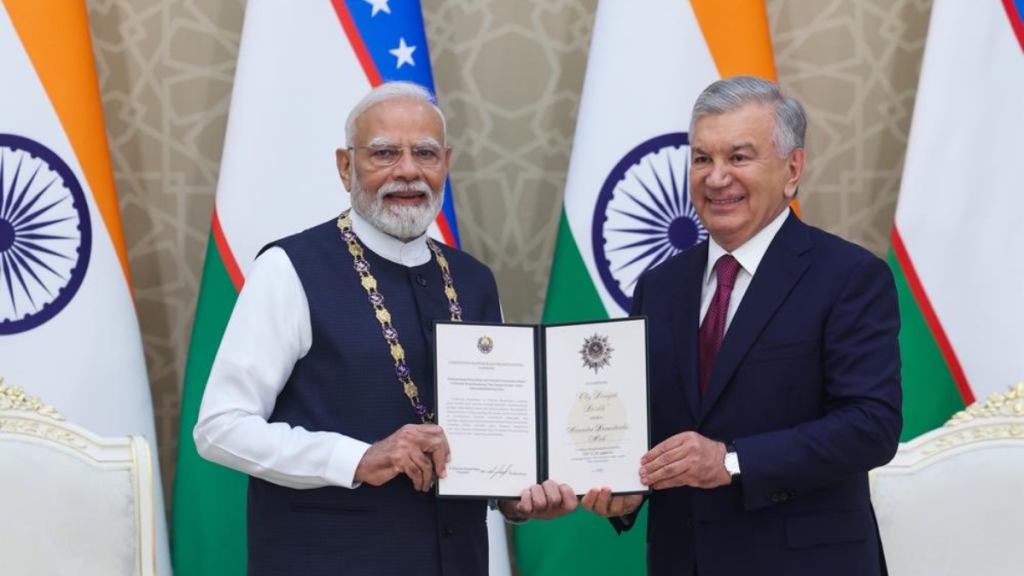
New Delhi: India and Uzbekistan have upgraded their bilateral ties to a comprehensive strategic partnership, marking a major step forward in relations as the prime minister, Narendra Modi, and the Uzbekistan president, Shavkat Mirziyoyev, held a high-level talks in Tashkent. The two countries also agreed to expand cooperation in defence, critical minerals, mining, infrastructure, digital technology, health, education and other strategic areas.
The decision came during delegation level talks between Modi and Mirziyoyev at the Kuksaroy Residence, where two leaders reviewed the entire spectrum of bilateral relations and discussed ways to further strengthen economic, strategic and people-to-people ties.
India and Uzbekistan also exchanged several MoUs and agreements covering mining, culture, education, tourism and ayurveda, among other areas.
Modi highlighted that the elevation of ties comes as the two countries mark the 15th anniversary of their strategic partnership. He also thanked Mirziyoyev and the people of Uzbekistan for the warm welcome during his fourth visit to the country. He described Uzbekistan as being at the heart of Central Asia and said it also holds a central place in India’s engagement with the region.
Highlighting similarities between the vision of Yangi (new) Uzbekistan and India’s Viksit Bharat 2047, Modi said youth, innovation, inclusive growth and modern technology are at the centre of both countries’ development priorities.
“On the basis of this similar vision, we will work together for the welfare of our people,” Modi said.
India-Uzbekistan set $5 billion trade target
Modi said bilateral trade between India and Uzbekistan has already crossed $1 billion, but the two countries have now set an ambitious target of taking it to $5 billion by 2030. He said both countries would work towards achieving the target by improving market access, connectivity, banking and payment systems. Cooperation in emerging and strategic sectors such as artificial intelligence, critical minerals, energy, space and nuclear energy would further make the relationship future-ready, he said.
The prime minister also stressed that connectivity should not remain limited to the capitals of the two countries, calling for stronger links between different states and regions of India and Uzbekistan.
Defence and security remained an important part of the discussions, with Modi describing terrorism and separatism as serious challenges and reiterating India’s zero-tolerance approach towards such threats. The two countries are expected to further strengthen defence and security cooperation alongside expanding collaboration in trade, technology and strategic sectors.
Modi also called for greater student and professional exchanges to strengthen people-to-people ties between both counties. He announced a scholarship initiative to promote the Hindi language in Uzbekistan, adding another dimension to the growing cultural partnership between the two countries.
Modi conferred Uzbekistan’s top state honour
During his visit, Mirziyoyev conferred on Modi the Order of Oliy Darajali Dustlik, one of Uzbekistan’s highest state honours. The award has been given to Modi for his contribution in strengthening the age-old bonds of friendship between the peoples of India and Uzbekistan.
The two leaders also witnessed the signing of agreements to expand cooperation across a range of sectors, a reflection of the broader scope of the newly elevated partnership. Modi also extended advance greetings and best wishes to the people of Uzbekistan ahead of the country’s Independence Day on September 1.
The prime minister ended his joint press meet by saying that a stronger India-Uzbekistan partnership would serve as a powerful force for peace, progress and prosperity in Central Asia.