


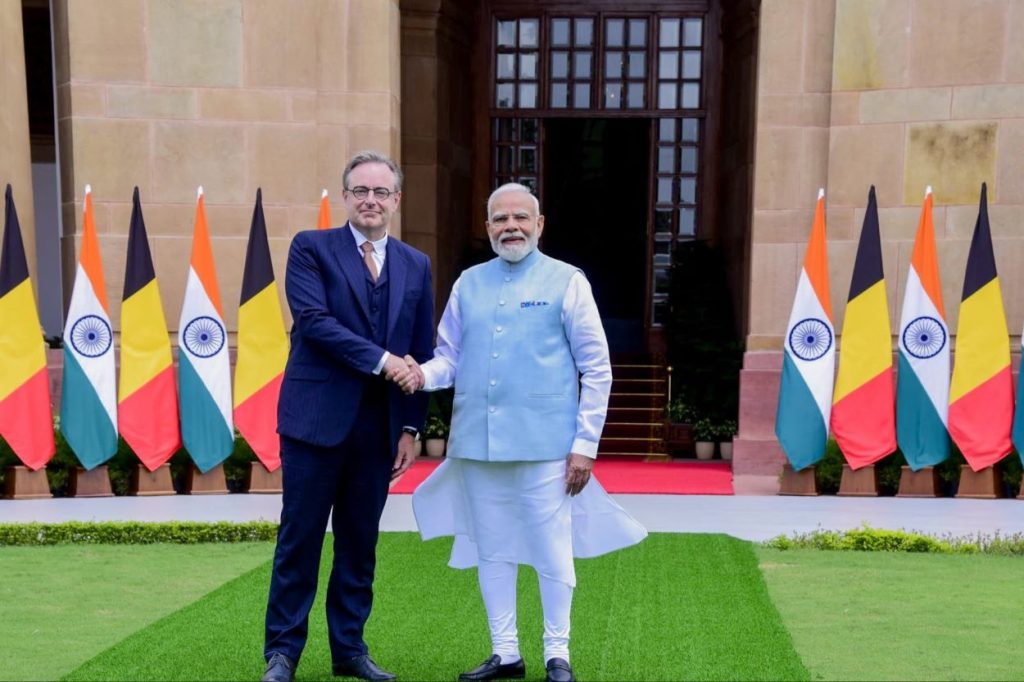
New Delhi: India and Belgium agreed to expand military exchanges and bilateral training as part of a wider effort to build a more substantive defence and security partnership. The understanding was announced after the prime minister, Narendra Modi, held delegation-level talks with the Belgian prime minister, Bart De Wever, in New Delhi on Thursday.
Modi described defence and security cooperation as an increasingly important pillar of bilateral relations, which have traditionally been driven by trade, investment and the diamond industry. He said agreements concluded between the two governments and their defence companies would create new opportunities for developing and manufacturing military equipment jointly.
The two countries will also strengthen intelligence-sharing arrangements and cooperation between their law-enforcement agencies against organized crime and other transnational threats. These measures indicate that New Delhi and Brussels are seeking to move beyond defence commerce towards a more structured relationship involving operational contacts, capacity-building and security coordination.
Meanwhile, the defence minister, Rajnath Singh, separately held talks with Belgium’s minister of defence and foreign trade, Theo Francken, and reviewed the full range of military and defence-industrial cooperation. The two sides agreed to establish a defence-cooperation dialogue and increase high-level visits, training programmes and capacity-building engagements, the Ministry of Defence said in a media release.
Singh and Francken also discussed regional security and the potential for maritime cooperation in the Indo-Pacific, a region in which European countries have steadily increased their diplomatic and naval engagement. Several memorandums of understanding and commercial contracts were signed by Indian and Belgian defence companies, although their financial value and detailed scope were not immediately disclosed.
The most visible example of existing collaboration is the Zorawar light tank being developed by the Defence Research and Development Organisation and Larsen & Toubro for the Indian Army. Belgium-headquartered John Cockerill has supplied turret technology for the programme and formed a joint venture with Pune-based Electro Pneumatics and Hydraulics to manufacture, assemble and commission turrets in India.
The venture was initially expected to supply 59 turrets and examine export opportunities, making it an important test of whether the relationship can generate manufacturing and technology partnerships rather than remain limited to purchases of finished equipment. The collaboration also supports India’s objective of developing a domestic production base for armoured platforms intended for high-altitude deployment.
Belgium has been attempting to strengthen its defence presence in India since a large economic mission led by Princess Astrid visited the country in March 2025. Brussels subsequently decided to post its first resident defence attaché in New Delhi, while both governments began working towards a formal framework for sustained military cooperation.
The latest agreements also complement the security and defence partnership concluded between India and the European Union in January this year. That framework covers maritime security, counterterrorism, cyberdefence, space security, emerging technologies, hybrid threats and the protection of critical infrastructure.
Defence formed part of a broader package discussed by Modi and De Wever, with both leaders setting a target of doubling bilateral trade over the next five years. India will establish a fast-track mechanism for Belgian investors, make the India-Belgium Business Forum a regular platform and encourage closer links between financial, fintech and regulatory institutions.
The two sides also signed an agreement on renewable energy and decided to cooperate in critical-mineral processing and recycling. Belgium’s semiconductor research centre Imec is expected to engage more closely with India’s semiconductor ecosystem, while Belgian participation in a large green-ammonia project at Kakinada in Andhra Pradesh was highlighted as another example of the partnership’s expansion into strategic technologies.
Earlier, De Wever paid tribute to Mahatma Gandhi at Rajghat earlier in the day before holding delegation-level talks with Modi. The national security advisor, Ajit Doval; foreign secretary, Vikram Misri; secretary (west), Sibi George; MEA spokesperson, Randhir Jaiswal; and minister of state for defence, Sanjay Seth; were among the Indian officials present.
De Wever’s September 2–4 visit is his first to India since taking office in February 2025 and the first by a Belgian prime minister in nearly two decades. His programme also includes engagements in Mumbai with the diamond, port and logistics sectors, underscoring Belgium’s attempt to preserve established commercial links while diversifying the relationship into defence, advanced technology and clean energy.