


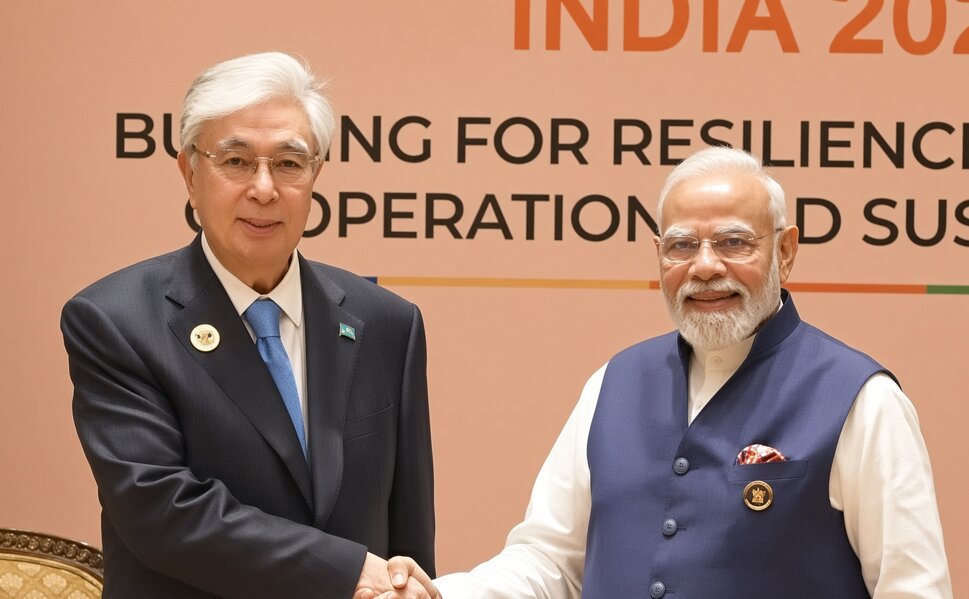
New Delhi: The prime minister, Narendra Modi, held separate bilateral meetings with the presidents of Kazakhstan and Burundi on September 13, using the second day of the 18th BRICS Summit in New Delhi to reinforce India’s strategic engagement with Central Asia and Africa. The talks with Kassym-Jomart Tokayev and Evariste Ndayishimiye came as India sought to use its BRICS chairship not only to shape the grouping’s wider agenda but also to give fresh momentum to important bilateral relationships across the Global South.
The meeting with Tokayev was particularly significant for India’s engagement with Central Asia, where Kazakhstan occupies a key position because of its energy resources, mineral wealth, geographical location and role in trans-Eurasian connectivity. Both leaders reaffirmed their commitment to strengthening the India-Kazakhstan strategic partnership and expressed satisfaction with the steady expansion of bilateral ties, according to the account of the meeting released after their talks.
The discussions come at a time when New Delhi and Astana are looking to move beyond political goodwill and expand the economic substance of their relationship. Bilateral trade stood at about $924.3 million in 2025, a modest figure considering the size and complementarity of the two economies, and both sides have been exploring ways to remove logistical and tariff-related constraints while diversifying the trade basket.
For India, Kazakhstan’s importance extends well beyond conventional trade. The Central Asian country is an important source of natural uranium for India’s civilian nuclear energy programme, while cooperation in oil and gas, critical minerals, rare earth elements and other strategic resources has acquired greater relevance as countries seek to make their supply chains more resilient.
The two sides have also identified opportunities in pharmaceuticals, engineering products, agriculture, digital technologies and artificial intelligence, alongside investment and industrial cooperation. Indian businesses see Kazakhstan as a gateway to the wider Central Asian market, while Kazakh companies have an expanding interest in the large Indian market and in partnerships that can support processing, manufacturing and technology transfer.
Connectivity remains another important piece of the relationship. India and Kazakhstan have been looking at ways of using the International North-South Transport Corridor to improve the movement of Indian cargo towards Central Asia, Russia and Europe, with Kazakhstan’s dry ports and logistics infrastructure offering potential links between South Asian and Eurasian markets.
That emphasis assumes added importance as the geopolitical and economic map of Eurasia changes. For India, stronger connectivity with Central Asia is not simply a commercial proposition; it is also a means of reducing the disadvantages created by geography and developing reliable routes to markets and resources in a region where China, Russia, Türkiye and other powers are competing for influence.
Kazakhstan, meanwhile, has pursued a multi-vector foreign policy, maintaining extensive relations with Russia and China while developing ties with India, Europe and other major powers. Its position as Central Asia’s largest economy and its substantial reserves of hydrocarbons, uranium and minerals make Astana an important partner for countries seeking diversified sources of energy and strategic raw materials.
The India-Kazakhstan relationship has also acquired greater political depth through regular high-level engagement. Tokayev’s visit to New Delhi for the BRICS summit followed a visit by Kazakh Prime Minister Olzhas Bektenov in February, when he held talks with Modi on the sidelines of the India AI Impact Summit, with energy, agriculture, digitalization and artificial intelligence among the areas identified for greater cooperation.
The latest meeting therefore provides an opportunity to translate accumulated political trust into more tangible economic outcomes. The challenge for both governments is less about identifying areas of potential cooperation than about overcoming the practical barriers – including transport costs, limited direct connectivity and the relatively small scale of two-way trade – that have prevented the relationship from reaching its full potential.

Africa and global south
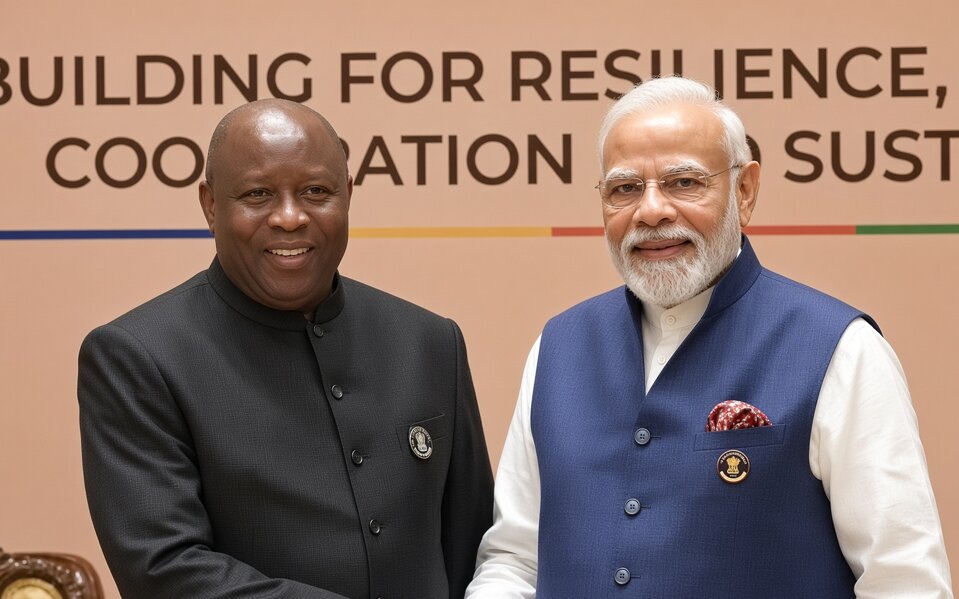
Modi’s meeting with Ndayishimiye carried a different but equally important message, reflecting India’s effort to deepen its engagement with Africa while strengthening the voice of developing countries in global institutions. The Burundian president attended the New Delhi summit as chairperson of the African Union, giving his bilateral engagement with the Indian leadership significance beyond the relatively modest scale of India-Burundi trade.
Ndayishimiye’s presence in New Delhi also underscored the growing institutional link between India and the African Union. India strongly backed the AU’s inclusion as a permanent member of the G20 during its own G20 presidency in 2023, and New Delhi has since sought to build a broader development and diplomatic partnership with African countries based on capacity building, technology, healthcare, education, infrastructure and economic cooperation.
The India-Burundi relationship itself has a substantial development-cooperation component. India extended an $80 million line of credit for the 20MW Kabu hydroelectric project, which was inaugurated by Ndayishimiye in October 2024 and became one of Burundi’s most important power-generation projects at the time of commissioning.
India has also supported Burundi through healthcare, education and capacity-building initiatives. New Delhi has supplied medicines, provided NCERT textbooks, supported digital initiatives and offered training under the Indian Technical and Economic Cooperation programme, while the number of ICCR scholarships for Burundian students has been increased to 15 from the 2026-27 academic year.
An important feature of this relationship is that much of India’s engagement with Burundi is rooted in development rather than transactional diplomacy. The approach is consistent with New Delhi’s broader Africa policy, which has sought to position Indian technology, skills, affordable medicines, digital public infrastructure and development experience as practical instruments of South-South cooperation.
The two countries have already explored cooperation in digital public infrastructure. Burundian authorities have expressed interest in India’s digital identity and payment platforms, including MOSIP and UPI, pointing to the possibility of extending India’s digital-development experience into another African market.
For New Delhi, such partnerships have an importance that extends beyond individual projects. Africa’s growing demographic and economic weight, its natural resources and its increasingly assertive role in multilateral institutions make stronger India-Africa relations an essential component of India’s effort to build a more representative international order.
BRICS as a diplomatic multiplier
The meetings with Tokayev and Ndayishimiye illustrate how India is using its 2026 BRICS chairship as a diplomatic multiplier. The summit has brought together 11 member countries and 10 partner countries, creating an unusually broad platform through which New Delhi can engage established powers, emerging economies and smaller developing states in the same diplomatic setting.
India’s chairship has been framed around “Building for Resilience, Innovation, Cooperation and Sustainability”, with New Delhi seeking to give the expanded grouping greater practical relevance in areas such as economic cooperation, technology, sustainable development and the priorities of the Global South. Modi has repeatedly argued that BRICS must move from declarations and frameworks towards concrete outcomes that can have a measurable impact on people and economies.
The bilateral meetings on the summit’s margins are an important part of that effort. Modi’s discussions with leaders from Central Asia, Africa, Southeast Asia and the Middle East have allowed India to pursue country-specific interests while simultaneously advancing the broader themes of its BRICS presidency.
The Tokayev meeting is especially relevant to India’s long-term Eurasian strategy, while the Ndayishimiye engagement reinforces the African dimension of New Delhi’s Global South diplomacy. Together, they underline a central feature of Indian foreign policy – the effort to widen strategic options without reducing relationships to exclusive geopolitical camps.
For India, that balance is becoming increasingly important. A rapidly changing international environment, disrupted supply chains, competition over critical minerals and energy, conflicts in Europe and West Asia, and growing pressure on multilateral institutions are forcing middle and major powers alike to cultivate a wider network of reliable partnerships.
The real test will now be whether the political momentum generated in New Delhi can be converted into projects, investment, trade and institutional cooperation. In the case of Kazakhstan, that means making connectivity, energy, uranium, critical minerals and technology cooperation more consequential; with Burundi and the wider African partnership, it means turning India’s development model and Global South diplomacy into sustained, measurable outcomes.
The symbolism of the two meetings was therefore matched by a practical message. India’s BRICS presidency is being used not merely to host a major multilateral gathering, but to strengthen the network of bilateral partnerships that New Delhi increasingly regards as essential to its economic security, strategic autonomy and larger role in a changing world order.