


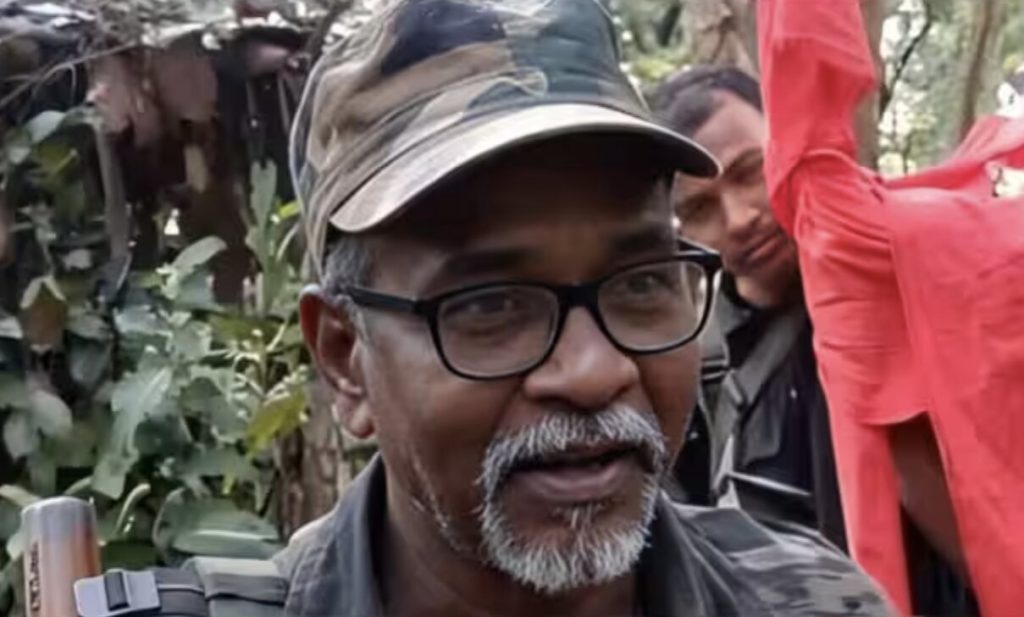
New Delhi: Security forces arrested Misir Besra, the last operational member of the central committee and politburo of the banned Communist Party of India (Maoist), in Jharkhand’s Dhanbad district on Tuesday. His capture leaves both apex bodies of the outfit without a single member still at large, police officials said.
A joint team of the Jharkhand Police and the Central Reserve Police Force’s Commando Battalion for Resolute Action (CoBRA) picked up Besra from the Maniadih area under Barwadda police station limits, near the Dhanbad-Giridih border. Two associates travelling with him – Mehnat, alias Mochu, a special area commander carrying a ₹25 lakh bounty, and Gaurav, alias Saurabh, a party cadre – were arrested alongside him, along with two local villagers taken in for questioning.
The inspector general of the Jharkhand Jaguar – a specialized anti-Maoist and counterinsurgency special task force of the Jharkhand Police, Anoop Birtharay, confirmed the arrests.
Officials said Besra had recently been flushed out of his longtime base in the Saranda forest of West Singhbhum district and was moving towards Giridih when security forces intercepted him, acting on specific intelligence. Besra, 65, was wanted in 141 cases of murder, extortion and bomb attacks across Jharkhand, Odisha and West Bengal, and carried a bounty of over ₹1 crore. His arrest came hours after 16 Maoist cadres, including a commander wanted in 128 cases, surrendered before the Jharkhand Police in Ranchi under the state’s Operation Navjeevan-II.
Among those who surrendered was Besra’s own bodyguard, whose disclosures are believed to have helped track him down.
Maoist top bodies now stand empty
The scale of what security agencies are calling a defining moment owes as much to arithmetic as to symbolism. The Union home minister, Amit Shah, told the Lok Sabha in March that the CPI (Maoist)’s central committee and politburo, which together once numbered 21 members, had been reduced to just two. “All main armed Maoist cadres have been finished,” he said at the time.
With Besra now in custody, that count falls to zero.
The insurgency traces its roots to the Naxalbari peasant uprising of 1967 in West Bengal and, at its height, spread across a so-called Red Corridor running through roughly a dozen states, claiming more than 20,000 lives over five decades. Shah had set March 31, 2026, as his deadline to eradicate the armed movement; by his own account to parliament, the number of Naxal-affected districts had by then fallen from 126 in 2014 to just two.
Besra’s arrest follows the killing earlier this year of senior commander Patiram Manjhi, alias Anal, and other cadres under his command in West Singhbhum during Operation Black Forest, and a steady run of surrenders that has thinned the organization’s remaining networks in Jharkhand. Officials, however, caution that scattered cadres are still believed to be active in pockets of Chhattisgarh and Odisha, and that the land disputes, tribal displacement and rural poverty that fed the movement for decades have not disappeared along with its leadership.
Maoist last field commander
Besra was born and raised in Giridih district and, according to police records, was drawn towards left politics while pursuing a degree in Hindi literature in the mid-1980s, reading the works of revolutionaries such as Bhagat Singh and Khudiram Bose. He briefly gravitated towards Shibu Soren’s Jharkhand Mukti Morcha before growing disillusioned with it.
Two local disputes stayed with him from that period: a shopkeeper who refused to pay him for mahua and threatened violence, and landlords who felled an old jackfruit tree in his village, which he and a group of young men physically resisted. In October 1985, a cultural troupe linked to a revolutionary left organization visited his village. Besra left with them and never returned home.
He trained with the People’s War Group in Andhra Pradesh, and after its 2004 merger with the Maoist Communist Centre of India formed the CPI (Maoist), he rose steadily to the central committee and eventually the politburo. Investigators have linked him to some of the insurgency’s deadliest attacks, including the 2004 ambush at Baliba in West Singhbhum that killed 29 security personnel.
He went on to head the organization’s Eastern Command, directing operations across Jharkhand, Chhattisgarh, Odisha, West Bengal and parts of Assam, and overseeing its military intelligence and arms procurement – a portfolio that earned him a reputation inside the party as a military planner rather than an ideologue.
Besra was first arrested in September 2007, during what police described as a chance patrol on a national highway; at the time, his photograph did not even exist in official records. He escaped two years later when armed Maoists stormed a court complex in Bihar’s Lakhisarai district during a production hearing, killing a policeman, and spent nearly two decades thereafter underground, much of it in the Saranda forest.
Earlier this year, appeals by his brother, son and son-in-law failed to persuade him to lay down arms. Besra, who has a daughter working in Delhi and an 18-year-old son, once described the middle classes’ distance from the movement as one of its central failures, telling an interviewer that “without the participation of the middle class, there will be no revolution.”