


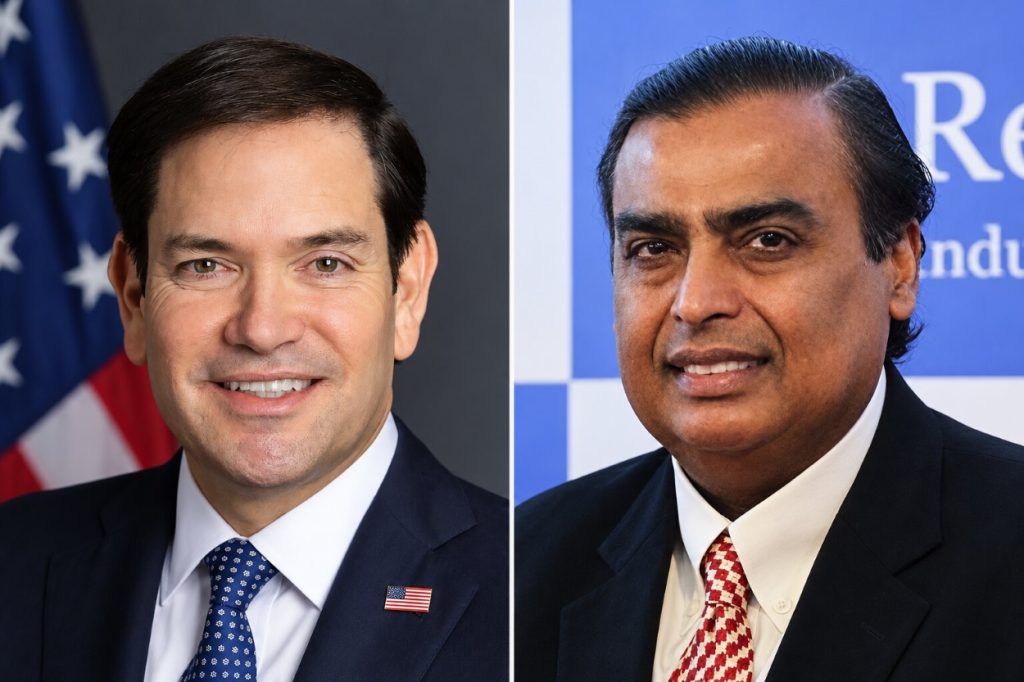
New Delhi: The US secretary of state, Marco Rubio, is expected to meet the chairman of Reliance Industries, Mukesh Ambani, during a visit to India next week, bringing energy investment and commercial cooperation into focus. The planned engagement comes days after Elon Musk accused Ambani of obstructing Starlink’s entry into India, allegations the Indian government has rejected.
The US ambassador to India, Sergio Gor, outlined the business emphasis of the visit at the Bloomberg New Economy Forum in New Delhi on Thursday. According to Bloomberg’s report, Rubio is expected to meet Ambani during the trip, which includes a stop in Jamnagar, Gujarat, where Reliance operates the world’s largest oil refining complex.
The US state department’s travel announcement places Mumbai and Jamnagar on an itinerary covering India and Uzbekistan from October 17 to October 22. That period covers the overall tour rather than six days exclusively in India, with Samarkand also included in the programme.
In India, Rubio will discuss the strategic partnership, regional and global developments, and opportunities for closer energy cooperation with senior government officials. Meetings with business leaders are also planned to encourage investment and economic engagement, giving the visit a substantial commercial component alongside its diplomatic agenda.
Gor described the forthcoming visit as more focused on business and indicated that the external affairs minister, S Jaishankar, was expected to meet Rubio in Mumbai. He also confirmed an engagement with Reliance representatives in Jamnagar, although the publicly announced programme provides fewer details about the individual corporate meetings.
The Jamnagar stop carries significance beyond the immediate controversy surrounding Musk because Reliance has become associated with a proposed American refinery backed publicly by the US president, Donald Trump. In March, Trump identified the Indian conglomerate as a partner in the America First Refining project at the Port of Brownsville in Texas.
The developer’s March 10 announcement described an investment from an unnamed global energy major and a binding 20-year offtake term sheet, providing a long-term commitment to buy the refinery’s output. The proposed facility is designed to process American light shale oil, with an annual capacity of approximately 60 million barrels.
The widely cited $300 billion figure associated with that announcement requires qualification: the developer combined an estimated $125 billion in crude purchases and processing with $175 billion in refined products over the agreement’s duration. Those projected commercial values should therefore be distinguished from the refinery’s construction cost or the amount of Reliance’s equity investment.
Rubio’s expected interaction with Ambani also comes against the backdrop of Musk’s increasingly public criticism of India’s satellite broadband approval process. On October 8, Musk questioned whether Ambani was the “real boss of India”, linking his criticism to Starlink’s prolonged wait to begin offering services in the country.
The communications minister, Jyotiraditya Scindia, subsequently rejected the suggestion that India permitted monopolies, while the government said licensed satellite operators faced comparable security and spectrum requirements. Musk’s allegations of interference remain unsubstantiated in the reporting, and the government has disputed his explanation for the delay.
The distinction between receiving a licence and obtaining permission to launch commercially is central to the dispute. India’s satellite communications framework gives the government responsibility for service authorizations, spectrum assignment and security conditions, meaning an initial clearance does not by itself complete the regulatory process.
Satellite broadband is intended to extend connectivity to remote and underserved areas while complementing terrestrial networks, making the emerging market commercially significant for competing operators. The government’s framework consequently places their rollout within the wider telecommunications system, rather than treating satellite access as a standalone approval.
Against this backdrop, the planned Reliance engagement indicates that Washington continues to pursue commercial cooperation with the conglomerate despite Musk’s criticism. Its immediate significance lies in the energy and investment agenda outlined for Rubio’s visit; the announced programme contains no commitment to a particular outcome in India’s satellite broadband approval process.