


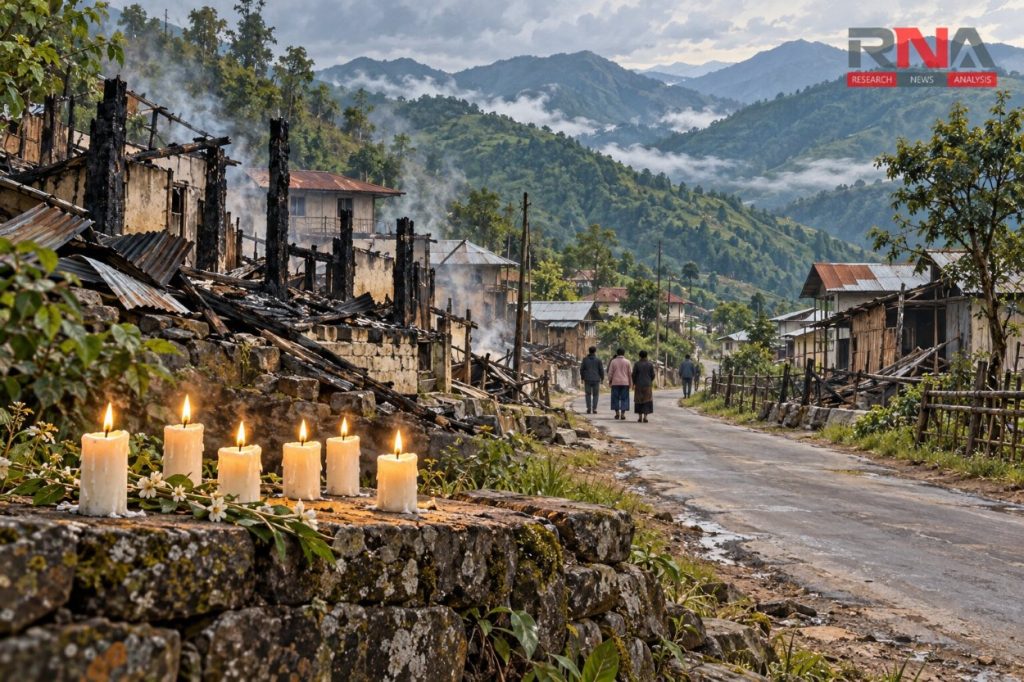
New Delhi: Six Naga civilians were killed in two separate attacks in Manipur within three days, intensifying concerns over security in the state’s hill districts amid renewed violence involving Naga and Kuki communities. The latest shooting, which left two men dead and two others injured in the Senapati area on Saturday, followed the killing of four Tangkhul Naga civilians, including a father and son, near the Myanmar border.
Unidentified gunmen opened fire at Kalenjang on Saturday afternoon, shortly after the chief minister, Yumnam Khemchand Singh, had attended a function elsewhere in the district, according to the Times of India. The attack came on the day Naga representatives announced the suspension of a prolonged highway blockade following negotiations with the Centre and the state government.
The victims were identified as Rocky Mao of Chowainamei village and Kumar Poumai of Laii Shirafii village, India Today NE reported, citing police and other accounts. The All Naga Students’ Association of Manipur (Ansam), identified the injured as Ashiho Sani and Adani Manio and described their condition as critical.
Ansam alleged that armed Kuki groups operating under the suspension of operations arrangement were responsible, but that allegation has not been independently established. The association demanded an independent investigation, prosecution of those responsible and stronger protection for civilians in Naga-inhabited areas.
The earlier attack occurred on Thursday, at Pilong in Kamjong district, a remote settlement near the India–Myanmar boundary. Ukhrul Times initially reported that five Tangkhul Naga civilians were present when armed men arrived, with one escaping and subsequently reporting the incident.
Those killed were Vareishim Jajo, 67, his son Phami Jajo, 43, Betterson Jajo, 50, and Ningthem Kashak, 35, according to subsequent reports. Their bodies were recovered early the following morning and brought to the district headquarters for postmortem examination, updating the initial account that recovery had been hampered by the location’s remoteness.
Police accounts carried by local and regional media outlets identified the suspected attackers as members of the Myanmar-based Kuki National Army – Burma (KNA-B). Pilong lies about 35 kilometres from Kamjong district headquarters, placing the attack in a border area where the suspected movement of armed men from Myanmar has become a central concern.
In a subsequent account published by Ukhrul Times, the survivor said he fled into the jungle after hearing gunfire and found his companions dead after the attackers departed. He attributed the attack to KNA-B on the basis of information received from people across the border, an identification the publication said it could not independently verify.
The Thursday attack came after a Naga teenager was killed while on his way to his school in Manipur’s Tamenglong district, as RNA Media had reported.
The Tangkhul Naga Long called a 24-hour shutdown from 7am on September 25 in protest against the Pilong killings, exempting essential services and funeral-related movement. Singh condemned the deaths, while the Phungyar legislator, Leishiyo Keishing, said the chief minister had assured him that three companies of the India Reserve Battalion would be deployed at Pilong.
The killings followed attacks on three Makui villages in Kangpokpi district on September 23–24, during which around 41 houses were reportedly burned and public buildings, including a church, were damaged. The Economic Times quoted a senior police officer as saying residents fled their homes during an assault that continued for nearly 12 hours.
Kuki civilians have also suffered in the recent violence: four people, including two women, were killed in separate attacks on Longpi and Tollen settlements in Tamenglong district on September 13. Kuki organizations demanded an impartial investigation, while the neighbouring Kaimai Naga Village Authority condemned the attacks and urged restraint to prevent further division between communities.
The Times of India put the toll from Naga-Kuki violence since February at more than 40, including at least 21 deaths since August 27. That count is separate from the wider Meitei-Kuki conflict, and police have cautioned that several accusations against armed groups remain under investigation.
Against this backdrop, the United Naga Council suspended its economic blockade from 6pm on Saturday, following tripartite talks in Guwahati. The negotiations brought together the council, central representatives and the state government to discuss security and peace-building, even as the latest killings renewed demands for effective civilian protection.