


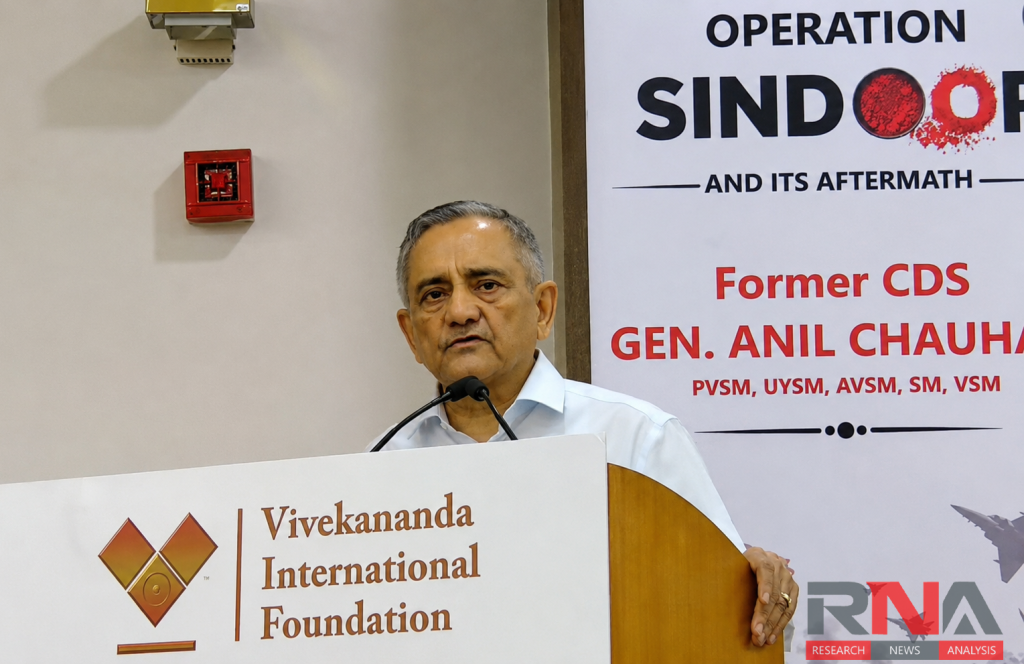
New Delhi: The former chief of defence staff, General Anil Chauhan (R), has said an Indian loitering munition may have inadvertently struck Pakistan’s nuclear-linked Kirana Hills during Operation Sindoor after failing to locate a radar near Sargodha. His explanation, offered more than 15 months after the conflict, has reopened the debate over whether the sensitive area was hit accidentally, deliberately or at all.
Speaking at a Vivekananda International Foundation event in New Delhi on Tuesday, Gen Chauhan said several loitering munitions had been sent towards Sargodha to search for Pakistani radars before subsequent strikes. Kirana Hills lies about 10 kilometres north of the airbase, and one of the weapons may have exhausted its endurance of roughly two hours without finding a target, he said.
“It must have come and hit one of those hills,” Gen Chauhan said, referring to images circulated by Pakistani media that appeared to show smoke rising from the area. His choice of words was important: the former CDS advanced a probable explanation but did not claim to be citing post-strike imagery, weapon telemetry or a formal battle-damage assessment.
Gen Chauhan maintained that Kirana Hills was never selected as a target and endorsed the denial issued during the conflict by Air Marshal AK Bharti, who was then the Indian Air Force’s director general of air operations. “Bharti had rightly clarified that we did not target Kirana Hills,” he said.
AM Bharti’s original statement on May 12, 2025, was broader than the version now attributed to him, because he said India had “not hit Kirana Hills, whatever is there”. Gen Chauhan has effectively drawn a distinction between not deliberately targeting the location and a munition nevertheless landing there – a distinction between operational intent and the weapon’s eventual point of impact.
The latest account therefore does not establish that India attacked a Pakistani nuclear installation, as several headlines have suggested. At most, it indicates that an Indian weapon may have struck an unspecified part of the wider Kirana Hills area without damaging the underground infrastructure associated with Pakistan’s strategic programme.
Kirana Hills is a scattered rocky formation near PAF Base Mushaf at Sargodha and has long been linked in open-source assessments to Pakistan’s nuclear history, hardened storage sites, radar positions and conventional military infrastructure. Its exact present-day role remains classified, however, and neither India nor Pakistan has released authoritative evidence showing that a nuclear storage vault, tunnel entrance or command facility was damaged.
Operation Sindoor began on May 7, 2025, with Indian precision strikes against nine terrorist facilities in Pakistan and Pakistan-occupied Kashmir in response to the April 22 Pahalgam terrorist attack, in which 26 people were killed. After Pakistan attempted retaliatory attacks, India widened its response to military targets, including airbases and air-defence installations, before the two sides stopped firing on May 10.
Gen Chauhan also disclosed that, after Pakistan indicated at about 10am that it wanted to talk, the chief of the air staff sought authorization to strike Sargodha and received approval. Skardu was subsequently cleared as an additional target, he said, but bad weather led planners to switch the mission to Bholari.
Why specialists are unconvinced
The accidental-impact explanation has been questioned by specialists because modern loitering munitions are not ordinarily expected to wander entirely uncontrolled until they strike an arbitrary location. The precise behaviour of the weapon would depend on its model, mission programming, communications status, available recovery mechanism and rules for aborting or terminating an unsuccessful sortie.
Gen Chauhan did not identify the munition involved, although some news reports described it as the Israeli-origin Harop without providing supporting evidence. That identification is difficult to reconcile with his reference to an endurance of about two hours, because manufacturer Israel Aerospace Industries gives the Harop an endurance of up to nine hours and says it remains under remote human supervision, with its attack capable of being aborted.
A two-hour endurance corresponds more closely to Elbit Systems’ SkyStriker, another loitering munition in the Indian inventory, but that does not by itself establish that a SkyStriker was involved. Elbit Systems says an operator can abort a SkyStriker attack until two seconds before impact, order it to re-engage or direct a safe return if no authorized target is available.
Decker Eveleth, a strategic-forces analyst with the US-based CNA research organization, questioned why Indian munitions were loitering so close to an obviously sensitive military complex if their targets were confined to radars around Sargodha. He also argued that the possibility of an unintended impact near nuclear-linked facilities should have formed part of mission planning, given the risk that Pakistan could interpret such an incident as a deliberate strike.
Dr Adil Sultan, a former official in Pakistan’s Strategic Plans Division and a scholar of nuclear deterrence, separately challenged the technical logic of Gen Chauhan’s account. Sultan said a loitering weapon that exhausted its power would generally crash rather than detonate unless it had been programmed to do so, and questioned whether a former CDS should offer what appeared to be a speculative explanation for such a sensitive incident.
Their objections do not conclusively disprove Gen Chauhan’s account because neither analyst had access to the weapon’s telemetry, mission plan or Indian operational records. They nevertheless underline that “it must have hit” is an inference and should not be treated as confirmation that a specific munition struck a specific facility.
Satellite image tells different theory
Geo-intelligence researcher Damien Symon had reached a different conclusion after examining Google Earth imagery captured in June 2025, which he said showed an impact point on one side of Kirana Hills. Symon found no indication of damage to tunnels or underground structures and described the location as an empty hillside with nothing of evident value nearby, leading him to suggest that it “must’ve been a warning strike” rather than an accident.
The imagery, reported by several media outlets, supported the proposition that an impact occurred somewhere in the hills but could not independently identify the weapon or determine the attacker’s intention. It therefore disputes the accidental-impact theory without conclusively proving a deliberate strike.
Christopher Clary, an associate professor of political science at the University at Albany and a specialist in South Asian security, had earlier concluded that the initial evidence for a Kirana Hills strike was minimal. In a Stimson Center assessment, he said the claims were based largely on false reports of radiation leaks and ambiguous footage, although he has now noted that Gen Chauhan’s disclosure adds information that was unavailable during the immediate post-conflict assessment.
Clary also questioned why the clarification had been issued more than 15 months after the operation, particularly when the official Indian position had previously been categorical. The delay, together with the absence of released telemetry or corroborating operational evidence, leaves room for competing interpretations.
Military analyst Tom Cooper has gone considerably further, alleging that India deliberately struck radar systems and entrances associated with the Kirana Hills complex. His account, however, rests heavily on his interpretation of publicly available videos and imagery and has not been endorsed by the Indian government or substantiated through an official battle-damage assessment.
Others have supported Gen Chauhan’s broader account of the operation, with the former director of naval operations and intelligence, Commodore Ranjit Rai, describing Operation Sindoor as a “total success”. Rai said the remarks demonstrated the effectiveness of India’s use of loitering munitions near Sargodha, although his comments did not resolve whether the Kirana Hills impact was accidental or intentional.
Conflicting signals from IAF
The Indian Air Force’s own public messaging has added to the ambiguity, particularly after a Republic Day video released in January 2026 appeared to include a depiction of Kirana Hills being struck. The Air Force subsequently maintained that it had targeted only terrorist and military installations, with the then vice chief of the air staff, Air Marshal Nagesh Kapoor, denying that a nuclear site at Kirana Hills had been attacked.
Gen Chauhan’s explanation can technically coexist with the assertion that the location was not an authorized target, but it does not sit comfortably with the earlier categorical statement that India had not hit the hills. A complete reconciliation would require the government to clarify whether an impact was verified, which munition was involved and whether its final trajectory was commanded, pre-programmed or caused by a technical failure.
There is no evidence that any Pakistani nuclear asset was damaged or that radioactive material was released during the confrontation. The International Atomic Energy Agency said on May 15, 2025, that the information available to it showed no radiation leak or release from any nuclear facility in Pakistan.
The larger concern is the escalation risk created when conventional military targets, air-defence radars and nuclear-associated infrastructure occupy the same geographical space. Even if Gen Chauhan’s accidental-impact explanation is accurate, the episode illustrates how a spent or malfunctioning weapon could be mistaken for an attack on strategic forces during a fast-moving confrontation between two nuclear-armed neighbours.
For now, the most defensible conclusion is that an Indian loitering munition may have struck an unoccupied part of Kirana Hills, but neither the accidental-impact theory nor claims of a deliberate warning strike have been proved beyond doubt. Gen Chauhan’s intervention has narrowed one part of the mystery – India did not intend to attack a nuclear installation, according to him – but it has also exposed inconsistencies that only operational evidence can settle.