


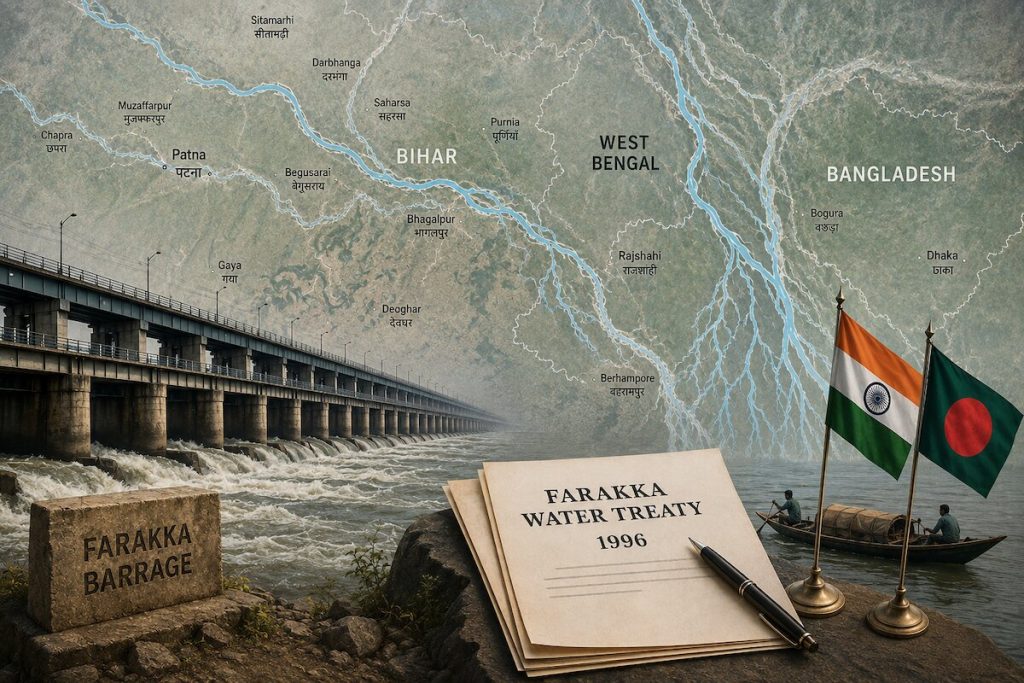
New Delhi: Bihar’s water security has resurfaced as a flashpoint in India’s river diplomacy with Bangladesh. A senior member of the Janata Dal (United), Sanjay Kumar Jha, has urged the central government not to renew the 1996 Farakka Water Treaty when it lapses later this year.
Jha, the JD(U)’s working national president and a Rajya Sabha member, raised the matter in the upper house on Thursday. He argued that the near three-decade-old pact has left Bihar short of water rather than protecting its interests, as originally intended.
The Farakka Water Treaty was signed by the then Congress-led government with Bangladesh on December 12, 1996, and its 30-year term is due to expire on the same date this year. Under its terms, the two countries share the Ganga’s flow at the Farakka barrage between January 1 and May 31 each year, divided into 10-day blocks and monitored by a joint bilateral committee.
Speaking to reporters outside parliament, Jha said his party and its national president, the former Bihar chief minister, Nitish Kumar, had opposed the treaty from the outset. He said the JD(U) believed the arrangement overlooked the broader interests of Bihar, and reiterated a demand he had first pressed years earlier as the state’s water resources minister.
His central contention, made through a special mention in the Rajya Sabha, was that the Farakka barrage was built primarily to sustain water flow for the Hooghly river and the Kolkata port. The treaty that followed, he said, ended up working against Bihar’s own requirements further upstream.
He cited three decades of experience in the Ganga basin state to argue that Bihar now suffers acute water shortages during the lean season, along with falling groundwater levels and a drinking water crisis in the southern part of the state. By his account, the state’s projected needs by 2050 could exceed current allocations by roughly 2,000 cusecs, a gap he said the existing framework does not address.
Rather than a straight renewal, Jha proposed that the Centre commission a fresh, scientific assessment of water requirements up to 2050 for every state dependent on the Ganga basin, Bihar included. A new arrangement built on that data, he argued, would be more durable than simply extending the old formula.
The intervention adds a domestic political dimension to what has largely been treated as a bilateral issue between New Delhi and Dhaka. The JD(U) is a constituent of the ruling National Democratic Alliance in Bihar, which gives Jha’s objection more weight than that of an opposition voice alone.
Bihar is not the only state pushing back. West Bengal has separately argued that it must be consulted before any renewal, citing reduced Ganga flows between January and May and the risk to irrigation, drinking water and agriculture in districts such as Malda, Murshidabad and Nadia if larger volumes are released to Bangladesh during that window.
The state government has also pointed to river erosion along the Ganga’s shifting course in Malda and Murshidabad, which it says has displaced large numbers of people and altered the ground realities on which the 1996 formula was based. Kolkata’s former chief minister, Mamata Banerjee, has repeated these concerns in the past.
With both Bihar and West Bengal now seeking a greater say, the Centre faces a more complicated renegotiation than a routine extension of the existing text. Any new treaty will need to balance India’s commitments to Bangladesh as the lower riparian state against competing demands from Ganga basin states upstream, a task that becomes harder the closer the December 12 deadline draws.