


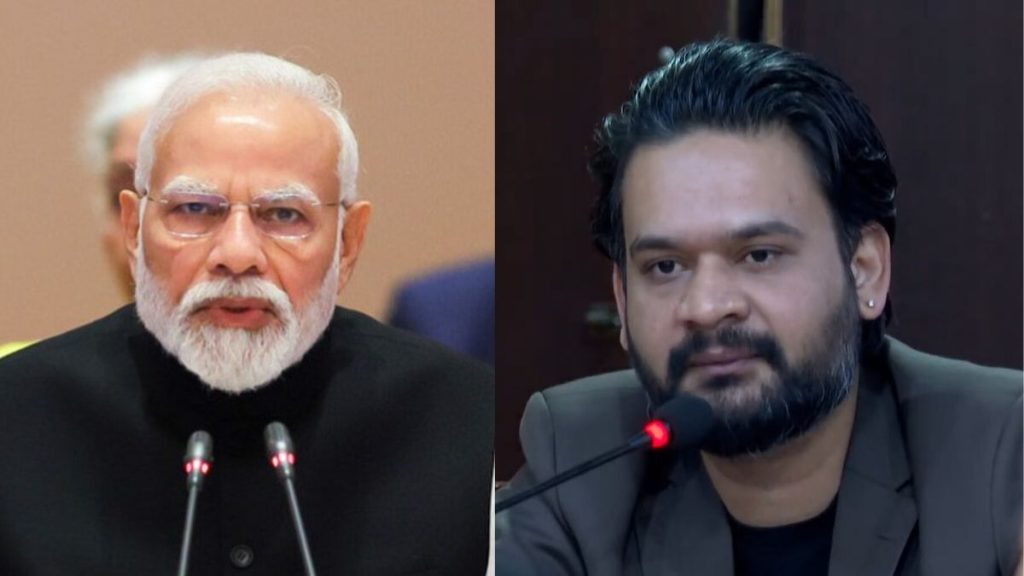
New Delhi: The Nepali prime minister, Balendra Shah, will embark on his first official visit to India since taking office in March 2026. His visit is expected to give fresh momentum to relations between the two neighbours, with economic cooperation, connectivity and development projects high on the agenda. Shah will visit New Delhi from November 22 to 23 at the invitation of the prime minister, Narendra Modi, and hold bilateral talks on November 23.
During the visit, Shah will also call on the president, Droupadi Murmu. The bilateral talks will cover the full range of India-Nepal relations as well as regional and international issues of mutual interest.
The two governments are also preparing agreements and development project announcements across several sectors. Nepal’s foreign secretary, Amrit Bahadur Rai has said the visit will include a 34-member official delegation, discussions involving business representatives and the inauguration of projects. The developments come as both countries seek to strengthen a relationship shaped by deep historical ties as well as unresolved political and territorial differences.
But beyond the diplomatic engagements, the visit raises a larger question: can New Delhi and Kathmandu translate their longstanding partnership into progress on issues that have remained unresolved for years?
Relationship built on history and open border
India and Nepal share close cultural, civilizational and people-to-people connections. Their relationship was formally strengthened through the 1950 treaty of peace and friendship, which provides for reciprocal treatment of citizens in specified areas and supports close economic and social engagement.
The two countries share an approximately 1,800 kilometers open border, allowing people to travel across it without visas. This arrangement has encouraged trade, employment, family connections and movement between communities on both sides.
However, the relationship is not without differences. Nepal has periodically sought a review of the 1950 treaty, arguing that the changing political and economic realities require an updated framework. The issue remains part of the wider debate over how the two neighbours should define their relationship as sovereign states.
Trade and connectivity remain central
India is Nepal’s largest trading partner and an important source of investment. Bilateral goods trade reached approximately $9.38 billion in the financial year 2025-26, accounting for more than 60 per cent of Nepal’s total external goods trade, according to figures based on India’s Ministry of External Affairs’ bilateral brief.
Despite these close economic links, Nepal has a substantial trade deficit with India. Kathmandu wants to expand exports, attract investment and improve access to markets. Better road, rail and air connectivity is also important for a landlocked country that relies heavily on transit routes through its neighbours.
One longstanding issue in India-Nepal connectivity discussions is Nepal’s demand for additional air entry routes through Indian airspace. Kathmandu has sought routes that would improve international access to airports including Bhairahawa. Progress on this issue could support Nepal’s aviation and tourism sectors, although technical and security considerations remain part of the discussions.
Hydropower offers an opportunity
Energy cooperation is another major pillar of the partnership. Nepal has significant hydropower potential, while India has a large and growing demand for electricity. Cross-border power trade provides an opportunity for Nepal to earn revenue through electricity exports and for India to diversify its energy supply.
The two countries have already developed transmission links and cooperation frameworks for hydropower projects. Nepal is also looking to expand electricity exports to India and Bangladesh.
However, major projects have faced delays. The Pancheshwar Multipurpose Project on the Mahakali River, designed for integrated water and power development, remains stalled over differences including water-sharing arrangements. Resolving such issues would be important for turning the energy partnership into tangible economic gains.
Border disputes and China factor
The relationship also carries unresolved territorial differences, particularly over Kalapani, Lipulekh and Limpiyadhura in the western Himalayas. Nepal claims these areas as part of its territory, while India rejects the claim. Both sides have referred to historical maps and records to support their positions.
The dispute has periodically affected diplomatic ties and remains a sensitive issue in Nepal’s domestic politics. Another longstanding concern is the review of the 1950 treaty and differences over trade and transit arrangements.
Nepal’s geographical position between India and China adds a strategic dimension to its foreign policy. Kathmandu maintains relations with both neighbours and seeks to protect its economic and diplomatic interests. For India, maintaining a stable partnership with Nepal is important because of their shared border, security interests and extensive economic links.
The relationship also holds importance for India’s Neighbourhood First policy, which places engagement with neighbouring countries at the centre of its regional diplomacy. Regular high-level exchanges between New Delhi and Kathmandu help maintain dialogue, review bilateral commitments and identify opportunities for mutually beneficial cooperation.
While the visit may not resolve all longstanding differences, it offers an opportunity for both countries to review existing commitments and strengthen cooperation. Progress on shared priorities such as trade, energy and connectivity will be important for shaping the next phase of India-Nepal relations.