


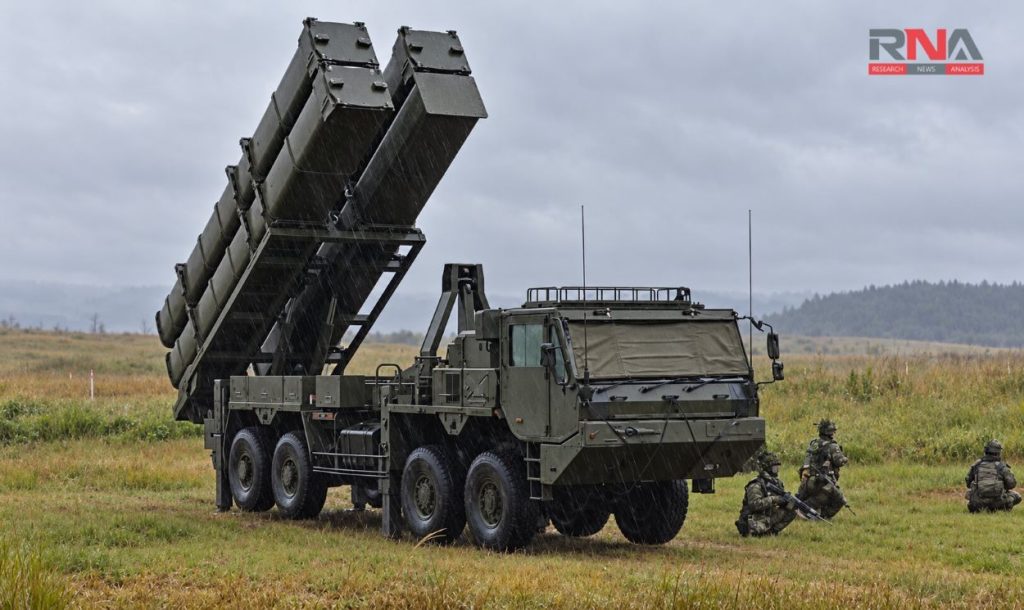
New Delhi: Japan is exploring the use of Indian training facilities for long-range anti-ship missiles and small attack drones, seeking more options to train personnel as it introduces weapons with substantially greater reach. The discussions could open another area of defence cooperation with New Delhi, although no agreement, exercise location or missile system has been announced.
The chief of staff of Japan’s Ground Self-Defense Force (GSDF), General Masayoshi Arai, confirmed on Tuesday that personnel had been sent to India for coordination. At his official press briefing, he explained that providing training opportunities suited to the reach of longer-range surface-to-ship missiles had become a significant operational challenge.
The development comes as the two countries review a broader expansion of military cooperation, including maritime security, air exercises and defence industrial engagement. As RNA Media earlier reported, the defence minister, Rajnath Singh, met his Japanese counterpart, Shinjiro Koizumi, in Cebu in the Philippines, on the sidelines of the Asean Defence Ministers’ Meeting-Plus on Wednesday.
During the meeting, both sides reaffirmed their commitment to strengthening defence cooperation. However, they did not announce an arrangement for Japanese missile firing in India. The distinction matters because the dispatch of a reconnaissance or coordination team does not establish that either government has approved live-fire training.
According to the Diplomat, citing an earlier NHK report, Japanese defence ministry officials travelled to India in mid-October and spent approximately a week inspecting test facilities and firing ranges. Arai’s subsequent confirmation brought the exploratory engagement into the public domain, while leaving its detailed scope undisclosed.
As RNA Media had reported, Japan’s newly deployed Type 25 surface-to-ship missile illustrates the training requirement behind the discussions, although its participation in any Indian exercise remains unconfirmed. Its range is widely reported to be approximately 1,000 kilometres, substantially exceeding the roughly 200-kilometre reach generally attributed to the earlier Type 12 system.
Japan’s 2026 defence white paper identifies the Type 25 as the ground-launched version of the upgraded Type 12 missile programme and records its deployment with the fifth surface-to-ship missile regiment at Camp Kengun in Kumamoto prefecture. The document also sets out plans for additional ground-based deployments and the development of ship-launched and air-launched versions of the upgraded Type 12.
These weapons form part of Japan’s effort to strengthen its stand-off defence capability – the ability to engage approaching ships or landing forces from beyond the immediate reach of their weapons. The white paper says that this requires supporting capabilities for collecting target information and exercising command and control, alongside the acquisition of missiles themselves.
A recent deployment drill demonstrated the difference between practising launch procedures and actually firing a missile over a long distance. On Sunday Japanese troops displayed Type 25 launcher deployment and firing preparations during the Keen Sword 27 exercise with the United States but did not launch a missile.
India offers an established missile-testing infrastructure that could be relevant to Japan’s search for suitable facilities. Its ranges on the Odisha coast support launches towards the Bay of Bengal, although public reporting has not identified an Indian site selected for Japanese use.
At the Integrated Test Range at Chandipur, Indian flight trials use radar, telemetry and electro-optical tracking equipment to monitor weapon performance. That infrastructure illustrates why a suitable firing range involves more than an unobstructed launch area: it must also support observation and assessment throughout a trial.
Small attack drones present a separate set of training requirements, and Arai confirmed that these were also being considered in the coordination with India. He identified operating frequencies, training content, locations and safety arrangements as factors that would shape decisions on where such activities could take place.
Japan is examining domestic training arrangements alongside possible overseas alternatives, rather than presenting the Indian option as a settled programme. Arai said no sequence had been determined for conducting overseas and domestic live-fire training, and declined to provide further details of the India mission, citing relations with New Delhi.
Military exchanges between the two countries have nevertheless continued to broaden, including through a separate Japanese professional study visit earlier this month. An Indian Army statement reproduced in the IANS report said a 34-member GSDF command and general staff course delegation visited India from October 4 to October 9.
The delegation interacted with Army and Defence Research and Development Organisation representatives and visited the Centre for Land Warfare Studies and the Wargame Research and Development Centre. That educational tour provided exposure to Indian military training and emerging technologies, but the published account does not establish that it was the team examining missile-training facilities.
At their latest meeting in Cebu, Singh and Koizumi welcomed progress in discussions on mine countermeasures and possible joint development in naval shipbuilding and design. They also reviewed closer air-service cooperation following Japanese fighter participation in Veer Guardian – 2026 in India and welcomed a bilateral defence industry forum attended by approximately 40 companies.
The ministers agreed to accelerate preparations for the fourth foreign and defence ministerial “2+2” dialogue and another defence ministers’ meeting in Tokyo later this year. For the proposed missile and drone training, however, the immediate questions remain unresolved: which facilities would be used, what weapons would be involved and when either government might authorize the activity.