


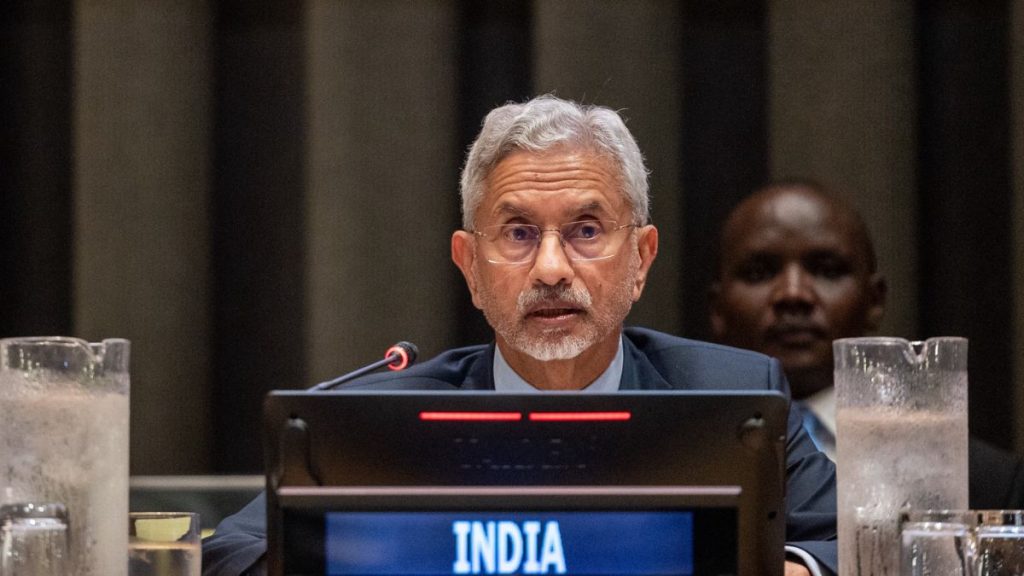
New Delhi: Peace and tranquillity along the line of actual control (LAC) remain essential for normalizing India-China relations, the external affairs minister, S Jaishankar, said on Tuesday, warning that any disturbance along the border would affect the wider relationship. He said conditions along the disputed frontier had improved considerably since 2024, allowing the two countries to gradually restore bilateral engagement, although major economic differences remain unresolved.
Speaking at the Bloomberg New Economy Forum in New Delhi, Jaishankar said India had consistently maintained that stability along the border was necessary for progress in bilateral relations.
“We don’t have an agreed border between India and China. This is not a new issue; it’s been going on for multiple decades,” he said, explaining the longstanding nature of the territorial dispute.
The minister indicated that the border situation had settled considerably since 2024 and that bilateral relations were moving towards normalcy. However, he made clear that renewed instability would have consequences for cooperation in other areas.
Jaishankar clarified that India was not insisting on a complete settlement of the boundary dispute before pursuing economic engagement with China. Instead, New Delhi’s immediate expectation was that both countries maintain peace along the frontier while negotiations on territorial differences continue.
The distinction is significant because the neighbours have yet to agree on a mutually accepted boundary despite decades of diplomatic negotiations.
Relations deteriorated sharply following the 2020 military standoff in eastern Ladakh and the Galwan valley clashes, in which 20 Indian soldiers were killed. Subsequent military and diplomatic negotiations led to an October 2024 agreement on patrolling arrangements at Depsang and Demchok, facilitating disengagement at the remaining friction points.
The agreement helped create conditions for renewed engagement but did not resolve the boundary dispute.
Jaishankar also indicated that India and China were exploring whether some parts of their boundary differences could be settled before reaching a comprehensive agreement. He described the possibility of a partial settlement as an active subject of discussion, without announcing any final arrangement or timetable.
Trade deficit widens to $112 billion
Beyond border stability, Jaishankar highlighted India’s concerns about the unequal trade relationship and limited market access available to Indian businesses in China.
He described the trade balance as heavily tilted towards China and argued that Indian companies were not receiving a level playing field in the Chinese market.
Official figures show that bilateral merchandise trade reached $151.10 billion in the financial year 2025–26, with Indian imports from China standing at $131.63 billion against exports of $19.47 billion, according to the embassy of India in Beijing.
The resulting trade deficit of $112.16 billion, compared with $99.21 billion in 2024–25, underscores New Delhi’s concerns over the widening commercial imbalance.
The embassy’s trade assessment also identifies machinery, electronics, computers, integrated circuits and other manufactured products among India’s principal imports from China. India has continued raising market-access difficulties through bilateral engagement.
On investment, Jaishankar indicated that economic cooperation could continue without waiting for a final boundary settlement. However, discussions on possible arrangements have not produced a publicly announced agreement.
The remarks underline India’s approach to managing relations with China, maintaining peace along the frontier while pursuing economic engagement and addressing unresolved trade and territorial differences. Further normalization will depend on sustained border stability and progress through diplomatic negotiations.