


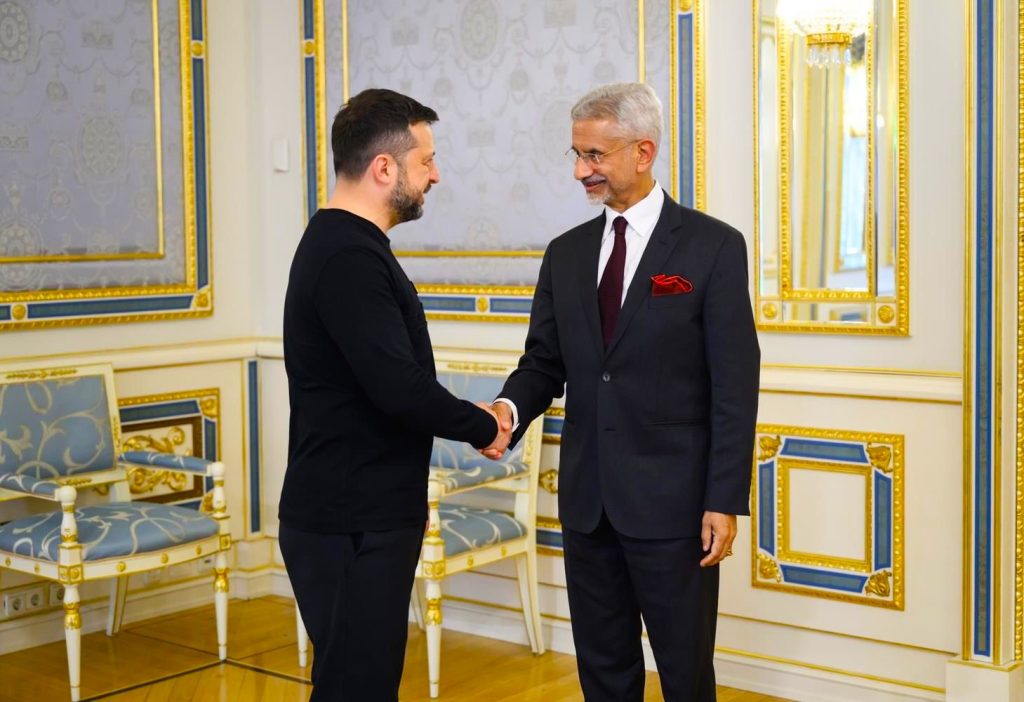
New Delhi: The external affairs minister, S Jaishankar, met the president of Ukraine, Volodymyr Zelenskyy, in Kyiv on Thursday for talks on strengthening bilateral cooperation and finding a negotiated end to the Russia-Ukraine war. The meeting came during the first standalone bilateral visit to Ukraine by an Indian foreign minister and at a time of renewed international efforts to revive diplomacy around the conflict.
Jaishankar said he briefed Zelenskyy on his earlier discussions with the foreign minister of Ukraine, Andrii Sybiha, about expanding cooperation between the two countries. He added that his conversation with the Ukrainian leader centred on possible approaches to ending a war that has entered its fifth year.
Zelenskyy thanked India for its commitment to peace and described New Delhi’s position as clear in opposing the continuation of the conflict. He said Ukraine expected other major powers to adopt an equally firm position in favour of a reliable and lasting settlement.
The Ukrainian leader briefed Jaishankar on Kyiv’s diplomatic engagements, including its recent contacts with the United States. He expressed hope that anticipated talks with American representatives would help generate movement towards ending the fighting.
The meeting took place against an active security backdrop, with Zelenskyy saying Russia launched jet-powered Shahed-type drones towards Kyiv while Jaishankar was in the capital. According to the Ukrainian account, the visiting Indian delegation remained safe as Ukrainian combat aircraft intercepted most of the incoming drones.
The two sides also discussed threats to commercial shipping in the Black Sea, where attacks on vessels and port infrastructure have affected international trade and placed civilian crews at risk. Jaishankar raised the deaths of Indian seafarers and underlined that maritime security was of particular concern to India, which supplies a significant part of the global merchant-shipping workforce.
He said disruption to shipping was causing wider shortages of fuel, food and fertiliser, with developing countries often bearing a disproportionate share of the economic consequences. Zelenskyy, for his part, accused Russia of obstructing Ukrainian ports and food-export routes, saying secure maritime access was essential for countries dependent on Black Sea supplies.
Bilateral economic relations also figured prominently in the talks, with Ukraine putting two-way trade at about $2.6 billion and identifying room for further expansion. Agriculture, food security, pharmaceuticals, infrastructure, transport, industry, machinery, digitalization and emerging technologies were among the areas discussed.
Jaishankar said commercial ties had shown resilience despite severe logistical disruption caused by the war and pointed to new opportunities in innovation, start-ups and artificial intelligence. He invited Sybiha to India for the next meeting of the bilateral intergovernmental commission, which is intended to translate the identified areas of cooperation into specific projects.
The visit carried diplomatic significance because Jaishankar had previously travelled to Ukraine only as part of the delegation accompanying the prime minister, Narendra Modi, on August 23, 2024. It also followed his August 24 meeting with the Russian president, Vladimir Putin, in Moscow, reflecting India’s continuing effort to preserve working relations with both parties to the conflict.
‘Halting Russian oil purchases won’t end war’
Addressing reporters after his talks with Sybiha, Jaishankar rejected the argument that curtailing India’s purchases of Russian crude would, by itself, bring the war to an end. “This conflict will be solved by dialogue, diplomacy, and negotiation,” he said, maintaining that the outcome would not be determined by whether individual countries bought Russian oil, metals, minerals or fertiliser.
The minister was responding to a question about whether India could reduce its purchases if the United States enacted further penalties against countries importing Russian energy. The US Senate has passed legislation that could authorize tariffs of up to 100 per cent on goods from major buyers of Russian oil and gas, although its implementation would depend on the remaining legislative and executive processes.
Jaishankar said India respected Ukraine’s view that energy exports provided Moscow with revenue during the war but expected equal recognition of New Delhi’s energy-security requirements. Supplying affordable energy to 1.4 billion people was a formidable responsibility, particularly when instability in major producing regions had tightened global supplies, he said.
Russia remains India’s largest crude supplier, although monthly volumes fluctuate according to availability, prices, shipping risks and refinery demand. India’s purchases rose sharply after February 2022 as discounted Russian barrels replaced some traditional supplies, while more recent disruption in the Middle East has reinforced New Delhi’s concern about overdependence on any single region.
Ukraine and several western governments contend that continued energy purchases sustain Russian state revenues and weaken the effect of sanctions intended to raise the economic cost of the invasion. India’s counterargument is that energy trade must be assessed within the realities of global demand and that penalizing large import-dependent economies cannot substitute for political negotiations.
Jaishankar reiterated India’s position that a durable solution was unlikely to emerge from the battlefield and said New Delhi was prepared to assist peace efforts in any useful manner. He referred to Modi’s recent call during his meeting with the Russian president, Vladimir Putin, at the SCO for “endless war” to give way to an “end of war”, while emphasizing that the parties directly involved would ultimately have to agree on the terms of a settlement.
The minister also mourned the death of an Indian national in an attack on Kyiv shortly before his visit and expressed sympathy for all families affected by the conflict. The casualty, together with the deaths of Indian seafarers in attacks on commercial vessels, has given New Delhi a more immediate stake in questions of civilian safety and freedom of navigation.
Jaishankar’s Kyiv visit therefore combined an effort to reinvigorate bilateral relations with a defence of India’s strategic autonomy on energy and foreign policy. It also demonstrated New Delhi’s attempt to remain engaged with both Kyiv and Moscow without presenting economic disengagement from Russia as a credible alternative to sustained diplomacy.