


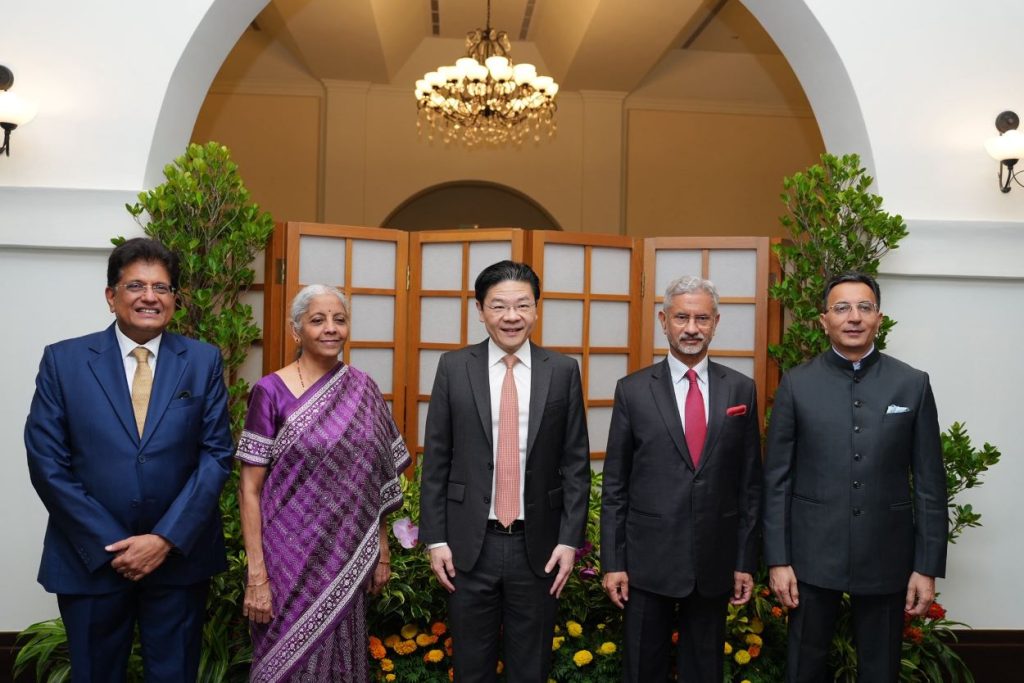
New Delhi: The external affairs minister, S Jaishankar, met the prime minister of Singapore, Lawrence Wong, in Singapore on Thursday as the two countries reviewed progress across their expanding strategic partnership. The discussion took place during a high-level Indian ministerial visit centred on the Fourth India-Singapore Ministerial Roundtable, the principal mechanism for converting political understandings into sector-specific cooperation.
Jaishankar said the meeting examined advances across various dimensions of the bilateral relationship and acknowledged Wong’s consistent support for stronger India-Singapore ties. Wong said separately that the two sides discussed building on the progress achieved through the roundtable and taking their comprehensive strategic partnership further.
The finance minister, Nirmala Sitharaman, led the Indian delegation, which also included the commerce and industry minister, Piyush Goyal, and the minister of state for electronics and information technology and commerce and industry, Jitin Prasada. The four ministers met Wong at the Istana before participating in the ministerial roundtable on August 20, 2026.
The leaders reviewed the implementation of the roadmap for the comprehensive strategic partnership and discussed deeper cooperation in economic affairs, digitalization, connectivity, skills development and sustainability. The relationship was elevated to a comprehensive strategic partnership during the visit of the prime minister, Narendra Modi, to Singapore in September 2024, and a detailed roadmap was adopted during Wong’s visit to India a year later.
The roadmap covers eight broad areas: economic cooperation, skills development, digitalization, sustainability, connectivity, healthcare and medicine, people-to-people exchanges, and defence and security. The ministerial roundtable concentrates on six operational pillars – advanced manufacturing, connectivity, digitalization, healthcare and medicine, skills development, and sustainability.
The fourth roundtable was led on the Singaporean side by the deputy prime minister and minister for trade and industry, Gan Kim Yong. His delegation included the senior minister and coordinating minister for national security, K Shanmugam, the foreign minister, Vivian Balakrishnan, the digital development and information minister, Josephine Teo, and the transport minister, Jeffrey Siow.
The discussions produced agreements to expand cooperation in telecommunications, broadcasting, food safety and maritime heritage. Indian and Singaporean regulators agreed to work together on spectrum management, consumer protection and regulatory coordination, while their food-safety agencies will exchange information on labelling, product recalls, emergency notifications and import procedures.
Semiconductors and advanced manufacturing occupied a prominent place in the talks as both countries assessed progress following their 2024 agreement on developing a semiconductor ecosystem. Singapore is considering training centres in Indian manufacturing clusters, and its ITE Education Services is helping establish a centre of excellence for advanced manufacturing in Chennai.
The two sides also considered ways to make it easier for Singaporean manufacturers and their suppliers to invest in India, particularly in semiconductor and food-processing projects. Plans to improve air connectivity were discussed alongside Project Nexus for linking national instant-payment systems and the India-Singapore Green and Digital Shipping Corridor.
Singapore has emerged as one of India’s most consequential economic partners in Southeast Asia and its largest trading partner within Asean. Bilateral merchandise trade increased to about $36.1 billion in the financial year 2025-26, compared with $6.7 billion in 2004-05, according to Indian government figures.
The city-state was also India’s largest source of foreign direct investment in 2025-26, contributing about $19.8 billion during the year. Cumulative investment from Singapore reached approximately $194.68 billion between April 2000 and March 2026, reflecting its importance as both a financial centre and a base for multinational companies investing in India.
The partnership has a significant security dimension beyond commerce, with the two countries maintaining regular military exercises, defence-policy consultations and maritime cooperation. Their longstanding engagements include the Simbex naval exercise, the Bold Kurukshetra Army exercise and joint training involving their air forces.
For India, closer relations with Singapore support its Act East policy and provide economic and strategic access to the wider Asean region. For Singapore, India offers a large market, a growing manufacturing base and an increasingly important partner at a time when geopolitical rivalry and trade barriers are pushing governments to diversify supply chains.
The latest meetings therefore went beyond a routine diplomatic exchange and focused on implementation, investment and measurable institutional linkages. The emphasis on semiconductors, digital payments, resilient food supplies, green shipping and skills suggests that both governments are attempting to give practical substance to their comprehensive strategic partnership.