


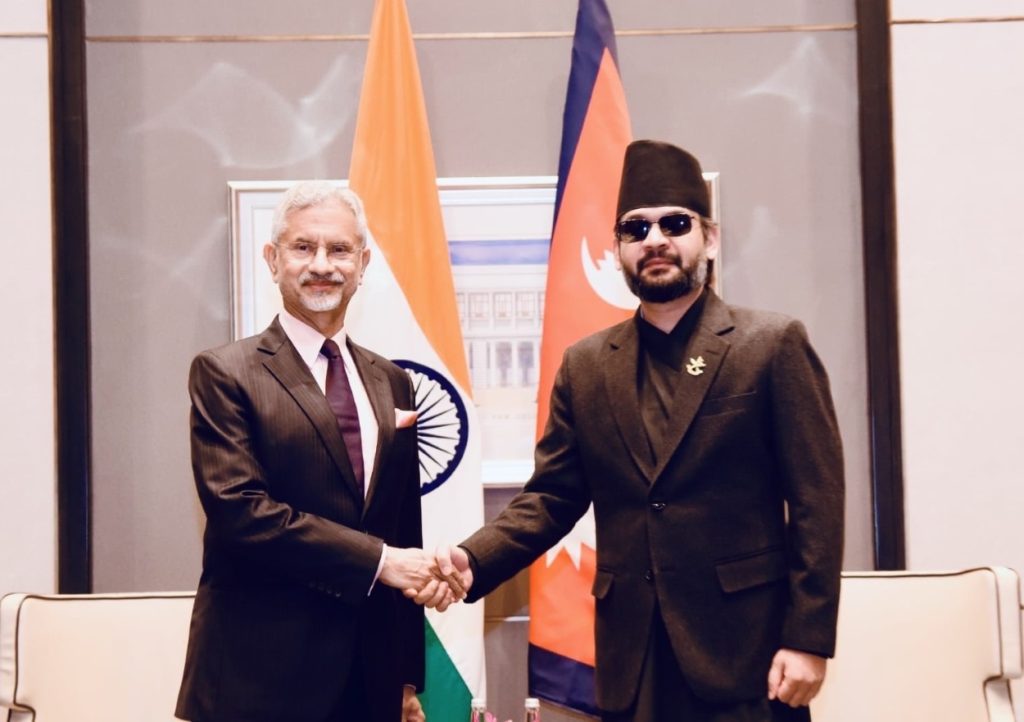
New Delhi: The external affairs minister, S Jaishankar, met the Nepali prime minister, Balendra Shah, in New Delhi on Sunday, reaffirming India’s commitment to its relationship with the Himalayan neighbour as the two countries prepare for crucial talks on economic cooperation, connectivity and longstanding diplomatic differences. The meeting, held hours after Shah arrived on his first official bilateral visit to India since assuming office in March, set the stage for his discussions with the prime minister, Narendra Modi, on Monday.
The two leaders discussed cooperation across trade, transit, energy, education, culture, sports and people-to-people exchanges during their meeting at the Taj Mahal Hotel, according to Nepal’s foreign ministry. Jaishankar subsequently described the relationship as a special friendship and expressed optimism about Shah’s forthcoming engagements with Modi, signalling New Delhi’s intention to strengthen bilateral ties despite differences over territorial claims and other sensitive issues.
“India cherishes the special friendship with Nepal,” Jaishankar wrote on X after the meeting, adding that he looked forward to the visiting leader’s discussions with Modi. Nepal’s foreign ministry said the exchange also covered opportunities to expand cooperation in cricket and football, reflecting the broader cultural and social connections underpinning the relationship.
Shah, who arrived on a two-day state visit at Modi’s invitation, was received at Indira Gandhi International Airport by the minister of state for commerce and industry, Jitin Prasada. His delegation includes senior ministers, government officials and business representatives, indicating that Kathmandu intends to give economic negotiations considerable prominence alongside political and diplomatic engagement.
The visit marks an important milestone for Shah, a former Kathmandu mayor who emerged as a significant figure in Nepal’s changing political landscape before becoming prime minister following the March 2026 elections. It also provides the two governments with their first opportunity for direct leadership-level discussions since his administration took office, following months of diplomatic preparations and contacts between senior officials.
$2 billion proposal and infrastructure cooperation
Economic assistance is expected to feature prominently in Monday’s discussions, with Nepal seeking approximately $2 billion in Indian grants and concessional credit for reconstruction, infrastructure development and other priorities. According to a Kathmandu Post report, New Delhi has responded positively to the proposal, although negotiations over its precise terms remain unfinished and no final agreement has been announced.
The proposed assistance assumes additional significance following the devastating floods that struck Nepal in August, damaging transport infrastructure and disrupting important cross-border connections. As RNA Media reported, Kathmandu has been seeking substantial Indian financial support for reconstruction and development, making the outcome of the visit particularly important for Shah’s domestic economic agenda.
Air connectivity has emerged as another difficult negotiating issue, with Nepal seeking additional access through Indian airspace to improve international aviation links. Kathmandu wants the existing western L626 air corridor to accommodate inbound flights, but discussions remain unresolved over operating conditions and India’s reported proposal concerning military aircraft access through the Bagdogra entry point.
Energy cooperation offers a more established foundation for progress, particularly as Nepal seeks to expand hydropower generation and increase electricity exports to India. Under a long-term agreement concluded in January 2024, the two countries agreed to work towards increasing Nepal’s electricity exports to India to 10,000MW within a decade, creating opportunities for investment in power generation, transmission networks and regional energy trade.
India remains Nepal’s principal commercial partner and an indispensable transit route for the landlocked country, making improvements in railways, roads, border infrastructure and customs arrangements commercially significant. The two governments are expected to consider additional connectivity projects and agreements covering sectors such as education, agriculture, health and disaster management, alongside possible inauguration of completed development projects.
Border disputes and China’s strategic shadow
Despite their extensive economic and social ties, India and Nepal continue to differ over the territorial status of Kalapani, Lipulekh and Limpiyadhura, areas claimed by Kathmandu but administered by India as part of Uttarakhand. Relations encountered fresh friction earlier this year when Shah suggested involving China and Britain in resolving the dispute, prompting New Delhi to reiterate that outstanding boundary questions must be settled through established bilateral mechanisms.
The dispute carries strategic implications because Lipulekh lies near the trijunction of India, Nepal and China and serves as an important route for trade and pilgrimage. China’s growing economic engagement with Nepal adds another dimension to the relationship, although Kathmandu has traditionally sought to preserve its autonomy by maintaining constructive relations with both neighbouring powers.
Other unresolved matters include the implementation of the Pancheshwar Multipurpose Project, longstanding discussions over the 1950 Treaty of Peace and Friendship and uncertainty surrounding the recruitment of Nepali Gorkhas into the Indian Army following the introduction of the Agnipath scheme. These issues illustrate why closer economic integration, although important, cannot automatically resolve disagreements rooted in sovereignty, security and differing political expectations.
For New Delhi, Shah’s visit represents an opportunity to reinforce its Neighbourhood First policy through concrete development commitments rather than diplomatic assurances alone. For Kathmandu, the challenge is to secure meaningful economic support and greater negotiating space without allowing disagreements over territory and strategic autonomy to overshadow the wider relationship.
Shah is scheduled to meet the president, Droupadi Murmu, and hold delegation-level discussions with Modi on November 23, when several agreements and development-related announcements are expected. The outcome will be measured not merely by the warmth of the meetings but by whether the two governments can translate their shared economic interests into tangible progress while keeping their longstanding differences manageable.