


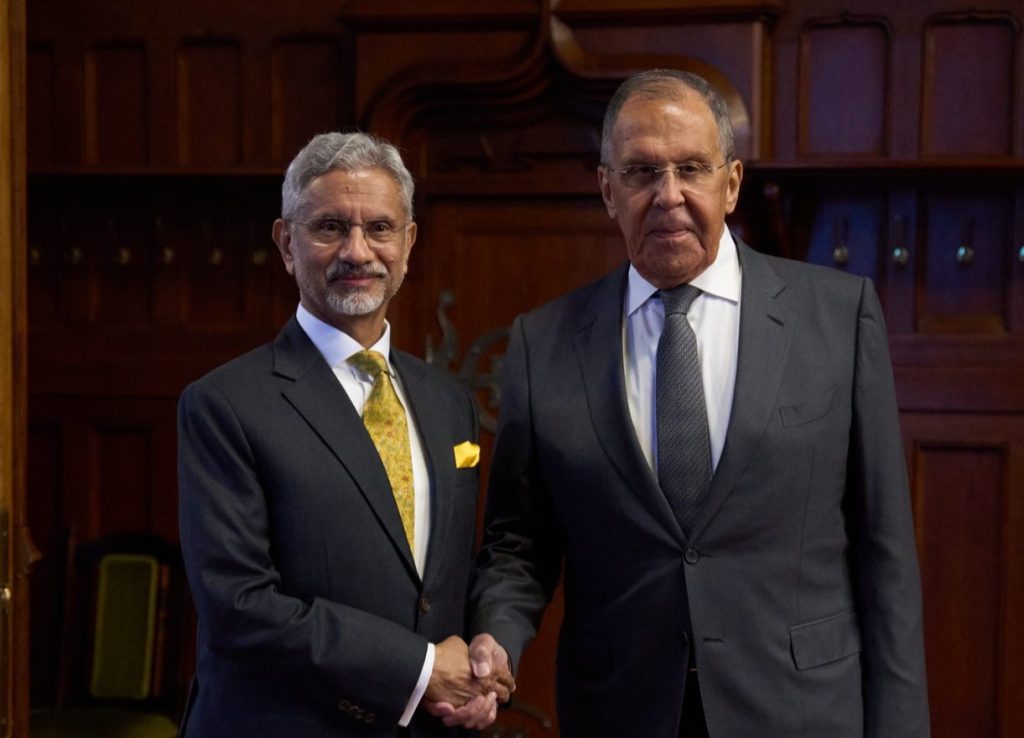
New Delhi: The external affairs minister, S Jaishankar, and the Russian foreign minister, Sergey Lavrov, held wide-ranging talks in Moscow on Monday, covering the conflicts in Ukraine and Iran, developments in Afghanistan and the broader India-Russia relationship. Their discussions acquired added significance because they preceded the BRICS leaders’ summit in New Delhi, where wars involving two members of the grouping will present India with a difficult test of diplomatic leadership.
Jaishankar said after the meeting that the two ministers had discussed bilateral cooperation, regional flashpoints, global challenges and multilateral issues. The Russian foreign ministry went further, saying the two sides had “coordinated approaches” towards Afghanistan, Iran and Ukraine and had agreed to strengthen their “trust-based dialogue” at every level.
According to Moscow, India and Russia also reiterated their intention to maintain close coordination in the United Nations, the Shanghai Cooperation Organisation, BRICS and the G20. The formulation suggested an effort to narrow differences before the BRICS summit, although it did not necessarily mean that New Delhi and Moscow had adopted identical positions on the conflicts.
The meeting with Lavrov concluded Jaishankar’s two-day visit to Russia, during which he also called on the Russian president, Vladimir Putin, and delivered a personal communication from the prime minister, Narendra Modi. Jaishankar told Putin that Modi looked forward to meeting him at the SCO summit and welcoming him to India for the BRICS summit, scheduled for September 12–13.
The visit’s economic component was handled through the 27th session of the India-Russia Inter-Governmental Commission on Trade, Economic, Scientific, Technological and Cultural Cooperation. Jaishankar co-chaired the meeting with Russia’s first deputy prime minister, Denis Manturov, and reviewed cooperation in trade, energy, fertilisers, nuclear power, technology and other sectors.
Bilateral trade has risen more than four-fold, from about $13 billion in 2021–22 to nearly $60 billion in 2025–26, but the expansion has been overwhelmingly driven by Indian imports of Russian crude oil and other commodities. India’s trade deficit with Russia consequently widened from $6.6 billion to more than $50 billion, which Jaishankar described as one of New Delhi’s foremost economic priorities.
India wants greater access to the Russian market for pharmaceuticals, agricultural products, engineering goods, textiles and other merchandise, along with the removal of tariff and non-tariff barriers. Stronger payment arrangements and deeper business-to-business engagement will also be essential if the two countries are to achieve their target of $100 billion in annual trade by 2030.
Putin told Jaishankar that bilateral commerce had returned to growth after a slight decline in the previous year and emphasized that the relationship extended well beyond energy. He said Russia was increasing fertiliser shipments to meet the requirements of Indian farmers, while the two sides were also advancing cooperation in nuclear energy and high-technology sectors.
The assurances have become particularly relevant as the conflict involving Iran has disrupted energy and fertiliser flows from the Gulf and increased pressure on prices. Russia has emerged as an increasingly important alternative supplier, although the concentration of trade in hydrocarbons has simultaneously deepened India’s dependence and produced an economically unsustainable imbalance.
Why the talks matter for India, Russia and BRICS
For India, the relationship with Russia remains important at three interconnected levels – economic security, defence preparedness and diplomatic room for manoeuvre. Russian crude has helped Indian refiners manage global supply shocks, Russian fertilisers support the agricultural sector, and Moscow remains a critical partner in nuclear power through the Kudankulam project.
Russia also continues to occupy an important place in India’s defence ecosystem because a substantial part of the country’s military inventory is of Soviet or Russian origin. Even as India diversifies its acquisitions and expands domestic manufacturing, the availability of spares, ammunition, upgrades and technical support for existing platforms makes stable relations with Moscow a continuing operational requirement.
The diplomatic value is equally significant because Russia gives India access and leverage across continental Eurasia, including Central Asia, Afghanistan and the Arctic. Maintaining a working partnership with Moscow also allows New Delhi to preserve strategic autonomy instead of allowing its relations with the United States and Europe to determine its engagement with every other major power.
Afghanistan illustrates this convergence particularly clearly, even though India and Russia do not follow identical policies towards the Taliban. Both have an interest in preventing Afghan territory from becoming a sanctuary for terrorist organizations, containing the spread of the Islamic State-Khorasan Province and limiting the flow of narcotics and extremism into South and Central Asia.
For Russia, India provides a large and politically important market at a time when Western sanctions and the Ukraine war have forced Moscow to redirect trade towards Asia. New Delhi’s willingness to maintain commercial and diplomatic engagement also helps Russia demonstrate that Western efforts to isolate it have not secured universal support, especially across the global south.
India, however, is more valuable to Moscow as an autonomous partner than as an unquestioning supporter. Unlike China, whose growing economic weight could leave Russia excessively dependent on a single market, India offers diversification, access to pharmaceuticals and manufactured goods, and long-term possibilities in technology, transport, nuclear energy and the Russian Far East.
This explains why correcting the trade imbalance is not merely an Indian demand but a strategic necessity for the durability of the relationship. A partnership in which Russia sells almost everything and buys comparatively little from India may generate impressive trade figures, but it will remain vulnerable to payment difficulties, sanctions exposure and political criticism.
The simultaneous conflicts in Ukraine and the Middle East have also connected bilateral diplomacy directly with India’s BRICS chairmanship. Russia is a founding member of the grouping, while Iran joined during its expansion, making both wars internal tests of BRICS cohesion rather than distant crises on which members can issue cost-free declarations.
On Ukraine, India has avoided joining Western sanctions and has continued buying Russian energy, but it has also consistently supported dialogue and diplomacy and emphasized respect for sovereignty and territorial integrity. This calibrated position allows New Delhi to engage Moscow without formally endorsing Russia’s conduct of the war, but it limits how far an India-led BRICS declaration can reflect Russian language or objectives.
The Middle East presents an even more complicated problem because Iran and the United Arab Emirates are both BRICS members and have taken opposing positions in the conflict. At the BRICS foreign ministers’ meeting in New Delhi in May, divisions over the Iran war prevented the members from adopting a joint statement, forcing India to issue a chair’s statement acknowledging that differing views persisted.
Those differences revealed the limits of BRICS solidarity at precisely the moment the grouping sought to project itself as a stronger voice for the Global South. Iran wanted an explicit condemnation of the United States and Israel, while the UAE rejected Tehran’s accusations against it and held Iran responsible for attacks on its territory and critical infrastructure.
India’s interests further complicate the equation because it has valuable relations with Iran, the UAE, Israel, Russia and the United States, while depending heavily on secure Gulf energy supplies and unhindered maritime trade. New Delhi therefore has little incentive to turn BRICS into a platform aligned with any combatant, but every reason to seek consensus around international law, civilian protection, dialogue, energy security and freedom of navigation.
The Strait of Hormuz and the Red Sea are especially important because disruptions there raise freight and insurance costs, threaten seafarers and transmit energy inflation across developing economies. At the May meeting, Jaishankar emphasized that safe and unimpeded maritime flows through international waterways remained essential to global economic well-being.
BRICS solidarity, therefore, should not be confused with military alignment or agreement on the causes of every conflict. The grouping operates by consensus and includes countries with competing security partnerships, regional rivalries and sharply different relationships with the West, making practical cooperation more achievable than a uniform geopolitical position.
Its credibility will instead depend on whether members can protect their common interests despite those differences. Coordinated payment systems, resilient energy and food supply chains, reform of multilateral institutions, humanitarian cooperation and resistance to indiscriminate economic coercion would constitute more meaningful solidarity than a strongly worded declaration that some members cannot genuinely support.
The Jaishankar-Lavrov discussions matter in this context because India and Russia are central to any workable BRICS compromise. Russia has influence with Iran and a direct stake in the Ukraine debate, while India, as chair, retains working relations across rival camps and can help formulate common ground without claiming a formal mediating role.
Success at the New Delhi summit would not require BRICS members to erase their disagreements over Ukraine or the Middle East. It would require them to show that those conflicts cannot paralyse cooperation on energy security, maritime stability, development finance and global governance – the areas in which the grouping’s relevance will ultimately be judged.