


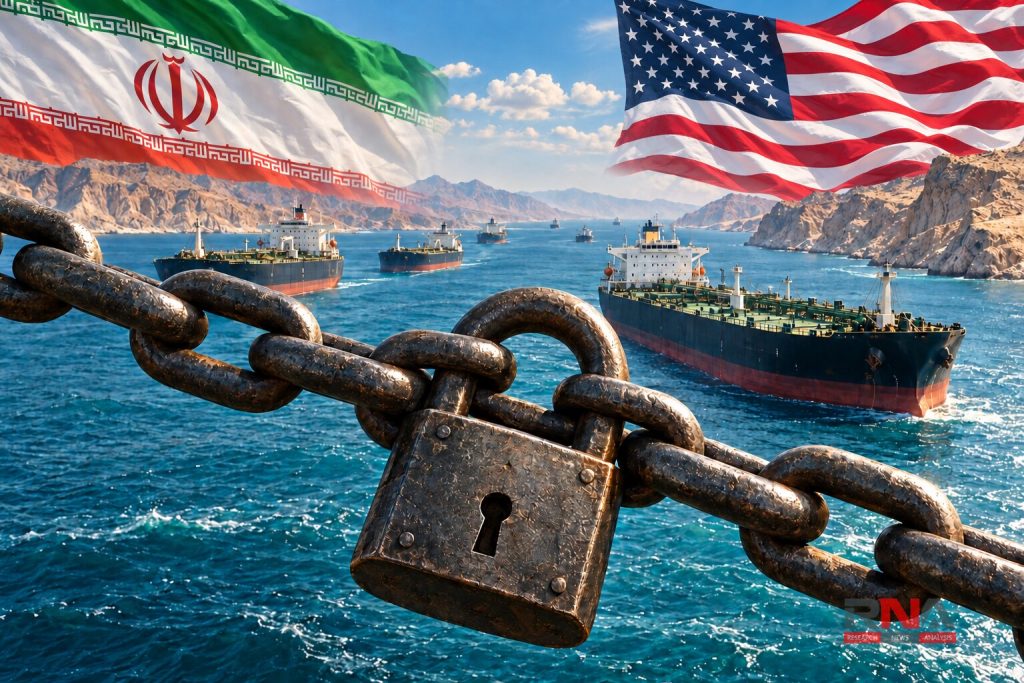
New Delhi: Iran said on Sunday that it would not reopen the Strait of Hormuz until Washington fulfilled seven conditions linked to an interim agreement reached in June. The declaration underscored the continuing diplomatic deadlock over a shipping route whose disruption has affected energy supplies and exposed major Asian importers, including India, to prolonged uncertainty.
The speaker of Iran’s parliament and a leading negotiator, Mohammad Bagher Ghalibaf, said Tehran’s position rested on the Islamabad memorandum of understanding. According to the National, he acknowledged that Washington had recently submitted proposals through intermediaries, indicating that diplomatic exchanges were continuing despite the public standoff.
Ghalibaf did not disclose the contents of those American proposals, and the accounts of his statement did not provide a complete list of the seven conditions. He nevertheless signalled that Tehran intended to keep negotiating while preparing for the possibility of renewed fighting, presenting military readiness as essential to its bargaining position.
The immediate diplomatic effort centres on an Iranian proposal to restore passage through Hormuz within seven days if the necessary reciprocal steps are taken. The seven-day implementation period and the seven conditions cited by Ghalibaf are distinct elements of Tehran’s position, rather than an unconditional commitment to reopen the waterway on a fixed date.
Qatar has been carrying messages between the two sides, with the Iranian foreign minister, Abbas Araghchi, receiving Washington’s feedback in Doha before returning to Tehran for consultations. Reuters reported on September 30 that the disagreement concerned the sequence of proposed measures rather than simply their substance, making the question of who acts first central to efforts to secure a breakthrough.
The Financial Times reported that the emerging arrangement envisaged reopening Hormuz in exchange for lifting the American naval blockade, restoring oil waivers and allowing Iran access to some frozen assets. Those reported negotiating provisions should not, however, be treated as a verified, exhaustive account of Ghalibaf’s seven conditions.
The June understanding had briefly reduced hostilities, but efforts to translate it into a durable settlement subsequently faltered. The latest mediation is therefore an attempt to restore an earlier diplomatic framework while resolving disagreements that prevented it from holding.
Tehran has also sought to separate immediate maritime arrangements from broader concessions on its nuclear programme. A senior Iranian official told Reuters on September 25 that acceptance of its Hormuz proposal, including the lifting of the blockade on Iranian ports, would not mean flexibility on nuclear issues.
Iran’s description of the strait as closed also requires qualification: it does not establish that all vessels or oil cargoes have stopped moving. Reuters’ separate reporting on Opec+ on Sunday referred to increasing flows through Hormuz, even as continuing export disruptions kept Gulf producers below their production targets.
The scale of the economic exposure explains why restoring dependable passage remains urgent beyond the immediate belligerents. According to the International Energy Agency’s pre-war assessment, roughly 20 million barrels of crude and petroleum products passed through Hormuz daily in 2025, representing about a quarter of global seaborne oil trade.
For India, the vulnerability extends beyond crude oil to liquefied natural gas, or LNG, used across industry and energy supply. The agency identified India among the principal buyers of oil shipped through Hormuz and among South Asian economies heavily dependent on LNG passing through the waterway.
Alternative pipelines through Saudi Arabia and the United Arab Emirates offer some capacity to bypass the strait, but cannot replace its entire pre-war oil throughput. Gas supplies face still tighter constraints: the agency’s assessment found no comparable alternative route for bringing the affected Qatari and Emirati LNG exports to world markets, leaving dependable maritime access critical even where oil shipments can be redirected.