


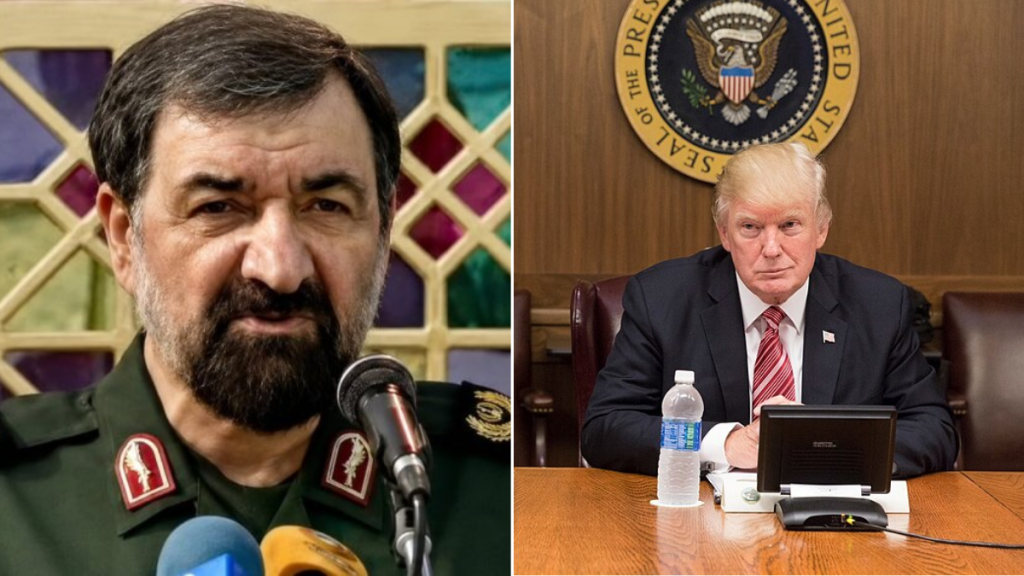
New Delhi: Iran has put forward seven conditions for restarting negotiations with the United States and ending the ongoing war, opening a new diplomatic channel even as Tehran warns that it is preparing for another major round of fighting if Washington rejects its terms. The conditions have been conveyed to the US through Qatar, with Iran now waiting for the United States president, Donald Trump, to response.
Iran wants the war to end on all fronts, its frozen funds released and the US naval blockade lifted. Tehran also wants a dispute-resolution mechanism in any new agreement after the previous MoU collapsed last month.
The Iran’s supreme national security council secretary, Mohsen Rezaei, disclosed the terms in an interview with Al Jazeera, saying Qatar had conveyed Tehran’s conditions to Washington. He said Iran remained in contact with Qatar and that Pakistan was also involved in efforts to bring the two sides back to negotiations after the expiry of the previous MoU.
The diplomatic opening, however, comes as the possibility of a fresh US strike remains on the table. Rezaei said Iranian military assessments considered another American attack “very much on the cards”, while insisting that Tehran was prepared for what he described as a “decisive war”.
The timing has added another layer of uncertainty in Washington. Trump cut short his stay at Camp David and returned to the White House on Saturday, a day earlier than scheduled, with the president originally expected to remain at the retreat until Sunday; the White House did not immediately provide an explanation for the change.
Iran offers talks while preparing for war
Tehran’s message is therefore moving on two parallel tracks: a diplomatic offer to end the conflict and an increasingly explicit warning about what could follow if the offer is rejected. Rezaei said Trump’s threats would not force Iran to back down and that Tehran was prepared for a wider confrontation.
Iran has also changed its military planning after two earlier rounds of fighting, according to Rezaei. He said the focus is now on US naval assets operating from the Gulf through the Gulf of Oman and the Arabian Sea, while targets farther towards the Indian Ocean would be beyond Iran’s reach.
Rezaei claimed Iran had recently test-fired a multi-warhead anti-ship missile near a US vessel or aircraft carrier and suggested that the technology could be developed further. He also warned that any future Iranian response could be extensive, potentially involving US military bases across the region as well as American commercial interests and companies operating locally.
The warning comes as regional mediators continue trying to reopen a diplomatic route. Qatar and Pakistan have been working to revive negotiations, while other countries in the region are also pushing for an end to the conflict that began after US and Israeli strikes against Iran in late February killed Iran’s slain supreme leader Ayatollah Ali Khamenei.
What happens to the nuclear deal?
The nuclear issue remains another major obstacle. Rezaei said Iran has not decided to withdraw from the Nuclear Non-Proliferation Treaty despite the US and Israeli attacks, although he warned that Washington’s actions could eventually push Tehran towards such a decision.
He also said Iran’s nuclear doctrine had not changed and that Tehran continued to observe a religious decree or fatwa, prohibiting nuclear weapons. At the same time, he warned that future developments could change the situation, particularly if additional sanctions are imposed or Iran’s nuclear file is referred to the UN security council.
Tehran has also rejected US accusations that it violated the earlier MoU by attacking an oil tanker in the Strait of Hormuz. Rezaei said Iran’s actions came only after US strikes on Bandar Abbas and an Iranian surveillance platform, while arguing that any dispute over the agreement should have gone before a dispute-resolution committee agreed between Iranian parliament speaker, Mohammad Bagher Ghalibaf, and the United States vice-president, JD Vance.
Hormuz and Yemen add to the uncertainty
The Strait of Hormuz remains another potential flashpoint, particularly for commercial shipping. Trump wants the strait reopened for normal vessel movement as soon as possible, while Iran continues to control and closely monitor shipping activity in and around the waterway.
Rezaei said Iran had come within “a short step” of announcing an agreement with Oman, but the deal was ultimately shelved. He said the framework remains ready and could still require regional endorsement before being made public.
On Yemen, Rezaei denied that Iran was directly involved in the war and said Tehran was prepared to help mediate between the warring sides. He also rejected speculation that Iran could order the closure of the Bab al-Mandeb Strait to pressure global energy markets, saying control of the waterway was a Yemeni matter linked to the actions of the Houthi movement.
The result is a fragile diplomatic opening surrounded by military threats. Iran says it has placed its conditions before Washington and is waiting for Trump’s answer.