


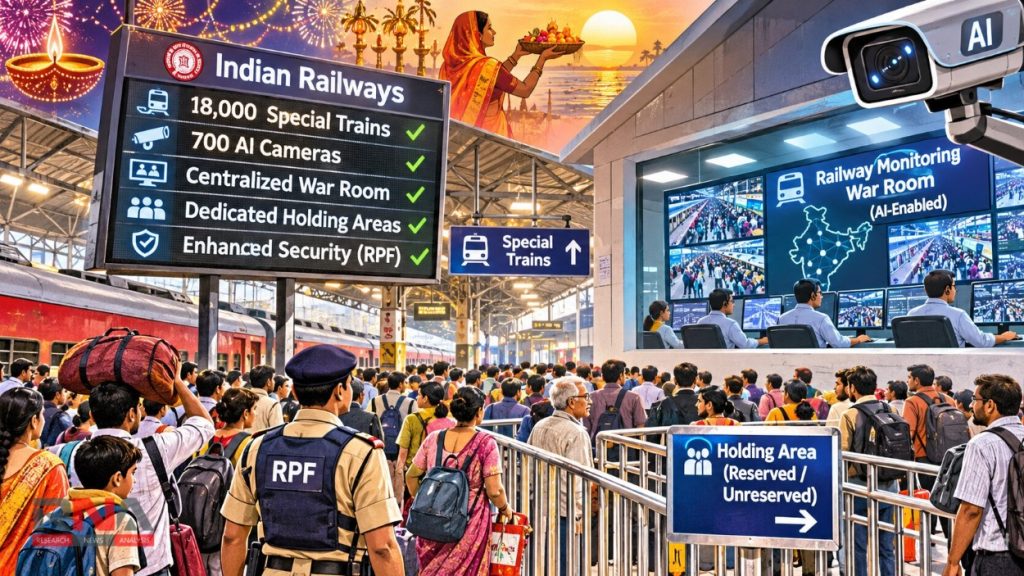
New Delhi: Indian Railways has launched one of its largest festive-season passenger-management operations, deploying more than 18,000 special trains, hundreds of artificial intelligence-enabled surveillance cameras and centralized monitoring facilities to cope with the surge in travel during Diwali and Chhath. The arrangements, which include dedicated waiting areas and additional security personnel, come as passenger traffic at major railway stations across the country rises sharply, placing considerable pressure on an already congested network.
The minister for railways, Ashwini Vaishnaw, said on Saturday that the number of special trains arranged for the current festive season had increased by 50 per cent from approximately 12,000 last year. Reviewing operational preparedness at Rail Bhawan in New Delhi on Saturday, he said the measures were designed to prevent overcrowding, regulate passenger movement and improve safety at major railway terminals.
A significant addition this year is a centralized railway monitoring facility, or war room, which receives live surveillance feeds from 38 railway stations across the country. The facility allows officials to monitor platforms, foot overbridges and station approaches simultaneously, identify potential congestion points and coordinate responses before crowding becomes dangerous.
Equipped with AI-supported video analysis and operational data, the war room also monitors train movements, delays and disruptions. Railway officials can examine individual camera feeds and assess developing situations, enabling more targeted deployment of security personnel and adjustments to passenger movement.
New holding areas and tighter crowd control
The Railways has installed more than 700 additional AI-enabled cameras to strengthen surveillance and crowd management at major stations. Dedicated passenger holding areas have also been established at approximately 20 stations, including New Delhi and Anand Vihar Terminal, to prevent large gatherings on platforms before trains are ready for boarding.
At New Delhi Railway Station, separate waiting facilities have been arranged for passengers holding reserved and unreserved tickets, alongside a common holding area intended to streamline entry. Ticketing and luggage-screening arrangements have been reorganized, with additional scanning counters, drinking water facilities and washrooms provided to accommodate the increased passenger volumes.
Additional personnel from the Railway Protection Force (RPF) have been deployed, particularly at stations handling large numbers of passengers travelling towards Bihar and eastern Uttar Pradesh. The operational emphasis is on regulating access to platforms and ensuring that passengers enter boarding areas in a controlled manner rather than accumulating near trains well before departure.
According to official figures released by the Ministry of Railways, major stations in Delhi recorded approximately 20,000,000 passenger movements between October 1 and November 5. Daily footfall in the capital’s railway network rose from an average of 500,000 to approximately 800,000 during the peak travel period of November 1–5, demonstrating the scale of the seasonal increase.
The pressure extends well beyond Delhi, with Mumbai’s principal stations recording approximately 15,000,000 passenger movements over the same 36-day period. Hyderabad’s major terminals handled around 9,000,000 movements, Bengaluru recorded approximately 10,000,000, and Surat and Udhna together registered about 5,000,000, according to the ministry.
These figures represent cumulative passenger movements rather than necessarily distinct travellers, since individuals can be counted at different stages of their journeys. Nevertheless, they demonstrate why temporary train services alone cannot address the risks associated with concentrated passenger arrivals at major terminals.
Safety concerns and the challenge of capacity
The enhanced arrangements also carry particular significance following the February 15, 2025, stampede at New Delhi Railway Station, which killed 18 people and injured 15 others during the Maha Kumbh pilgrimage rush. The tragedy exposed the dangers of overcrowded platforms and prompted the Railways to introduce stronger access controls, passenger holding facilities and emergency coordination mechanisms.
In a November 2 Delhi high court order, the court emphasized that the effectiveness of railway safety protocols ultimately depended on their implementation during crowded events. It also called for accountability and proper documentation of crowd-management measures, reinforcing the importance of operational preparedness rather than relying solely on surveillance technology.
Beyond immediate safety concerns, the festive rush has highlighted the limitations of India’s railway infrastructure, where passenger services compete with freight trains for track capacity. Vaishnaw said approximately 36,000 kilometres of additional tracks had been laid over the preceding decade, with further expansion necessary to ease congestion and improve punctuality.
The minister also outlined plans to expand seven major railway corridors to four tracks, potentially allowing more than 1,000 additional regular train services in the longer term. However, the immediate test will be whether the expanded train operations, AI surveillance and revised station-management arrangements can accommodate the continuing festive rush without major disruptions or safety incidents. Excerpt: Indian Railways has deployed over 18,000 special trains, 700 AI cameras and a centralized monitoring network as record festive crowds test station safety and railway capacity.