


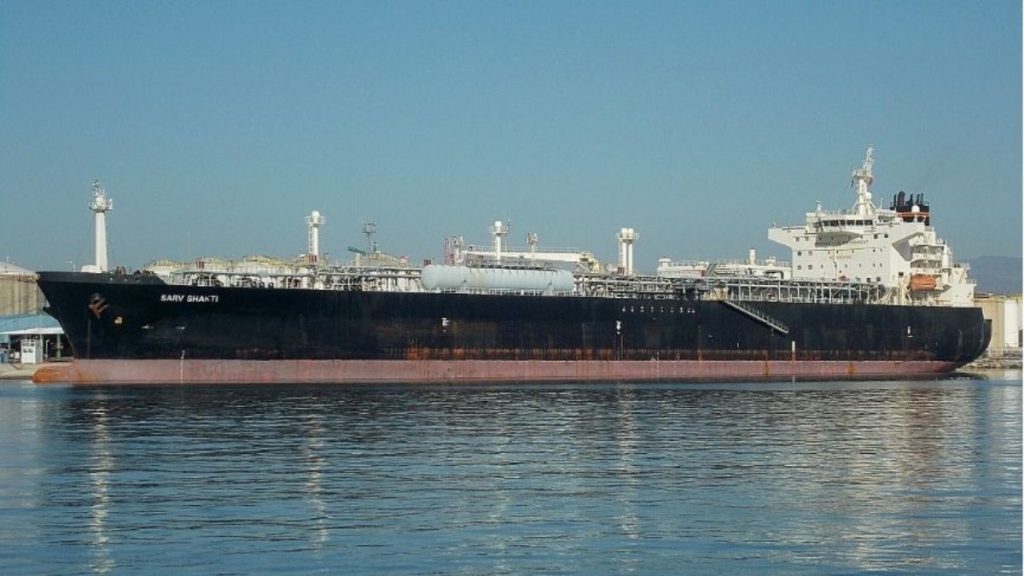
As tensions in West Asia continue to rattle global energy markets, a single tanker’s journey through the Strait of Hormuz has drawn great attention. The passage of the Sarv Shakti, an India-linked liquefied petroleum gas (LPG) carrier, is being seen as a major logistical feat for India especially when geopolitics, war, and energy security are hitting one of the world’s most volatile chokepoints together.
The Marshall Islands-flagged vessel, carrying around 45,000 tons of LPG widely used as cooking fuel in India, successfully moved past Iran’s Larak and Qeshm islands into the Gulf of Oman over the weekend, according to ship-tracking data. The Ministry of Petroleum & Natural Gas said that the vessel is expected to arrive at Visakhapatnam on May 13, 2026.
Sarv Shakti is among the first India-linked vessels to transit the Strait of Hormuz since a weeks-long US-led blockade targeting ships tied to Iran effectively choked maritime movement in the region.
Why is Sarv Shakti’s crossing being closely watched?
Shipping flows through the strait, which typically handles a fifth of the world’s oil trade, had plummeted after escalating hostilities involving the US, Israel, and Iran. The brief reopening of the passage in April quickly descended into chaos when Iranian forces reportedly fired on vessels, forcing many to retreat mid-transit.
Against that backdrop, the Sarv Shakti’s successful crossing signals a narrow and uncertain reopening.
“A Marshall Islands-flagged LPG carrier, MT Sarv Shakti (IMO No. 9350599), carrying 46,313 MT of LPG (Indian cargo), with 20 crew members onboard including 18 Indians, has safely crossed the Strait of Hormuz on 02 May 2026, and is expected to arrive at Visakhapatnam on 13 May 2026,” the petroleum ministry informed on Sunday (May 3, 2026).
Is India facing an energy crisis?
India, heavily reliant on energy imports from the region, has found itself navigating a delicate balance. While not directly involved in the conflict, its energy lifelines run straight through contested waters. The passage of the Sarv Shakti, broadcasting its Indian crew as a safety measure, reflects the new playbook ships are adopting to avoid confrontation.
As the world’s third-largest oil importer and the second-largest consumer of LPG, India has been scrambling to offset supply disruptions from the Middle East.
However, the petroleum ministry has assured that even though LPG supply continues to be affected by the prevailing geopolitical situation, gas supply to domestic households has been prioritised and no dry-outs have been reported at LPG distributorships.
New Delhi has ramped up domestic LPG production by 60% to 54,000 tons and prioritized LPG carriers at ports. Yet, even with these measures, a gap remains. Daily consumption, though slightly reduced to 80,000 tons, continues to outpace domestic output, according to a Bloomberg report. This makes each successful tanker delivery not just important, but essential.
How is India managing to keep supplies flowing despite the risks?
Diplomacy appears to be doing as much heavy lifting as logistics. India has reportedly managed to move at least eight LPG vessels through Hormuz during the conflict, largely after bilateral engagements with Tehran.
There have also been quieter, more covert strategies. One India-linked crude tanker, Desh Garima, is said to have slipped through by switching off its transponder, effectively going dark to avoid detection. Such tactics, while risky, highlight the extent to which conventional shipping norms are being bent under pressure.
The Sarv Shakti’s cargo itself adds another layer of complexity. Loaded via a ship-to-ship transfer off Dubai, the precise origin of the LPG remains unclear. For now, the strait remains unpredictable. A full transit takes just 10 to 14 hours under normal conditions, but under the current environment, it can hinge on military postures coupled with split-second decisions at sea.