


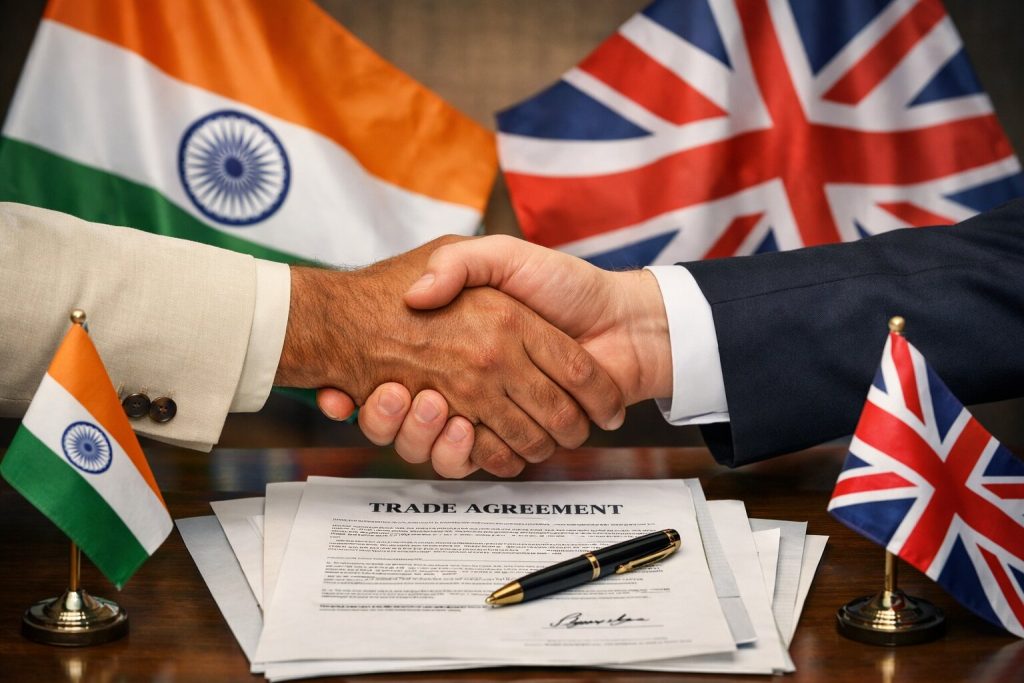
New Delhi: The India-UK Comprehensive Economic and Trade Agreement (CETA) came into force on Wednesday after more than four years negotiations began and almost a year after the deal was signed in London. This deal cuts tariffs on thousands of goods and widen access for services firms and professionals in both countries.
The agreement, described by British officials as the United Kingdom’s most economically significant bilateral trade deal since leaving the European Union, and by Indian officials as the country’s most comprehensive trade pact with a G7 economy, was signed in July, 2025, following 14 rounds of talks. It entered into force alongside a linked “double contribution” convention on social security, after both governments completed their domestic ratification procedures.
Under the pact, Britain will scrap duties immediately on 96.8% of its tariff lines, covering 97.7% of trade value with India. This gives Indian exporters immediate duty-free access to most British tariff lines, benefiting labour-intensive sectors such as textiles, leather, footwear, marine products, gems and jewellery, and processed foods, where British tariffs had previously ranged between 4% and 20%.
India, for its part, will remove duties at once on 64.1% of its tariff lines and phase out tariffs on a further 21% over time, while keeping a set of sensitive products, including sugar, milled rice, pork, chicken and eggs, outside the agreement’s scope. British exporters stand to gain from calibrated openings in automobiles and alcoholic beverages: passenger vehicle imports will operate under a phased quota system allowing 37,000 fully built units annually at preferential tariffs, while the import duty on Scotch whisky drops immediately from 150% to 75%, with further staged cuts to 40% over the following decade, a change industry estimates could lift British beverage exports to India by close to 180%.
Trade in services, which forms a substantial share of the relationship, was also addressed. The agreement expands market access across 137 sub-sectors, including information technology, business services, telecommunications, finance and education, and eases the temporary entry of business visitors, intra-company transferees, investors and independent professionals. Under the accompanying double-contribution convention, eligible Indian professionals on temporary assignment in Britain will be exempt from British National Insurance contributions for stays of up to five years, a provision expected to benefit roughly 75,000 workers and more than 900 employers.
The trade minister, Piyush Goyal, said the agreement opened new avenues for trade, investment and innovation, and would create opportunities for Indian businesses across sectors. The pact also introduces India’s first comprehensive government procurement chapter in a trade agreement, allowing British suppliers to bid for Indian central government contracts worth an estimated £38 billion a year, while Indian suppliers gain reciprocal access to Britain’s roughly £90 billion procurement market.
According to figures from the trade ministry, India exported $13.44 billion worth of goods to Britain in 2025-26 against imports of $11.68 billion, while bilateral services trade stood at $35.44 billion in 2024, leaving India with a services surplus of close to $7.9 billion. The British government has projected that the agreement will raise bilateral trade by £25.5 billion a year in the long run, lifting British GDP by £4.8 billion and India’s by £5.1 billion annually.
Beyond tariffs, the agreement sets a 48-hour customs clearance target for most goods, with priority given to perishables, alongside a shift towards electronic documentation and expedited treatment for traders enrolled under the “Authorized Economic Operator” scheme. Businesses on both sides seeking preferential rates must, however, satisfy the agreement’s rules of origin requirements, meaning goods will need to be genuinely produced or substantially transformed in the exporting country, with British exporters required to register with Britain’s revenue and customs to self-certify origin declarations.
For India, the CETA marks a rare instance of an advanced western economy agreeing to open its market on Indian terms on textiles, leather and marine exports from the outset, even as Indian tariff reductions on automobiles and spirits are staggered over a decade. This sequencing reflects New Delhi’s traditional caution in protecting politically sensitive domestic industries while still committing, for the first time, to a full-fledged government procurement chapter with a G7 partner.