


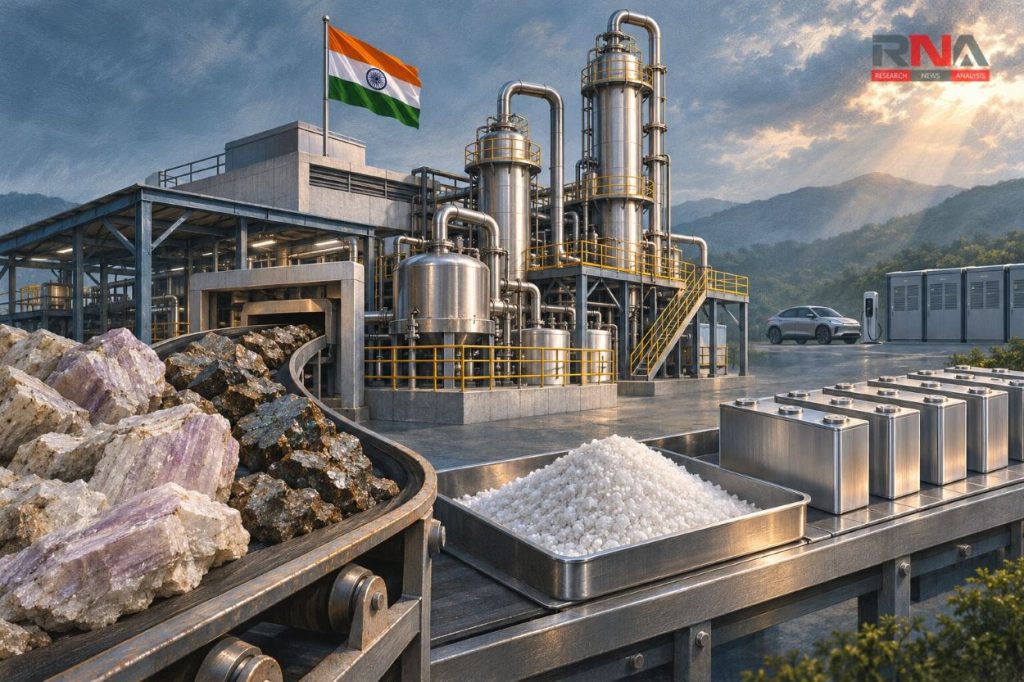
New Delhi: The Union Cabinet on Wednesday approved a ₹2,814 crore scheme to expand domestic processing of critical minerals, targeting a crucial stage in the supply chain for batteries and advanced manufacturing. The five-year programme will support lithium and nickel processing facilities, seeking to reduce dependence on imported processed materials and retain more industrial value within India.
The information and broadcasting minister, Ashwini Vaishnaw, announced the decision following the cabinet meeting chaired by the prime minister, Narendra Modi. The programme will run from the financial year 2026–27 to 2030–31, providing capital support for facilities that turn mineral inputs into materials suitable for manufacturing.
According to the Ministry of Mines’ announcement, the government will subsidize 30 per cent of eligible investment in four plants – two for lithium and two for nickel. Each lithium facility must have a minimum capacity of 30,000 tonnes, while each nickel facility must have a minimum capacity of 50,000 tonnes.
The scheme specifically targets the conversion of lithium and nickel ores, or intermediate products, into high-purity compounds. Its focus is therefore the processing stage between extracting minerals and using them in finished industrial products, a distinction that is central to understanding what the investment is intended to achieve.
Ahead of the approval, the proposed subsidy ceilings were ₹500 crore for each lithium beneficiary and ₹900 crore for each nickel beneficiary. Those figures were reported as part of the proposal before the cabinet meeting, rather than as separately verified final implementation conditions.
The newspaper also reported that cobalt was expected to be recovered as a by-product of nickel processing. The proposed facilities were envisaged as suppliers to industries including electric mobility, battery energy storage, electronics, defence and speciality steel.
The announcement follows months of work on incentives for domestic refining, with the mines secretary, Keshav Chandra, previously indicating that a substantial lithium and nickel programme was being prepared. In September, he described the intended intervention as addressing the gap between support for mineral recycling and the processing of freshly mined material into higher-value products.
For India, the underlying issue extends beyond securing access to mineral deposits: manufacturers also need dependable supplies of processed materials of the required quality. Developing that conversion capability is an important part of strengthening domestic battery and electric vehicle supply chains.
The wider international concern is the concentration of mineral supply chains and the growing use of trade restrictions, both highlighted in the International Energy Agency’s Global Critical Minerals Outlook 2026. The agency says governments are increasingly treating diversification and security of supply as economic and national security priorities, alongside the question of whether enough minerals are available.
India’s processing push also includes a separate programme supporting mineral-processing parks in Andhra Pradesh, Gujarat, Odisha and Maharashtra, with ₹500 crore earmarked for that initiative. These parks form part of the broader effort to bring processing infrastructure and associated industries together; they should not be read as a confirmed allocation of the four plants covered by the new subsidy scheme.
Chandra’s earlier account of the parks’ intended specializations placed lithium in Maharashtra and nickel in Odisha, with Gujarat and Andhra Pradesh pursuing rare-earth-related activities. He said Odisha’s mineral resources and eastern coastal location could support the processing of nickel imported from countries such as Indonesia, illustrating how domestic refining can develop alongside overseas sourcing.
The policy framework behind these measures is the National Critical Mineral Mission, approved on January 29, 2025. It envisaged ₹16,300 crore in expenditure and an additional ₹18,000 crore in expected investment from public sector undertakings and other participants, covering exploration, mining, processing and recovery from products at the end of their useful lives.
The mission also encourages Indian companies to acquire mineral assets overseas, expand trade with resource-rich countries and develop domestic stockpiles. Its scope reflects the need to address several different vulnerabilities – access to resources, processing capability and continuity of supply – across the same industrial chain.
A complementary ₹1,500 crore recycling incentive scheme, approved on September 3, 2025, supports the recovery of critical minerals from electronic waste, spent lithium-ion batteries and other scrap. Running through 2030–31, it combines capital and operating incentives and supports actual mineral extraction rather than only the production of partially processed battery waste.
The government’s rationale for recycling is that exploration, mine development and overseas acquisitions take time to deliver usable supplies. The new processing subsidy adds another part of that response, but its practical contribution will emerge as plants are established and begin supplying manufacturers with the high-purity materials the programme is designed to produce.