


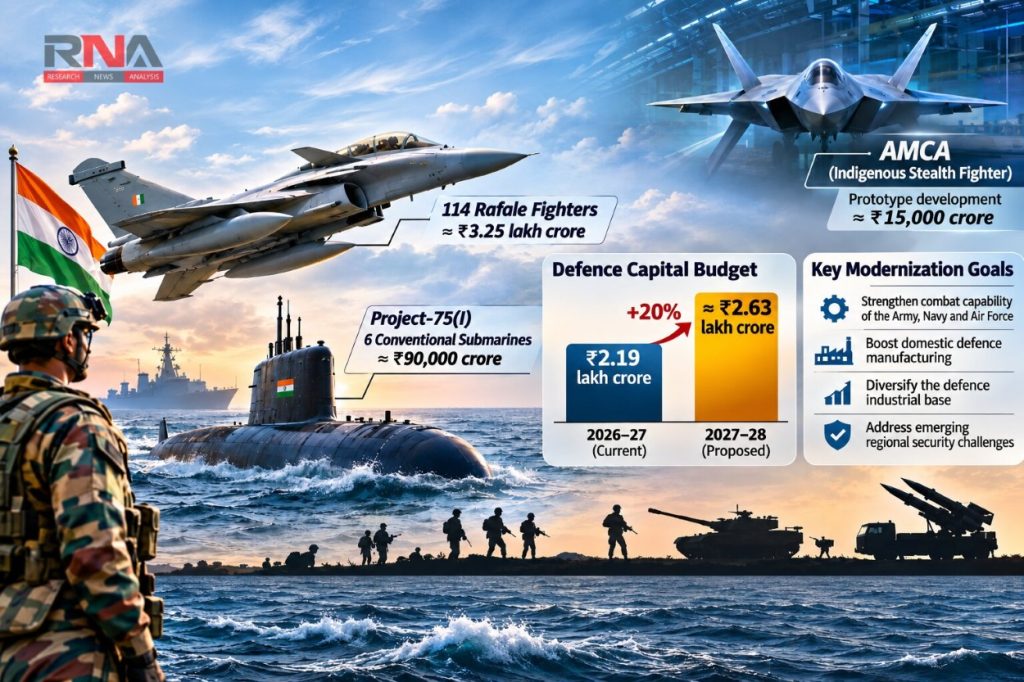
New Delhi: India’s defence ministry has sought a 20 per cent increase in capital expenditure for 2027–28 as it prepares for some of the largest military procurement contracts in the country’s history, including 114 French Rafale fighter jets and six German-designed conventional submarines. The proposal reflects New Delhi’s growing emphasis on accelerating military modernization, strengthening domestic defence manufacturing and addressing critical capability gaps in the armed forces at a time of mounting regional security challenges.
The request was disclosed by the defence secretary, Rajesh Kumar Singh, during a curtain-raiser event for the Federation of Indian Chambers of Commerce and Industry (Ficci) annual general meeting in New Delhi on November 18. Singh expressed confidence that the finance ministry would approve the proposed increase, which would follow the nearly 22 per cent rise in capital allocations provided in the current financial year.
The 2026–27 defence budget allocated approximately ₹2.19 lakh crore for capital expenditure, representing a 21.84 per cent increase over the previous year’s budget estimates. A further 20 per cent increase would raise the allocation to approximately ₹2.63 lakh crore, providing an additional ₹43,861 crore for military modernization, equipment acquisition and infrastructure development.
Singh indicated that substantially higher capital spending would be necessary to sustain India’s long-term military modernization plans, particularly as the government moves towards awarding several expensive contracts. He said he had presented projections envisaging annual capital expenditure growth of around 30 per cent to the Finance Commission, although the ministry’s immediate request was for a 20 per cent increase.
The emphasis on capital expenditure rather than recurring expenses is significant because defence spending also covers salaries, pensions, maintenance and operational requirements. Singh argued that these commitments would continue to receive funding, making increased investment in new equipment and military capabilities the more pressing requirement.
Rafale and submarine purchases drive spending requirements
The most expensive acquisition under consideration is the proposed purchase of 114 Rafale multirole fighters from France, estimated at approximately ₹3.25 lakh crore. The procurement is intended to strengthen the Indian Air Force’s combat fleet as ageing aircraft are retired faster than indigenous replacement programmes can deliver new fighters.
France has already submitted its technical and commercial proposal for the acquisition, as RNA Media reported. The proposed arrangement envisages substantial manufacturing in India, although negotiations on pricing, technology transfer, indigenous content and contractual conditions remain crucial before a final agreement can be concluded.
Another major expenditure involves Project-75(I), under which the Indian Navy plans to acquire six advanced diesel-electric attack submarines through a partnership involving Mazagon Dock Shipbuilders Limited and Germany’s Thyssenkrupp Marine Systems. Recent estimates place the proposed acquisition at approximately ₹90,000 crore, although earlier project assessments were lower and the final contractual value remains subject to approval and negotiation.
The programme assumes particular importance because India’s conventional submarine fleet faces a gradual reduction as older vessels approach retirement. As RNA Media highlighted in an earlier report, the potential withdrawal of additional Kilo-class submarines could worsen the Navy’s underwater capability gap before replacement vessels become operational.
Together, the estimated values of the Rafale and Project-75(I) programmes exceed ₹4 lakh crore, considerably more than a single year’s defence capital allocation. However, these contracts would involve payments spread across several years, meaning their total announced values should not be confused with the immediate budgetary requirements for 2027–28.
Indigenous stealth fighter programme approaches key decision
The higher spending proposal also comes as the government prepares to select an industrial partner for the advanced medium combat aircraft (AMCA), India’s indigenous fifth-generation stealth fighter programme. Singh indicated that the selection process for the approximately ₹15,000 crore prototype development project could be completed within a month, potentially clearing a major administrative hurdle.
Three contenders remain in the competition – Tata Advanced Systems, a consortium comprising Larsen & Toubro, Bharat Electronics and Dynamatic Technologies, and another grouping Bharat Forge, BEML and Data Patterns. As RNA Media had reported on the AMCA competition, the selection will determine which industrial grouping partners with the Aeronautical Development Agency to manufacture and test the aircraft’s prototypes.
The AMCA programme represents a strategic investment in India’s future aerospace capabilities, particularly as China expands its fifth-generation fighter fleet. However, developing the aircraft, securing a suitable engine, completing flight trials and establishing production facilities will require sustained funding and technical progress over several years.
Defence manufacturing and budgetary pressures
India’s total defence allocation for 2026–27 stands at approximately ₹7.85 lakh crore, accounting for 14.67 per cent of central government expenditure. Of this, around ₹1.85 lakh crore was earmarked for capital acquisitions, with approximately 75 per cent of that procurement allocation reserved for domestic defence industries.
At the Ficci event, Singh outlined the government’s ambition to create a more diversified defence manufacturing industry, with two or three major military aircraft producers, several missile and ammunition manufacturers, and hundreds of specialized technology companies. The objective is to expand competition, increase manufacturing capacity and reduce excessive dependence on a limited number of suppliers, according to Ficci’s official account of the discussions.
The proposed expenditure increase would nevertheless require careful management of competing fiscal priorities, particularly as major acquisitions generate long-term payment obligations. The challenge is not simply securing larger allocations but ensuring that procurement decisions, manufacturing schedules and contractual payments are synchronized to prevent delays and avoid underutilization of available funds.
India has already demonstrated an improved capacity to utilize defence allocations, with the ministry reporting that it fully spent its revised capital outlay of approximately ₹1.86 lakh crore in 2025–26. A government statement on capital expenditure also recorded overall defence budget utilization of 99.62 per cent during that financial year.
For New Delhi, the proposed 20 per cent increase therefore represents more than another annual adjustment to military expenditure. Its strategic value will ultimately depend on whether higher spending translates into timely deliveries, stronger domestic production capabilities and measurable improvements in the operational readiness of the Army, Navy and Air Force.