


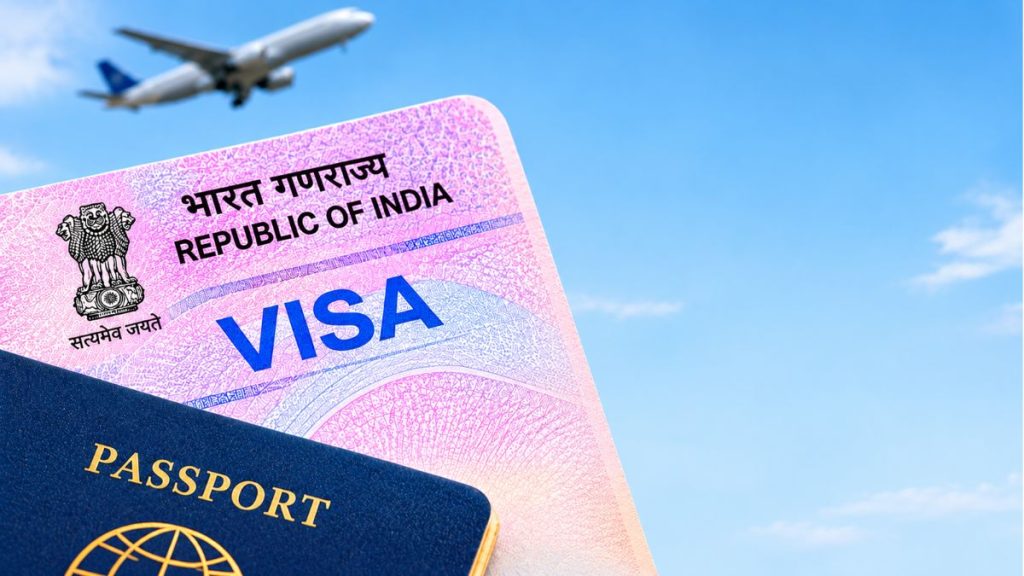
New Delhi: India has reduced its main visa categories from 13 to nine and renamed the tourist visa as the visitor visa, expanding the activities foreign nationals may undertake during short visits. The revised system also cuts visa subcategories from 49 to 23 and reduces application-form fields by 65-70 per cent, although the changes are not yet operational.
The Ministry of Home Affairs announced the overhaul on Wednesday, saying the rationalization was undertaken on August 27. It follows an October 2025 revision that reduced 22 main categories to 13 and 63 sub-categories to 49.
RNA Media had earlier reported that the government was planning to reduce visa application requirements by nearly 70 per cent as part of efforts to simplify entry procedures for foreign nationals.
What changes for visitors?
The new V-1 Visitor Visa permits multiple entries over 30 days, covering tourism alongside business meetings, medical consultations, short-term treatment, wellness retreats and brief courses in Indian languages, music, art and craft. Short-duration yoga programmes are also included, allowing travellers to combine leisure with other permitted activities.
V-2 is intended for longer visits, with validity of one, five or 10 years depending on eligibility and the purpose of travel. It permits V-1 activities and mountaineering, for which a six-month multiple-entry visa is specified. The wider Visitor Visa framework also covers transit, although neither V-1 nor V-2 automatically authorizes employment in India.
What about business, medical and student visas?
Business visas are being reorganized into B-1 for long-term, licence-based activities such as establishing commercial ventures, and B-2 for shorter assignments involving conferences, sporting events, cultural performances and film production. B-2 also covers eligible foreign technical specialists undertaking industrial installation, commissioning, quality checks, IT and ERP implementation, supply-chain development, maintenance, training and technology transfer under the production investment business visa, replacing the earlier e-B4 designation.
Medical visas distinguish treatment outside Ayush systems (M-1) from Ayush treatment (M-3), with a default validity of one year and multiple entries. Their attendants may receive M-2 and M-4 visas respectively, subject to the applicable conditions.
Student visas are divided into S-1 for school and degree studies and S-2 for research, doctoral programmes, visiting faculty, internships and exchanges. Eligible students enrolled through the study in India portal may receive multiple-entry e-S1 visas for up to five years or their course duration, whichever is shorter.
Nine categories, less paperwork
The nine main categories are Business, Diplomatic, Work, Journalist, Medical, Official, Student, Visitor and Miscellaneous. The final category covers specified dependents, people of Indian origin and their families, certain Afghan nationals and other designated purposes.
The MHA says shorter forms will retain essential information while reducing paperwork across all 23 sub-categories. Fewer fields do not remove eligibility requirements, supporting documents or security checks, and visa approval is not automatic.
The government hopes the changes will encourage tourism, medical travel, international education and business activity. India recorded 9.15 million foreign tourist arrivals in 2025, according to the ministry of tourism figures.
When will the changes take effect?
The government is upgrading its IT systems and expects visas under the revised framework to be issued by the end of 2026. The existing e-visa facility currently covers nationals of 172 countries under 13 sub-categories.
Until the new system becomes operational, foreign nationals should follow the existing application requirements on the official Indian visa online portal. Applicants should not assume that V-1, V-2 or other revised categories are already available for selection.