


New Delhi: India has rejected the newly operationalized Pakistan-China Boundary Joint Commission, saying the mechanism has “no legal basis” and reiterating its position that Islamabad cannot enter into arrangements concerning territories New Delhi says are under Pakistan’s illegal occupation. The rejection followed the commission’s inaugural meeting in Islamabad on Wednesday.
Pakistan and China operationalized the commission as an institutional mechanism for cooperation on border management, joint border surveys, trade flows and people-to-people connectivity. Islamabad described the development as a significant milestone in Pakistan-China relations.
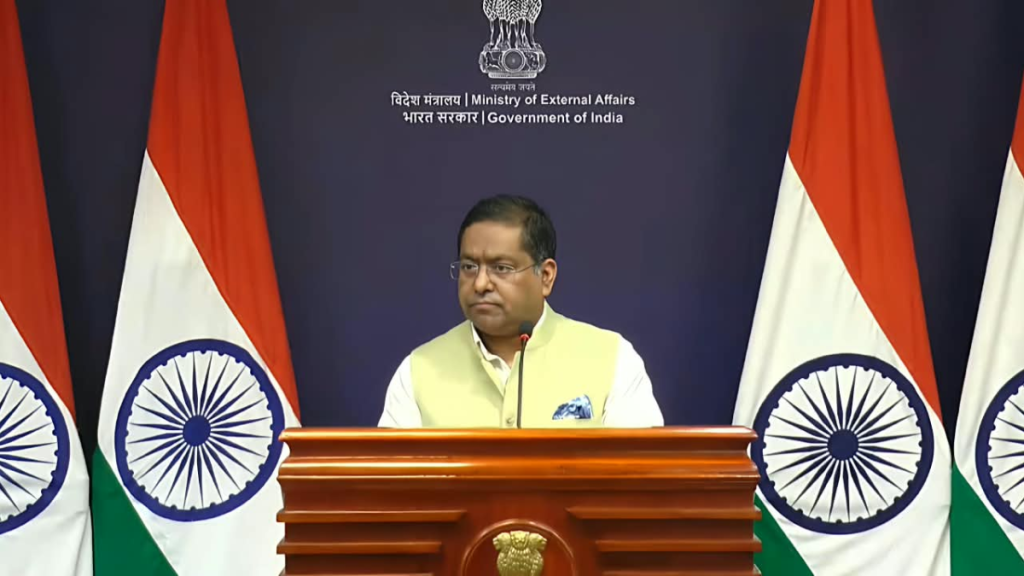
The Ministry of External Affairs spokesman, Randhir Jaiswal, said India’s position on the issue remained “clear and consistent”. “There is no boundary between Pakistan and China. We reject the so-called joint commission, which is without any legal basis,” he said.
Jaiswal reiterated India’s position that the Union territories of Jammu & Kashmir and Ladakh “have been, are and will always remain integral and inalienable parts of India”. He said Pakistan had no locus standi to enter into arrangements concerning territory that New Delhi considers to be under its “illegal and forcible occupation”.
India also reiterated its longstanding rejection of the China-Pakistan boundary agreement signed in 1963. New Delhi has consistently maintained that the agreement is illegal and invalid and that Pakistan had no authority to enter into an arrangement concerning territory claimed by India.
“We have never recognized the so-called ‘China-Pakistan boundary agreement’ of 1963 and have consistently maintained that it is illegal and invalid,” Jaiswal said.
He added that any Pakistan-China boundary cooperation involving territories claimed by India would be “completely unacceptable” and would have no bearing on India’s sovereignty over those territories.
“Instead of engaging in such theatrics, we call on Pakistan to immediately vacate areas under its illegal and forcible occupation,” Jaiswal said.
The inaugural meeting was held at Pakistan’s Ministry of Foreign Affairs in Islamabad and was co-led by Li Ya, deputy director general of the boundary and ocean affairs department in the Chinese foreign ministry, and Bilal Mahmood Chaudhary, director general for China in Pakistan’s foreign ministry. The mechanism is intended to provide an institutional framework for cooperation on practical border-management issues.
Dawn reported that the commission stems from the 2013 agreement on the Boundary Management System signed by Pakistan and China during the visit of then Chinese premier Li Keqiang to Islamabad. Article 45 of the agreement provides for the establishment of a joint commission to oversee implementation of border management arrangements.
The mechanism covers issues including the maintenance and inspection of the boundary, joint surveys, boundary markers, cross-border facilities and the handling of incidents along the border. It is distinct from the Joint Boundary Demarcation Commission established under the 1963 China-Pakistan boundary agreement.
Separate India-China boundary process
The development comes as India and China pursue a separate bilateral process on their boundary question. National security adviser, Ajit Doval and Chinese foreign minister, Wang Yi met in Beijing on August 25 for the 25th round of special representatives talks on the boundary question.
At the meeting, the two sides agreed to continue negotiations towards a framework for settlement of the boundary question and advance discussions through expert mechanisms dealing with boundary delimitation and border management. They also agreed on additional military meeting points and hotline channels aimed at improving management of the line of actual control.
The India-China talks remain separate from the Pakistan-China commission, and neither side’s official account of the August meeting linked the two mechanisms. New Delhi’s objection to the new commission is centred on its longstanding position that Pakistan cannot enter into boundary arrangements concerning territories claimed by India.