


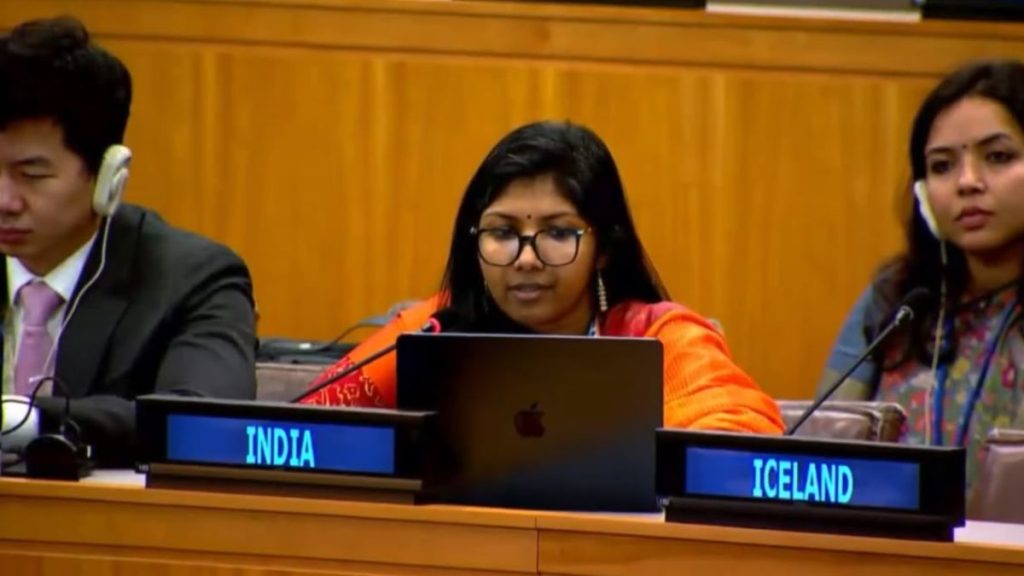
New Delhi: India challenged Pakistan’s criticism of its religious freedom record at the United Nations on Thursday, accusing Islamabad of failing to protect its own minorities. The confrontation unfolded during a discussion on funeral rights, where New Delhi also questioned a UN report’s approach to terrorism and religious discrimination during the Covid-19 pandemic.
Bhavika Mangalanandan, first secretary at India’s permanent mission to the UN, delivered the remarks during an interactive dialogue with the special rapporteur on freedom of religion or belief, Nazila Ghanea, at the UN general assembly’s third committee.
Pakistan’s representative had earlier alleged that families in Jammu & Kashmir were denied customary funeral rites following security operations.India’s permanent mission subsequently highlighted Mangalanandan’s remarks in an official post on X, drawing attention to her criticism of Pakistan’s minority-rights record, the UN report and the handling of Pakistani soldiers’ bodies during the 1999 Kargil conflict.
India questions UN report, raises rights of terror victims
Mangalanandan questioned why the report, freedom of religion or belief and funeral rights in exceptional circumstances, appeared to concentrate on discriminatory practices in the global south during Covid-19 while overlooking comparable experiences in developed countries.
She also challenged its discussion of restrictions on funeral rights in counter-terrorism operations.
“Burial rights for terrorists are being justified by indicating that states may restrict funeral rights of terrorists, but only within legal limits. Legal limits should be determined in accordance with the principles of sovereign rights. A terrorist not only kills innocent people but damages the psyche of a nation.”
She continued: “We are surprised that the fervent advocacy for the rights of terrorists, who violate the most sacred right of humans, the right to life, does not similarly extend to the victims of terrorism.”
“The report goes back half a decade to find references to my country. It fails when it comes to grave violations committed recently in our region and in the developed world,” she added. The UN report examines funeral rights during armed conflicts, security operations and public emergencies. It maintains that restrictions must satisfy legal requirements, including necessity, proportionality and non-discrimination.
Kargil burials and Pakistan’s minority rights
Invoking the 1999 Kargil conflict, Mangalanandan questioned Pakistan’s criticism of India’s treatment of the dead.
“It is deeply ironic that a state that did not even accept the bodies of its own soldiers who were killed in combat in 1999 in Kargil, unabashedly speaks with fervor on faith, religious freedom, and burials. Let me remind them, it was the Indian Army who buried a number of Pakistani soldiers with military honors and in accordance with Islamic rites.”
Contemporary reporting confirms that Indian troops conducted Islamic burial ceremonies for Pakistani soldiers during the conflict, although some remains were subsequently repatriated.
Mangalanandan also criticized Pakistan’s repeated references to Jammu & Kashmir, urging Islamabad to focus on developments in territories under its control.
“Pakistan’s deep obsession with what is happening in the Indian union territory of Jammu & Kashmir should be actually directed at the developments that are underway in the parts of Jammu & Kashmir under its illegal occupation, such as Rawalakot,” she said.
“In Pakistan, a number of minorities are shrinking, their rights regularly abused. A state that cannot ensure the safety of its own minorities has no standing to lecture India,” she said.
Her criticism comes amid concerns over alleged forced conversions, abductions and marriages involving girls from religious minority communities in Pakistan, particularly Sindh. UN human rights experts have separately warned that coercion and inadequate legal safeguards contribute to forced conversions through marriage, particularly among Hindu and Christian communities, emphasizing that religious conversion must be voluntary and that child marriage undermines meaningful consent under international law.
The exchange highlighted continuing disagreements between India and Pakistan at the UN over religious freedom, counterterrorism and the protection of minority communities.