


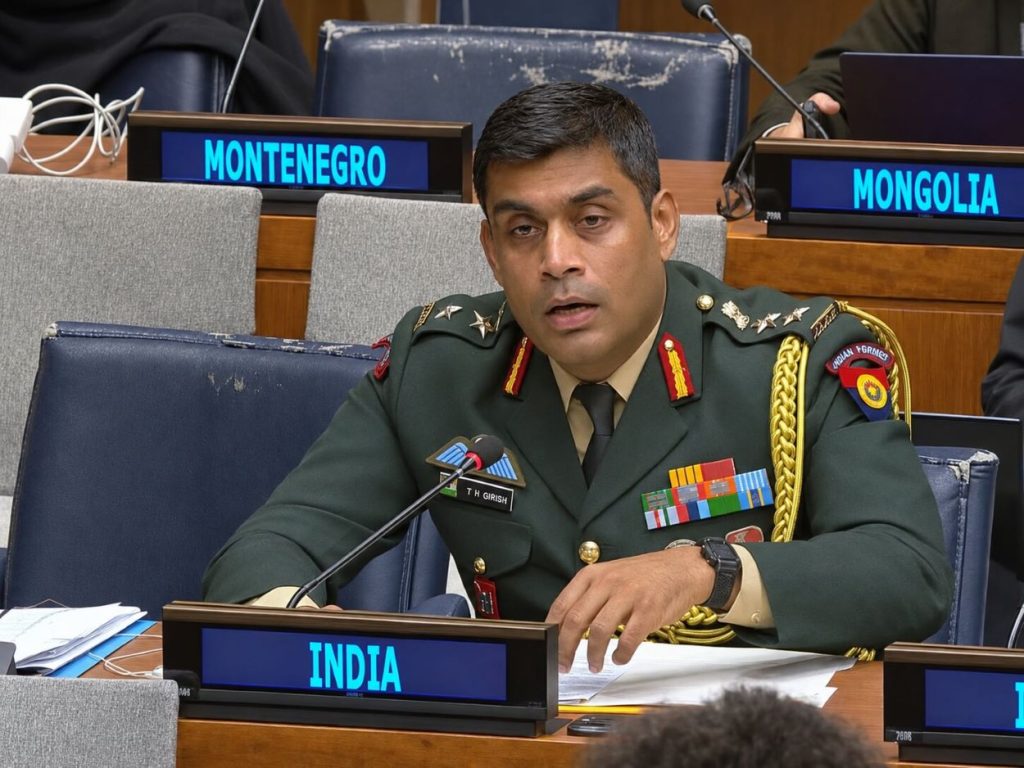
New Delhi: India has called for sweeping improvements in United Nations peacekeeping operations, demanding stronger protection for deployed personnel, adequate funding and greater participation by troop-contributing countries in decisions governing international missions. The appeal comes as UN peace operations face mounting financial pressures and increasingly sophisticated security threats, raising concerns over their ability to protect civilians and maintain stability in conflict-affected regions.
Addressing the UN general assembly’s annual debate on peacekeeping operations in New York on Thursday, Colonel Tarunendra Pratap Singh, military adviser at India’s permanent mission to the world body, argued that peacekeepers must be provided with the capabilities and resources necessary to carry out their responsibilities. He emphasized that countries supplying military and police personnel should have a meaningful role in formulating operational mandates, rather than merely implementing decisions taken by the UN security council.
Col Singh underlined India’s extensive involvement in international peacekeeping, pointing out that the country has contributed more than 300,000 personnel to approximately 50 UN missions over seven decades. He paid tribute to the 184 Indian peacekeepers who have died while serving under the UN flag, saying their sacrifices demonstrated the country’s enduring commitment to international peace and security.
India’s intervention also comes as New Delhi prepares to seek election as a non-permanent member of the UN security council for the 2028–29 term, with strengthening peacekeeping identified as a central priority of its candidature. The government formally launched its campaign in July this year when the external affairs minister, S Jaishankar, highlighted India’s peacekeeping record and argued for a more representative and effective multilateral system.
Greater responsibility, adequate resources
A central argument in India’s presentation was that peacekeeping missions cannot succeed through military deployments alone, particularly when their political objectives remain uncertain or their resources are insufficient. Col Singh maintained that operations should be linked to viable political processes, supported by clearly defined objectives and equipped with the personnel, technology and logistical capabilities required to achieve them.
The concerns reflect a broader crisis confronting UN peacekeeping, with funding shortfalls affecting deployments, patrols and civilian protection activities across several missions. In an October assessment, the UN warned that unprecedented financial pressures were forcing missions to reconsider their operations even as conflicts became more complex.
India also questioned the practice of maintaining missions without a sufficiently clear operational justification or realistic prospects of political progress. Col Singh argued that such deployments could absorb resources needed elsewhere, weakening the credibility of peacekeeping and making it essential to periodically review mandates in consultation with host governments.
Protecting peacekeepers from emerging threats
The safety of peacekeeping personnel emerged as another major concern, particularly as armed groups increasingly employ asymmetric tactics and advanced technologies in conflict zones. Col Singh called for stronger accountability mechanisms to ensure that attacks against UN personnel are investigated and perpetrators brought to justice.
He referred to UNSC Resolution 2589, adopted during India’s presidency of the council in August 2021, which addresses accountability for crimes against peacekeepers. The initiative remains an important element of India’s diplomatic efforts to strengthen the protection of personnel operating in dangerous environments.
India additionally advocated wider adoption of modern technologies and renewable energy systems to improve operational efficiency and reduce vulnerabilities. Col Singh highlighted New Delhi’s support for the UN’s Unite Aware platform, which integrates incident reporting, patrol monitoring, geographical information and data analysis to improve situational awareness and field-level decision-making.
Women peacekeepers and India’s expanding role
India also emphasized the importance of women in peacekeeping, recalling its pioneering deployment of the world’s first all-female formed police unit to Liberia in 2007. The contingent became a significant example of women’s participation in international security operations, particularly in community engagement, public confidence-building and policing.
According to Col Singh, India currently has 160 women peacekeepers serving in various missions and has deployed female engagement teams alongside its contingents since 2019. These initiatives form part of New Delhi’s broader effort to increase women’s operational participation – an objective also reflected in the permanent mission’s priorities for the UNGA’s 81st session.
India further reaffirmed that the UN special committee on peacekeeping operations, commonly known as C-34, should remain the principal forum for detailed discussions on peacekeeping policy and reform. Col Singh reiterated that successful missions must adhere to the fundamental principles of consent, impartiality and the limited use of force, while adapting to changing security conditions.
New Delhi’s position reflects a wider debate over how UN peacekeeping should evolve when missions face increasingly demanding responsibilities but shrinking financial and operational resources. For India, the immediate priority is to ensure that peacekeepers receive adequate protection and equipment, while the longer-term objective is to give countries providing personnel a stronger voice in shaping the missions they are asked to undertake.