


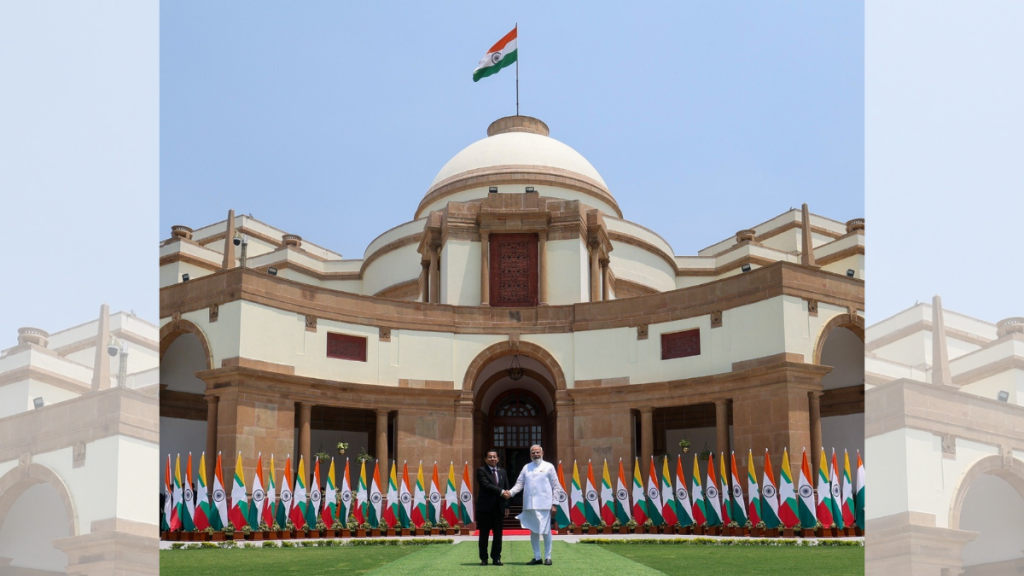
New Delhi: India and Myanmar have agreed to deepen engagement on critical minerals and rare earths, even as the two countries continue cooperation in defence training and United Nations peacekeeping capacity building, the foreign secretary, Vikram Misri, said on Monday.
Misri was briefing the media after the prime minister, Narendra Modi, held summit talks in New Delhi with Myanmar’s president, U Min Aung Hlaing, on Monday. Hlaing is on a four-day visit to India his first foreign trip since assuming the presidency earlier this year.
“Issues related to critical minerals and rare earths did come up during the discussion today. This has been a subject of bilateral discussion for some time. Today as well, there was an understanding that the two governments will continue to stay in touch on these issues and take forward cooperation in these areas,” Misri said.
Myanmar holds significant reserves of rare earth elements and is among the world’s top producers of heavy rare earths, which are critical inputs for defence systems, electric vehicles, and advanced electronics. India, which has been working to reduce dependence on China for such materials, has been looking to diversify its rare earth supply chains – making Myanmar a strategically important partner in this regard.
Defence cooperation
On the defence front, Misri clarified that India’s engagement with Myanmar remains focused on training and institution-building rather than hardware transfers, a distinction that carries weight given the international scrutiny of Myanmar’s military government following the 2021 coup.
“This has been a focus for several years now, and mostly the defence cooperation with Myanmar focuses on training, capacity building, and institution building. A very important part of the training is in the context of UN peacekeeping,” he said.
India has long been one of the largest troop contributors to UN peacekeeping missions and has used this experience to train partner nations’ military personnel – a form of soft-power engagement that keeps bilateral defence ties active without attracting the level of controversy that arms sales might generate.
Stalled connectivity projects
The summit also addressed two long-delayed flagship connectivity projects – the Kaladan Multi-Modal Transit Transport Project and the Kalewa-Yagyi segment of the India-Myanmar-Thailand Trilateral Highway – both of which remain incomplete, largely due to deteriorating security conditions inside Myanmar.
“These projects have been underway for several years, and they have been delayed in most cases, and certainly, right now, the obstacle that faces both of these projects is the security situation in Myanmar,” Misri acknowledged.
The Kaladan project, which aims to link India’s landlocked north-eastern states to the sea through Myanmar’s Sittwe port, has been in development for over a decade. Its completion is considered vital for India’s Act East policy and for reducing the region’s economic isolation. The trilateral highway, once operational, is expected to open overland trade routes connecting India to Southeast Asia through Myanmar and Thailand.
Trade and economy
Bilateral trade between the two countries stands at just over $2 billion, with India’s exports at slightly over $600 million and Myanmar’s exports to India at slightly over $1.5 billion. Misri said the focus going forward would be on technology, energy, and infrastructure cooperation.
Both sides also expressed interest in advancing ties in health, education, artificial intelligence, and the space sector, according to Misri. The Ministry of External Affairs said Modi and Hlaing agreed to advance cooperation for peace, progress, and prosperity – covering trade, investment, connectivity, development partnership, security, and border management.
Modi also expressed India’s readiness to support peace and dialogue in Myanmar, including sharing experiences on federal governance and economic development – a signal that New Delhi is attempting to engage Naypyidaw on political stabilization without directly intervening in its internal affairs.
Hlaing was accompanied by a senior ministerial delegation covering foreign affairs, finance, agriculture, industry, and the central bank, as well as a business delegation from sectors including agriculture, pharmaceuticals, energy, banking, construction, IT, and logistics. Members of the Myanmar-India Friendship Association were also part of the visiting group.
Misri noted that Hlaing extended an invitation to Modi to visit Naypyidaw, though no date was announced.