


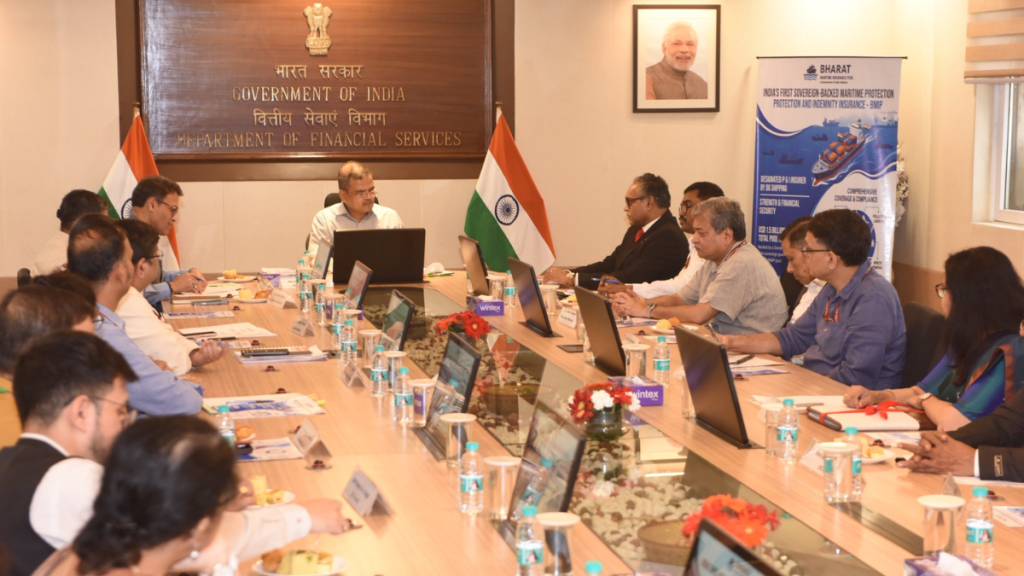
New Delhi: India has launched a sovereign-backed protection and indemnity (P&I) insurance facility under the Bharat Maritime Insurance Pool (BMIP), strengthening financial protection for Indian shipping companies amid heightened geopolitical and war-related risks in West Asia. The move comes as commercial shipping faces growing uncertainty in the Persian Gulf and Strait of Hormuz, with 10 Indian seafarers among 16 Indian nationals killed in the conflict.
Sovereign-backed cover for Indian shipping
The Department of Financial Services has launched the new P&I facility to ensure that Indian shipping companies continue to have access to essential insurance cover as international insurers face growing pressure from the conflict.
P&I insurance protects shipowners and operators against liabilities arising from vessel operations, including claims involving crew, third parties and other maritime obligations. The facility is intended to provide continued coverage as commercial vessels operate in an increasingly volatile security environment.
The BMIP, launched earlier this year, provides a combined indemnity capacity of up to $1.5 billion. The pool was set up to support the maintenance of maritime insurance capacity and to support Indian shipping companies facing disruptions and heightened risks caused by the Middle East crisis.
Shipping exposed to rising regional risks
The insurance move is particularly relevant as the conflict has increased the risks to vessels operating in or transiting the Persian Gulf region, Red Sea and Black Sea. Disruptions in the region have raised concerns about vessel safety, crew security and the free flow of cargo and energy supplies.
For India, which has a large seafaring workforce employed on international shipping routes, maintaining access to insurance has become an important part of protecting the country’s maritime trade and shipping operations.
10 Indian seafarers among 16 deaths
The wider risks facing Indians in the region are also reflected in the casualties reported since the outbreak of the conflict. According to the government, 16 Indian nationals have died and 75 have been injured across West Asia.
Ten of those killed were Indian seafarers, underlining the particular exposure of maritime crews operating in waters affected by the conflict. The deaths have been reported across Oman, the UAE, Kuwait, Iran and Saudi Arabia, with eight fatalities in Oman, four in the UAE, two in Kuwait and one each in Iran and Saudi Arabia.
However, the seafarers’ losses also bring a human factor into play in relation to the larger disruption that affects the industry, whereby seafarers continue to be at risk of war despite their ships being far from the actual battlefront.
Insurance to cushion war-related liabilities
The government-backed P&I mechanism is designed to ensure that Indian shipping companies do not lose access to critical insurance protection as geopolitical tensions disrupt conventional maritime insurance arrangements.
While the facility cannot eliminate the security risks faced by ships and their crews, it provides financial protection against liabilities at a time when insurers and shipping operators are dealing with heightened war-related exposure.
The government has also said it is coordinating with host countries and extending assistance to the families of Indians who have died in the conflict. The deaths of the 10 seafarers underline why protecting both the financial resilience of Indian shipping and the safety of its workforce has become increasingly important amid the continuing crisis in West Asia.