


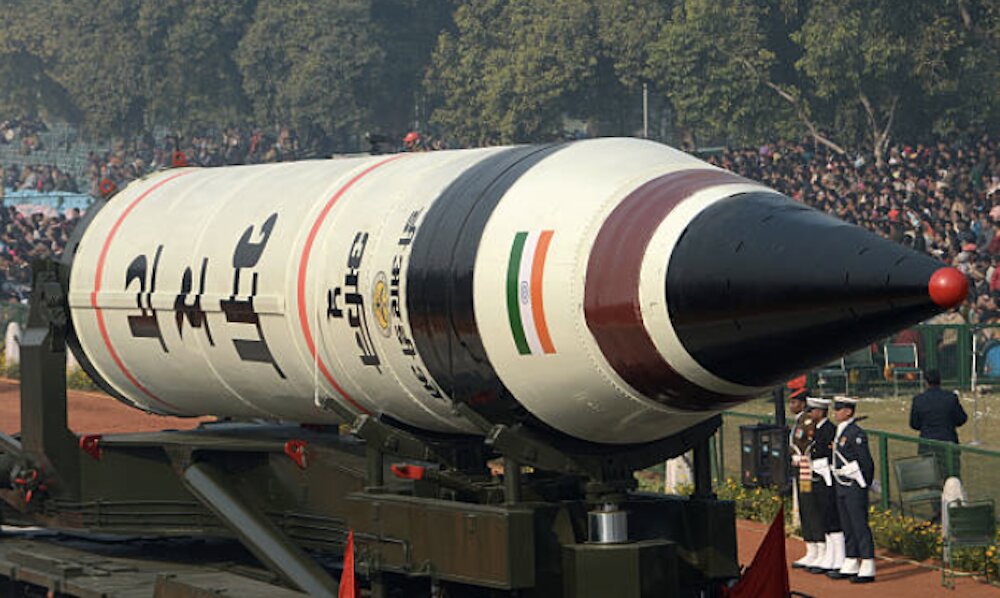
New Delhi: For the first time in its history as a nuclear-armed state, an authoritative body has said that India has operationally deployed nuclear warheads on active delivery systems during peacetime. This assessment with a figure by Stockholm International Peace Research Institute (Sipri) challenges India’s decades-long official nuclear posture.
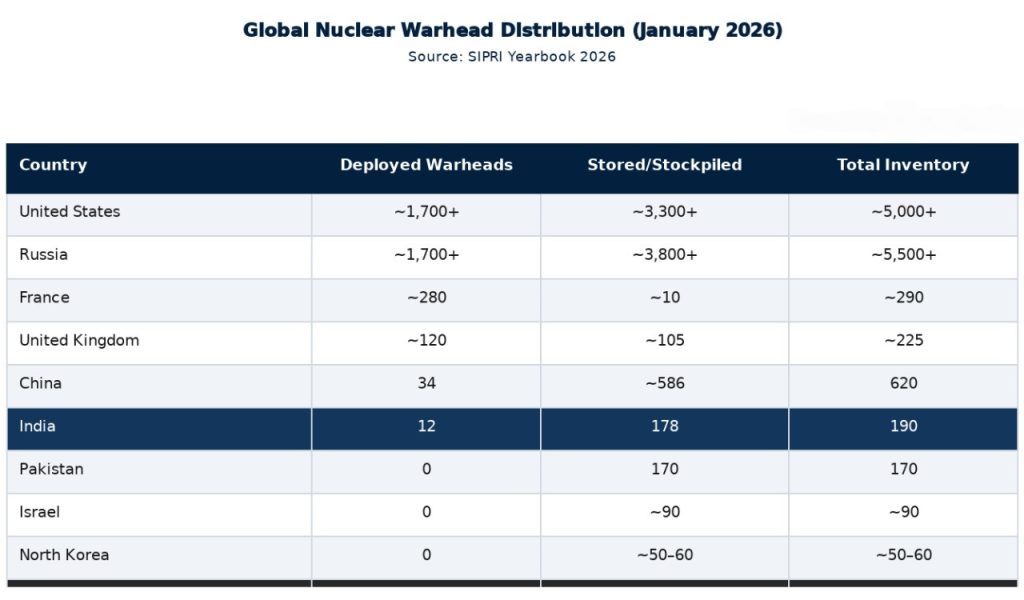
According to the Sipri Yearbook 2026, India now has 12 warheads in a deployed state out of a total inventory of 190.
What ‘deployed’ means
Sipri defines “deployed warheads” as those already mounted on active missiles or located at bases with operational forces for immediate or near-immediate use. Warheads that are kept in central storage or are awaiting dismantling are counted separately and are not classified as deployed. This distinction is significant: for years, India maintained a strict peacetime practice of keeping all its nuclear warheads de-mated – that is, physically separated from their delivery systems.
The 12 deployed warheads now recorded against India represent a departure from that practice.
India’s nuclear inventory
As of January 2026, India holds a total of 190 nuclear warheads, of which 12 are deployed and 178 remain in storage. This places India ahead of Pakistan, which has a total inventory of 170 warheads but zero deployed operationally, and ahead of Israel (approximately 90 warheads, none deployed) and North Korea (approximately 50–60 warheads, none deployed).
India’s total warhead count has grown steadily over the past few years, consistent with its continued investment in fissile material production and delivery system development.
Global nuclear warheads (January 2026)

China’s expanding arsenal
As RNA reported earlier citing a Sipri report in June 2025, China’s nuclear expansion is widely regarded as a primary factor shaping India’s strategic planning. According to the Sipri Yearbook 2026, China’s total nuclear arsenal has grown to 620 warheads, with 34 of them now in a deployed state – an increase that reflects Beijing’s active push to expand its peacetime operational readiness.
China’s Dongfeng (DF) series of ballistic missiles, including the intercontinental-range DF-41 and DF-5B, form the core of its land-based nuclear deterrent. The People’s Liberation Army – Rocket Force has been rapidly expanding its silo-based missile infrastructure, with commercial satellite imagery having identified multiple new silo fields across China since 2021. Against this backdrop, India’s decision to place 12 warheads in an operationally deployed state can be read as a calibrated response to a changing threat environment – particularly along its northern border.
India’s nuclear triad
India has built its nuclear deterrence around a triad of land-based ballistic missiles, aircraft-delivered bombs, and submarine-launched ballistic missiles. The land leg is anchored by the Agni series of missiles. The Agni-5, with a range exceeding 5,000 kilometres, is classified by several analysts as an intercontinental ballistic missile (ICBM) and has been tested multiple times. It is capable of covering targets across China. The shorter-range Agni-1 and Agni-2 are oriented towards Pakistan.
India completed its nuclear triad with the induction of INS Arihant-class submarines equipped with K-series submarine-launched ballistic missiles. The triad crossed a significant milestone on April 3, when the country’s third nuclear-powered ballistic missile submarine (SSBN), INS Aridhaman, was quietly commissioned. A fourth boat of the class, INS Arisudan, was launched in May this year and is expected to be commissioned in the coming years.
These submarines provide India with a second-strike capability – the ability to absorb a nuclear first strike and still retaliate – which is central to the credibility of its deterrence posture.
The question of whether any of the 12 deployed warheads are on submarine-launched systems has not been officially confirmed by the Indian government. India does not publicly disclose the specifics of its nuclear deployments.
India’s ‘no first use’ doctrine
India’s nuclear doctrine, formally articulated in 2003 and reaffirmed repeatedly since, is built around three pillars: credible minimum deterrence, a no-first-use (NFU) policy, and massive retaliation against any first nuclear strike. Under this doctrine, the authority to authorize nuclear use rests solely with the Nuclear Command Authority, whose political council is chaired by the prime minister.
India reaffirmed these commitments as recently as October 2025 at a United Nations general assembly meeting marking the international day for the total elimination of nuclear weapons, where its representative stated that India is “a responsible nuclear-weapon state, committed to maintaining credible minimum deterrence with a policy of no-first-use and non-use against non-nuclear-weapon states.”
The operational deployment of 12 warheads does not, by itself, constitute a revision of this doctrine. However, it does signal that India is moving towards a more ready deterrent posture, which analysts say is consistent with the demands of a maturing nuclear triad – particularly with submarines that, by their nature, operate on continuous deterrence patrols.
The global picture
The nine nuclear-armed states together have a combined deployed warhead count of 4,012 out of a global inventory of 12,187, according to the Sipri Yearbook 2026. The United States and Russia together control roughly 86 per cent of all nuclear weapons worldwide, with between 2,100 and 2,200 of their respective deployed warheads kept on high operational alert on ballistic missiles at any given time.
Pakistan, India’s other nuclear-armed neighbour, continues to keep all its 170 warheads in storage with zero deployed, consistent with its historical practice of maintaining weapons in an unassembled state during peacetime. Pakistan’s arsenal is generally oriented towards tactical and short-range deterrence against India, with systems such as the Nasr (Hatf-9) and the Shaheen series of ballistic missiles.
Sipri notes a broader global trend of nuclear-armed states either maintaining or modernizing their arsenals, while the overall number of warheads continues to decline from Cold War-era peaks due to the gradual retirement of ageing weapons, primarily by the US and Russia.
As RNA reported earlier, Sipri, an independent international institute dedicated to research on conflict, armaments, arms control, and disarmament released its 2026 yearbook on Monday. Its nuclear data is among the most cited in global security literature, though it cautions that all figures are estimates based on open-source analysis, given that no nuclear-armed state publishes comprehensive warhead inventories.