


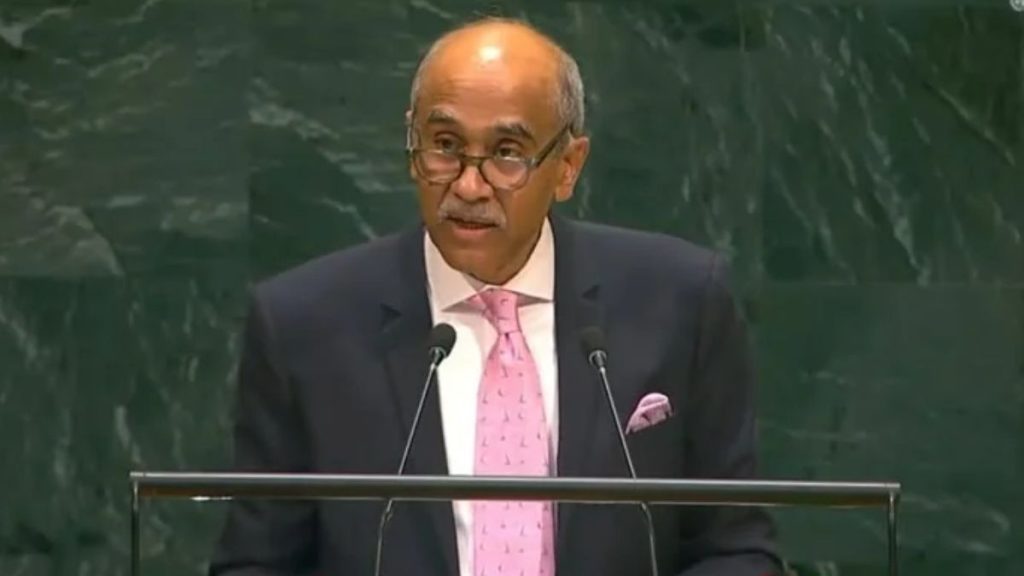
New Delhi: India has called for a comprehensive overhaul of the United Nations security council (UNSC), warning that veto powers must not be used to pursue narrow political interests. The demand places membership expansion, regional representation and decision-making rules alongside efforts to restrain veto use.
Speaking on Monday at a plenary discussion of the intergovernmental negotiations (IGN) on security council reform, India’s permanent representative to the UN, Parvathaneni Harish, urged restraint in using the veto on matters affecting international peace and security. “It should not be an instrument of narrow political expediency,” he said.
“India reiterates its call for a comprehensive approach towards security council reforms. The starting point is early commencement of text-based negotiations with clearly defined timelines and milestones. Addressing the veto in isolation does not change the decision-making dynamic of the P5,” Harish said.
Harish said the veto had been exercised 331 times on approximately 200 resolutions since the UN’s establishment. He noted that two permanent members had not exercised the veto for more than 35 years, while most vetoes or threats to use it had come from the other three. He also questioned the effectiveness of the UN general assembly’s 2022 Veto Initiative, pointing to the continued use of veto powers despite greater scrutiny.
India opposes unequal permanent membership
India reiterated that its position on veto powers aligns with the common African position, under which all permanent members of a reformed security council must enjoy equal rights for as long as the veto exists. Harish opposed creating a new category of permanent membership, with or without veto powers, arguing that such arrangements would complicate negotiations and perpetuate existing inequalities. He also maintained that periodic elections were fundamentally incompatible with the concept of permanent membership.
The 15-member council comprises five permanent members, China, France, Russia, the United Kingdom and the United States, and 10 elected members serving two-year terms. Only the permanent members can veto substantive resolutions.
Harish also highlighted an “effective or de facto veto” exercised through consensus-based procedures in the security council. He said individual members could block presidential statements, press statements and sanctions committee decisions without formally exercising veto powers, often without providing explanations. He argued that addressing the veto in isolation would not change the decision-making dominance of the five permanent members and called for comprehensive reform through text-based negotiations with clearly defined timelines and milestones.
India wants reform to address five linked questions: membership categories, regional representation, council size, working methods and veto powers. Its G4 partners, Brazil, Germany and Japan, also support expanding both permanent and elected membership, including greater representation for Africa, Asia-Pacific and Latin America.
Competing models and difficult hurdles
The uniting for consensus group, which includes Italy and Pakistan, rejects additional permanent seats and supports more elected or longer-term rotating places. In its October 22 statement, it also advocated limiting veto use in mass-atrocity cases while continuing to support its eventual abolition.
Separately, a French-Mexican initiative proposes voluntary veto restraint during mass atrocities. Under a 2022 UN general assembly resolution, a veto ordinarily triggers an assembly debate within 10 working days, but that accountability mechanism does not alter veto rights.
Harish urged negotiations based on a formal text and measurable milestones, warning that demands for consensus had hampered progress. Any charter amendment would need approval from two-thirds of the general assembly and ratification by two-thirds of UN members, including all five permanent council members, leaving fundamental reform dependent on their consent.