


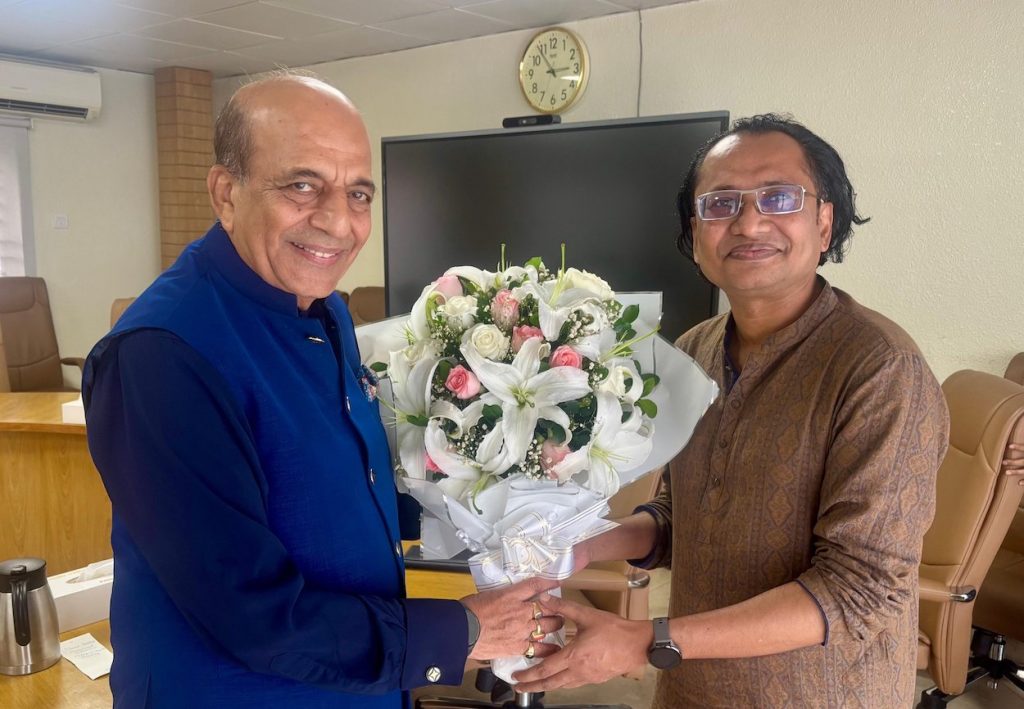
New Delhi: India and Bangladesh have signalled a desire to strengthen people-to-people relations and sustain wider engagement, with the Indian high commissioner to Bangladesh, Dinesh Trivedi, meeting the Bangladesh prime minister’s advisor for policy and strategy, information and broadcasting and cultural affairs, Dr Zahed Ur Rahman, in Dhaka on Sunday. The meeting covered a wide range of issues concerning bilateral relations, with both sides expressing optimism that the two countries would continue working together to deepen ties between their peoples.
The meeting was disclosed by the Indian high commission in Dhaka, which said Trivedi met Rahman on Sunday and discussed a broad spectrum of issues relating to India-Bangladesh relations. The mission said the two dignitaries were optimistic that the two “vibrant democracies” would continue to cooperate to strengthen people-to-people links.
The deliberately broad description of the discussions leaves the specific subjects off the public record, but the engagement is significant against the backdrop of a relationship that has experienced considerable political turbulence over the past two years. New Delhi and Dhaka have continued to maintain diplomatic channels despite differences over several sensitive issues, including the future of former Bangladesh prime minister Sheikh Hasina, who remains in India.
Trivedi’s meeting with Rahman also has significance because the Bangladeshi adviser has been involved in some of the more contentious aspects of the bilateral relationship. Rahman has publicly addressed issues involving India on several occasions, including Dhaka’s position on Hasina and the circumstances surrounding her departure from Bangladesh.
The two sides, however, have also repeatedly acknowledged the practical importance of maintaining a working relationship. Geography, economic interdependence, cross-border connectivity, water resources, trade, security and extensive social and cultural links make sustained engagement between New Delhi and Dhaka difficult to avoid, irrespective of political differences.
The latest meeting therefore appears to underline a pragmatic strand in the relationship – keeping dialogue alive even when some of the larger political questions remain unresolved. The reference to people-to-people relations is particularly relevant because India and Bangladesh share extensive historical, linguistic, cultural and familial connections that extend well beyond the formal diplomatic relationship.
For India, stronger societal links with Bangladesh also form an important part of the broader relationship with its eastern neighbour. Cultural exchanges, educational links, tourism, business contacts and cross-border movement have the potential to create constituencies for a more stable bilateral relationship, provided that political and security concerns are managed through sustained dialogue.
For Dhaka, maintaining constructive engagement with New Delhi remains important for similarly practical reasons. India is Bangladesh’s immediate neighbour on three sides, while the two countries share a long land border, several transboundary rivers and important transport and commercial links.
The latest engagement follows a period of heightened diplomatic activity between the two capitals. In August, Trivedi travelled to New Delhi after meetings with Bangladesh’s prime minister, foreign minister and home minister in Dhaka, and subsequently met the prime minister, Narendra Modi, to discuss ways of strengthening the bilateral relationship.
That outreach suggested that both governments were looking for avenues to prevent political disagreements from overwhelming the wider relationship. The September 13 meeting provides another indication that engagement is continuing at the political and diplomatic levels even as difficult issues remain on the agenda.
Rahman himself has previously argued that Bangladesh’s relationship with India needs to be recalibrated around mutual interests and respect for sovereignty. At the same time, the Bangladesh government has continued to stress the importance of securing its interests through diplomatic engagement rather than allowing disagreements to close channels of communication.
The backdrop is nevertheless complicated. Relations have remained sensitive since the fall of Sheikh Hasina’s government in August 2024, while disagreements over her continued presence in India and Dhaka’s demand for her return have become particularly difficult issues in bilateral diplomacy.
The two countries have also experienced diplomatic friction over Rahman himself. In June, he was subjected to additional checks at Delhi airport before being permitted to enter India, but chose to return to Bangladesh, prompting Dhaka to lodge a formal protest; India subsequently said he had been allowed entry after his travel purpose was verified.
Against that backdrop, a direct meeting between Rahman and the Indian high commissioner carries importance beyond the limited details released publicly. It demonstrates that officials on both sides remain willing to engage despite disagreements that have occasionally spilled into public diplomacy.
The emphasis on people-to-people relations could also prove useful in insulating broader bilateral ties from political fluctuations. India and Bangladesh have accumulated decades of cooperation in areas ranging from trade and connectivity to culture and security, creating a substantial institutional base that can be built upon even when political relations become difficult.
The latest meeting should therefore not be read as evidence that all outstanding differences have been resolved. Rather, it points to an effort by the two sides to preserve communication and identify areas of common interest while more contentious questions continue to be handled through established diplomatic channels.
For New Delhi and Dhaka, the immediate challenge will be to translate such positive signals into sustained engagement. If the emphasis on people-to-people relations is followed by practical initiatives in cultural, educational, commercial and social exchanges, it could provide a relatively less contentious pathway towards stabilising the wider relationship.