


New Delhi: India has voted in favour of a UN general assembly resolution reaffirming the rights of Palestinians and the Arab population of the occupied Syrian Golan over their natural resources. Proposed by Uruguay, the resolution received 151 votes in favour, seven against and 11 abstentions. Separately, India voted against a UN resolution calling for a moratorium on the death penalty.
The Palestine resolution called on Israel to stop exploiting or damaging natural resources in the Occupied Palestinian Territory, including East Jerusalem, and the occupied Syrian Golan. It covered land, water and energy resources.
It also called for an end to activities damaging the environment, including waste dumping, and the destruction of essential infrastructure such as water pipelines, sewage networks and electricity systems. The text further demanded an end to the demolition of Palestinian homes and the confiscation of agricultural land and water wells.
The resolution described Israel’s wall and settlements in the occupied Palestinian territories as contrary to international law. It also called for compliance with the International Court of Justice’s July 2004 advisory opinion and stressed the need for reconstruction and development projects, particularly in Gaza.
Israel and the US were among the seven countries that voted against the resolution.
India defends death penalty, votes against moratorium
India defended its use of capital punishment, saying it is reserved for the “rarest of rare” cases and backed by extensive legal and constitutional safeguards. New Delhi argued that every sovereign state has the right to determine its own laws and criminal justice system.
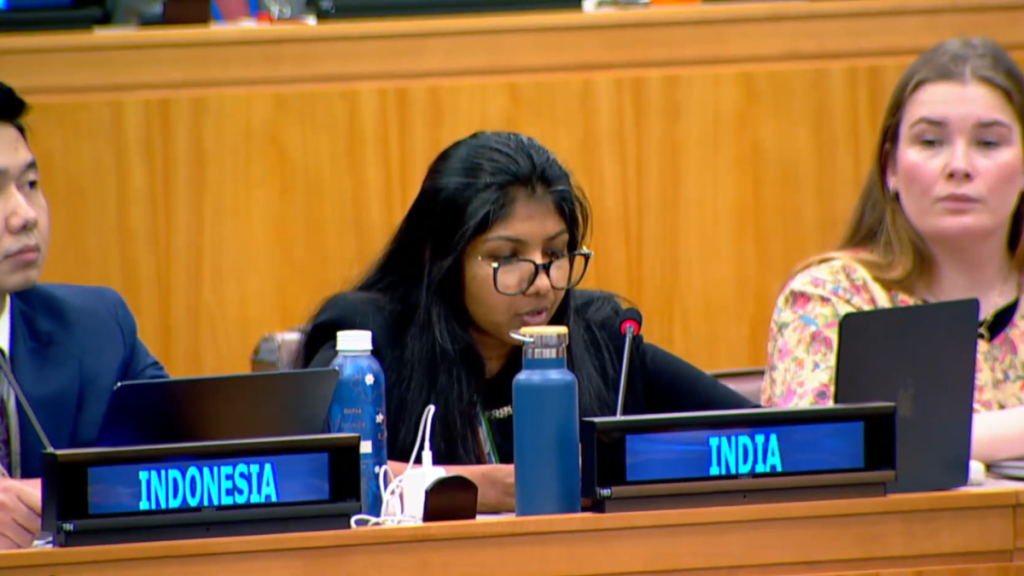
Addressing the UN General Assembly’s Third Committee, India’s first secretary, Bhavika Mangalanandan, said death sentences are imposed only in cases where the crime deeply shocks society’s conscience. She said the country’s judicial framework guarantees a fair trial before an independent judiciary, the presumption of innocence and access to legal representation.
India also highlighted the checks in place before a death sentence can be carried out. Every death sentence requires mandatory confirmation by a higher court, even if the accused does not file an appeal.
The Indian representative said the legal system also considers personal circumstances before deciding whether a death sentence should be commuted to life imprisonment. These include socio-economic conditions, psychological factors and exceptional hardships faced by the accused.
She further pointed to provisions that allow death sentences to be commuted for pregnant women, and said Indian law also prohibits the execution of people with mental disabilities and juvenile offenders.
The representative said Indian courts do not impose mandatory death sentences for all offences, as this would undermine judicial discretion. She also highlighted the constitutional powers of the president and state governors to grant pardons, reprieves, respites and remissions, including the power to suspend or commute death sentences.
India objected to the UN resolution because it called for a halt to executions with the eventual aim of abolishing capital punishment. New Delhi argued that the proposal failed to recognize the sovereignty of individual countries over their domestic laws and criminal justice systems.
“Therefore, India supported the amendment A/C.3/81/L.50 and my delegation has voted against the resolution as a whole as it goes against our statutory law,” Mangalanandan said.
India also objected to part of a separate draft resolution on extrajudicial, summary or arbitrary executions. While supporting action against unlawful killings, it dissociated itself from a paragraph that linked lawful capital punishment with torture and ill-treatment.