


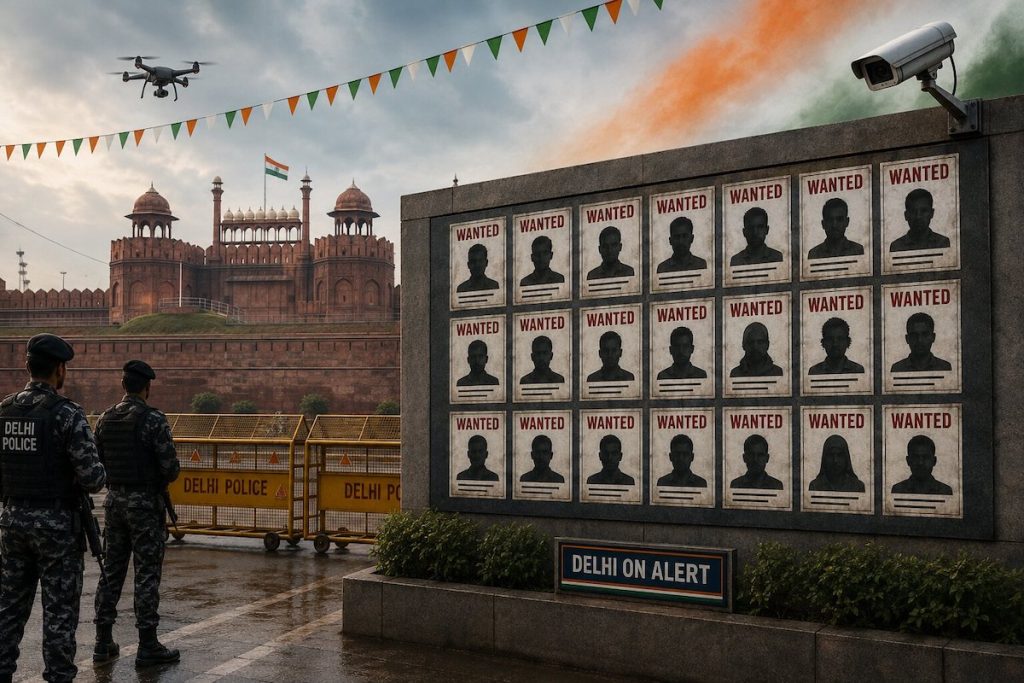
New Delhi: Posters carrying photographs of 19 wanted terrorists linked to Indian Mujahideen, al-Qaida and Khalistani terror networks have been put up across Delhi as security agencies intensify vigilance ahead of Independence Day. The public-awareness exercise is intended to help police identify and track suspects while drawing citizens into the capital’s wider preventive-security effort.
The posters have appeared at several locations as part of security preparations for the August 15 celebrations, when the prime minister will address the nation from the Red Fort. Police said the exercise forms part of the annual Independence Day security drill and is aimed at encouraging people to report information that could help locate wanted individuals.
Security has simultaneously been reinforced at crowded markets, Metro stations, railway stations, bus terminals, government buildings, transport hubs and other sensitive locations. Delhi Police have increased patrolling and vehicle checks, established additional pickets and checkpoints and deployed drones for surveillance as the capital moves into a heightened state of alert.
As RNA Media reported earlier, the Red Fort and its surrounding areas are under a particularly dense security blanket, with an estimated 15,000 to 20,000 Delhi Police and paramilitary personnel expected to be deployed for the main ceremony. Nearly 1,000 CCTV cameras, including units integrated with facial-recognition systems, have been installed in and around the venue, supported by a control room monitoring activity across a radius of more than three kilometres.
Authorities are also carrying out a cybersecurity audit of the surveillance network around the Red Fort to guard against unauthorized access to camera feeds. Security personnel are being positioned on more rooftops than last year, while the area around the monument has been divided into eight zones, each under an officer of deputy commissioner of police rank.
Technology is playing a larger role in the security grid this year, with police using the Abhigyan application to check fingerprints against a database containing records of more than one crore criminals. Facial-recognition vans fitted with high-resolution cameras have also been deployed at strategic locations to scan crowds and alert control rooms when potential matches with wanted or suspicious persons are detected.
Snipers have been stationed at selected elevated positions and anti-drone systems deployed to detect or prevent unauthorized aerial activity near sensitive areas. Restrictions have also been imposed on drone and kite flying around the Red Fort as part of measures designed to prevent breaches from the air.
The wider operation extends well beyond central Delhi, with more than 1,600 police personnel deployed in the southern zone alone and around 60 border, major and minor pickets established there. Officers are conducting integrated checks with traffic police, PCR teams and local police, focusing particularly on suspicious vehicles, parking areas and people with known criminal backgrounds.
Traffic and access controls are also being tightened around the ceremonial zone, while additional personnel have been assigned to monitor entry and exit points into the capital. Police said the emphasis in the remaining days before August 15 would remain on preventive deployment, intensive patrolling and rapid response to suspicious activity.