


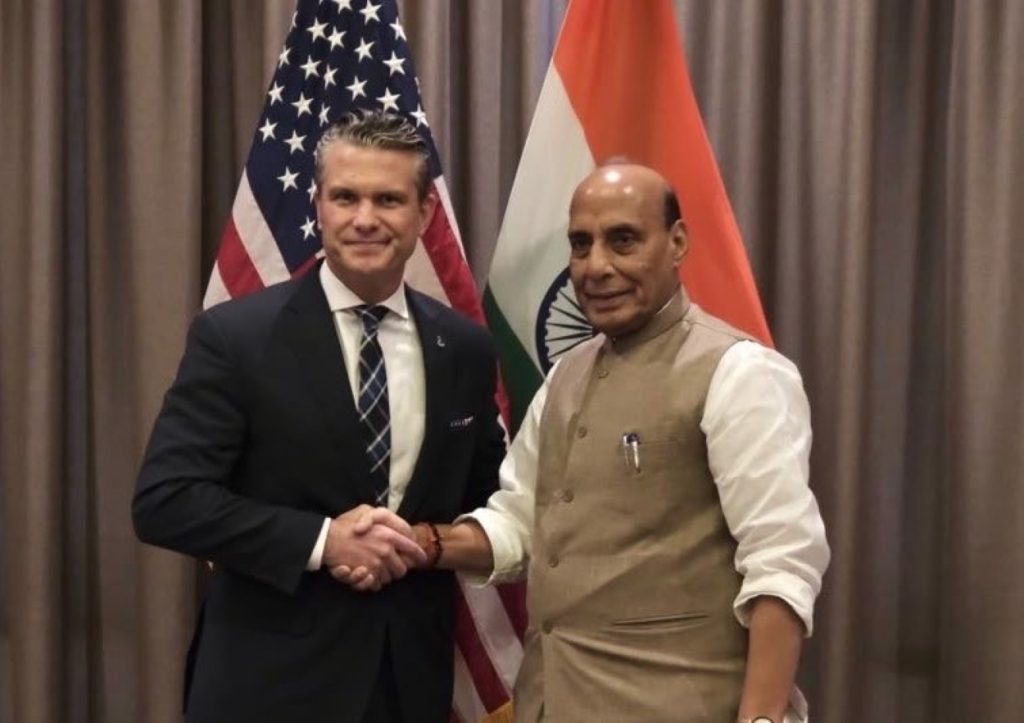
New Delhi: The defence minister, Rajnath Singh, and the US secretary of war, Pete Hegseth, reviewed their countries’ 10-year defence framework in the Philippines on Wednesday, focusing on military technology, information sharing and co-production. Their meeting in Cebu, held shortly before the agreement’s first anniversary, also covered security developments in the Indo-Pacific and opportunities to strengthen bilateral cooperation.
The discussions took place on the sidelines of the 13th Asean Defence Ministers’ Meeting-Plus, or ADMM-Plus, which brings together Southeast Asian countries and eight partner nations. Singh is leading the Indian delegation at the two-day gathering starting Wednesday, where he is also conducting bilateral discussions with other participating defence ministers.
In his public account of the meeting with Hegseth, Singh identified technology cooperation, information sharing and joint production as areas driving closer strategic coordination. He described the relationship as a “cornerstone for a free, open, and secure Indo-Pacific”, placing the bilateral review within the wider regional security agenda.
Hegseth said the two sides marked the framework’s first anniversary and examined ways to expand cooperation. Their public accounts did not provide a project-by-project assessment or announce a new procurement contract, leaving the detailed progress of individual industrial and technology programmes unspecified.
The framework was signed in Kuala Lumpur, on October 31, 2025, during the previous ADMM-Plus gathering. India’s defence ministry described it as a document providing an overarching vision and policy direction for the defence relationship over the following decade.
Its scope extends beyond equipment purchases to the ability of the two countries’ armed forces to operate together across land, maritime, air, space and cyberspace domains. A US fact sheet on the framework identifies maritime security, awareness of activity at sea, defence industrial capacity, technological innovation and counterterrorism among its priorities.
The document also envisages more extensive and complex military exercises, stronger logistics cooperation, exchanges on the use of common equipment, and better coordination in responding to regional threats and disasters. It supersedes the 2023 defence industrial cooperation roadmap, bringing operational and industrial objectives within a broader framework.
The emphasis on co-production gives the partnership an industrial dimension alongside military engagement and defence trade. However, neither minister’s account of the Cebu meeting specified new manufacturing arrangements, technology-transfer commitments or delivery schedules, making it difficult to assess publicly how far particular projects have advanced.
The review comes as defence cooperation continues despite strains in the wider India-US relationship under the administration of the US president, Donald Trump.
The present partnership rests on a series of arrangements concluded over the past decade, including Washington’s designation of India as a major defence partner in 2016. That designation was followed by India’s elevation to Strategic Trade Authorization tier 1 in 2018, easing access to a range of US military and dual-use technologies regulated by the commerce department.
The Logistics Exchange Memorandum of Agreement, signed on August 29, 2016, established procedures for reciprocal supplies and services, including refuelling, repairs and other logistical support. Such assistance remains subject to agreed conditions and authorization; the agreement does not establish military bases or oblige either country to undertake joint operations.
The Communications Compatibility and Security Agreement, signed in 2018, supports secure military communications and access to advanced US systems, while the Basic Exchange and Cooperation Agreement, concluded in October 2020, provides for geospatial cooperation. Together, these arrangements supply much of the practical foundation for the information sharing and closer military coordination discussed in Cebu.
Singh also met Australia’s deputy prime minister and defence minister, Richard Marles, to review defence cooperation, improve the ability of their militaries to operate together and discuss regional security challenges. He reaffirmed India’s commitment to its comprehensive strategic partnership with Australia and its importance for Indo-Pacific security.
During those discussions, Singh invited Marles to Aero India 2027, scheduled for February in Bengaluru. The Australian engagement formed part of a broader programme of bilateral meetings alongside the Asean-led gathering.
The ADMM-Plus forum provides a wider setting for these exchanges, bringing Asean members together with India, the US, China, Russia, Japan, South Korea, Australia and New Zealand. Unlike a bilateral defence dialogue, it places countries with differing security interests within the same consultative mechanism.
Singh is scheduled to address the gathering on regional and international security issues on Thursday. India is also co-chairing the forum’s counterterrorism experts’ working group with Malaysia for the 2024–2027 cycle, linking its bilateral defence diplomacy with practical cooperation under its Act East policy.