


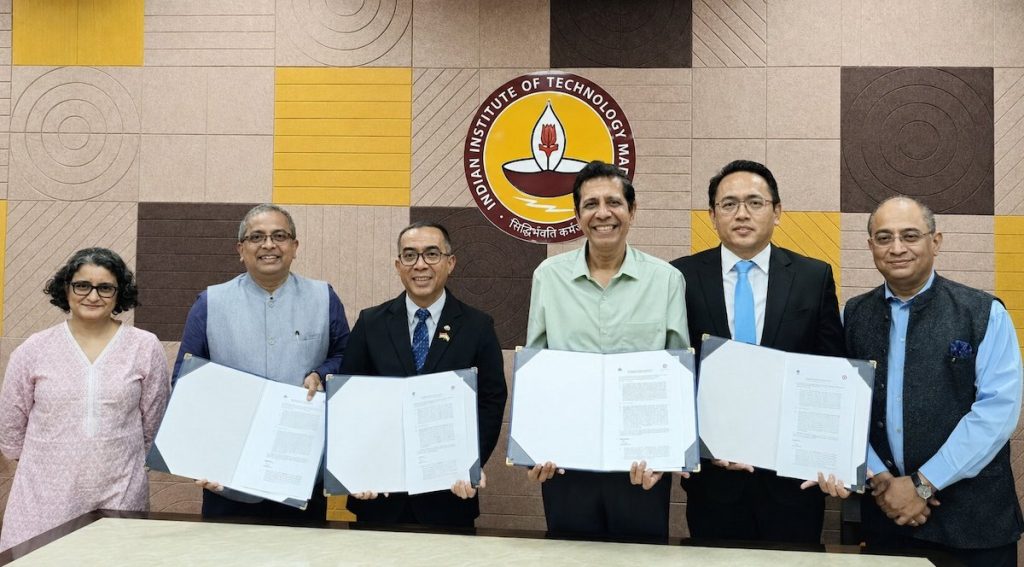
New Delhi: The Indian Institute of Technology-Madras and the government of Indonesia have signed a memorandum of understanding to deepen cooperation in research, innovation and deep technology. The agreement, concluded in Chennai on Wednesday, marks a fresh chapter in the widening academic and technological partnership between the two countries.
The pact was signed between IIT-Madras Global Research Foundation, the institute’s international arm, and Indonesia’s higher education, science and technology ministry. It was concluded during a visit to the Chennai campus by the minister of higher education, science and technology of Indonesia, Brian Yuliarto.
The memorandum sets out to strengthen collaborative research and innovation ecosystems between the two countries and to accelerate the commercialization of deep-tech ventures. It is also intended to advance the India – Indonesia South-South Strategic Partnership, a framework through which the two nations have sought to share expertise on equal terms rather than through conventional donor-recipient arrangements.
By combining IIT-Madras’s research strengths in emerging technologies with Indonesia’s national development priorities, the two sides hope to build solutions with commercial value for both economies. Officials described the initiative as a template that could eventually be replicated across other south-south collaborations.
The director of IIT-Madras and chairman of IIT-Madras Global Research Foundation, V Kamakoti, received Yuliarto on campus. The MoU itself was signed by the director of IIT-Madras Global Research Foundation, Raghunathan Rengaswamy, its chief executive officer and director, Madhav Narayan, and Indonesia’s director general of research and development, Mohammad Fauzan Adziman.
The signing was witnessed by Kamakoti, Yuliarto, the Indian ambassador to Indonesia, Sandeep Chakravorty, and the dean of global engagement at IIT-Madras, Preeti Aghalayam. Senior officials from both governments, along with deans and faculty members of the institute, were also present.
Yuliarto said Indonesia had set itself an ambitious goal of becoming a globally competitive, innovation-driven economy, a task that demanded strong institutional partnerships. He said the collaboration would give Indonesian universities greater access to joint research, talent development and technology-commercialization programmes with IIT-Madras, adding that the aim was to convert research into startups capable of competing globally.
Kamakoti said the partnership reflected the confidence that strategic nations placed in IIT-Madras’s research and innovation ecosystem. He added that the Foundation was extending the institute’s capabilities beyond national borders to co-create solutions for real-world challenges, describing the tie-up as a marker of the enduring friendship between India and Indonesia.
The partnership traces its origin to recent bilateral talks between the prime minister, Narendra Modi, and the president of Indonesia, Prabowo Subianto. During those discussions, the two leaders had reaffirmed their commitment to expanding cooperation in higher education, science, technology, innovation and entrepreneurship.
The signing thus carries diplomatic weight as much as academic significance.
The Chennai agreement builds on groundwork laid weeks earlier. On July 22, Yuliarto received Chakravorty and a delegation from IIT-Madras in Jakarta to discuss setting up a joint centre of excellence, along with cooperation on human resource development and technology-based startups.
The momentum has continued beyond Chennai. On the sidelines of the 13th BRICS education ministers’ meeting in Bhubaneswar, India’s union minister of education, Pralhad Joshi, held bilateral talks with Yuliarto on Thursday, where the two sides discussed expanding cooperation further in higher education and research.
Yuliarto, a professor of nanotechnology at the Bandung Institute of Technology, took charge of Indonesia’s higher education, science and technology ministry in February 2025. He has previously been ranked among the world’s top two per cent of scientists and received Indonesia’s Habibie Prize in 2024 for his research work.
For IIT-Madras Global Research Foundation, the Indonesian tie-up adds to a growing portfolio of international partnerships the institute has built in recent years to extend its research footprint beyond India. Whether the collaboration yields tangible startups and joint patents, as both sides hope, will become clearer once work under the memorandum gets under way.