


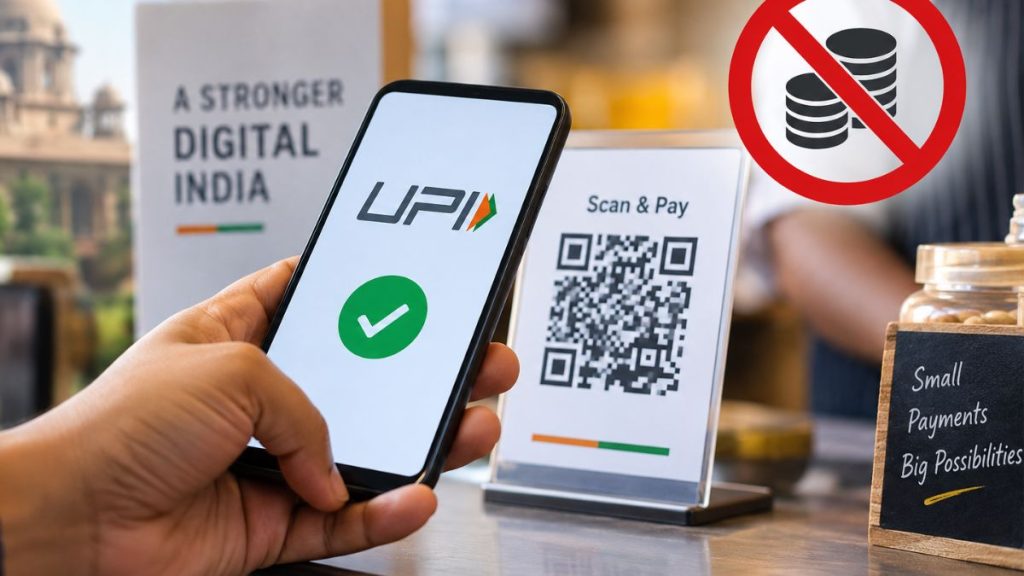
New Delhi: The government has formally barred banks and payment system providers from imposing direct or indirect charges on UPI transactions of up to ₹2,000, giving statutory protection to small value payments. The finance ministry notification also covers payments made through RuPay-powered debit cards, while any merchant discount rate on higher-value UPI transactions remains a separate policy decision.
Issued by the Department of Financial Services on Monday under Section 10A of the Payment and Settlement Systems Act, 2007, notification SO 5067(E) says no bank or system provider can levy a charge on a person making or receiving a payment through the specified modes. The ₹2,000 ceiling applies specifically to UPI, while RuPay-powered debit cards are listed separately without that value limit.
For users, the immediate position is clear: qualifying UPI payments up to ₹2,000 cannot attract a charge from a bank or system provider. The finance minister, Nirmala Sitharaman, had also clarified in Parliament in August that consumers would not face UPI transaction charges and that all person-to-person payments would continue to be free.
The notification does not impose a charge on UPI payments above ₹2,000. It means that transactions above that threshold are not covered by the same statutory no charge protection under this notification, leaving the government scope to consider a merchant discount rate (MDR) for eligible person-to-merchant transactions.
As RNA Media reported earlier, the amendment to Section 10A gives the government the power to specify through notification which digital payment modes remain protected from charges. The earlier report said this could make a future MDR framework possible for certain merchant UPI transactions, while no fee, rate or implementation timeline had then been decided.
MDR is a fee associated with a merchant accepting a digital payment and is distinct from a consumer facing transaction charge. The finance ministry said in August that, if introduced, MDR would apply only to a limited set of merchant transactions above a specified threshold and at a nominal rate.
No MDR rate or implementation date has been notified. The government has said the NPCI-led UPI and Services Steering Committee will decide on MDR, if any.
The notification follows Parliament’s amendment of section 10A through the Taxation and Other Laws (Amendment) Act, 2026, which received presidential assent on August 17. The amendment allows the central government to specify by notification the electronic payment modes on which banks and system providers cannot impose charges.
The finance ministry described the amendment in August as an enabling provision aimed at UPI’s long-term sustainability, technological development and resilience. It said rising transaction volumes require continued investment in cybersecurity, fraud prevention and infrastructure.
The economics behind the policy have also come under scrutiny. The union budget has provided ₹2,000 crore in 2026-27 for the incentive scheme supporting RuPay debit cards and low-value BHIM-UPI merchant transactions, while the Indian Express reported, citing the Department of Financial Services, that the payments industry incurs an estimated ₹20,700 crore annually in processing person-to-merchant transactions. The gap has sharpened the debate over how banks and payment companies can fund infrastructure and security while keeping everyday UPI payments free.
UPI volumes continue to climb
The policy change comes as UPI handles record transaction volumes. National Payments Corporation of India data show that 24.51 billion transactions were processed in August, worth ₹29.82 lakh crore, with 752 banks live on the platform. August marked UPI’s highest monthly transaction volume.
Indian Express reported that only about 4 per cent of person-to-merchant UPI transactions in 2025-26 exceeded ₹2,000, but they accounted for roughly two-thirds of such payments by value. The figures highlight the distinction between protecting routine low-value transactions and considering a revenue model for a smaller pool of higher-value merchant payments.