


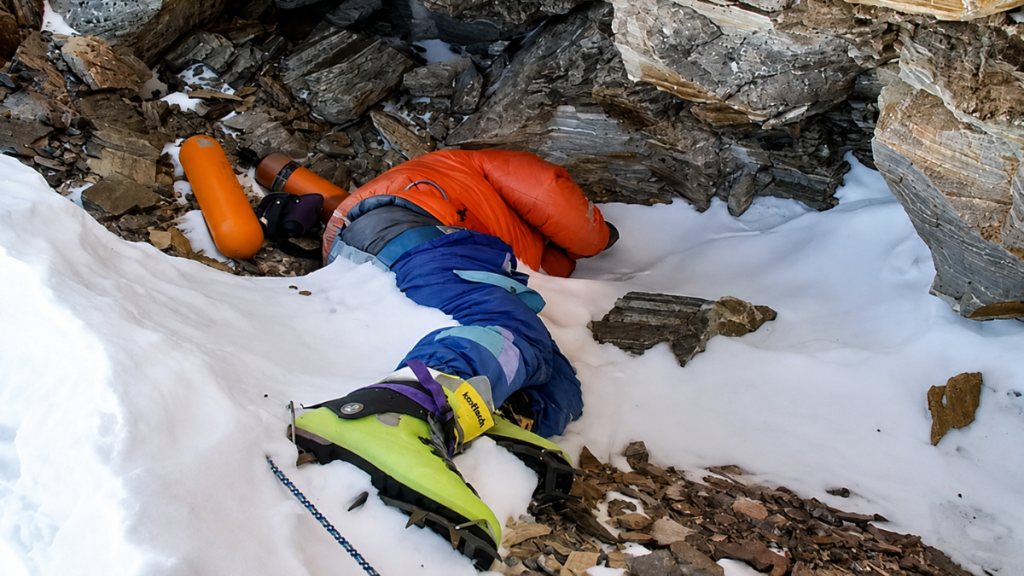
New Delhi: India is looking for a specialist high-altitude recovery team to bring down the remains of an Indian climber from Mount Everest, nearly 30 years after he died while descending from the summit. The Indo-Tibetan Border Police (ITBP), which is funding the operation, wants the body recovered from the Chinese side of the mountain by September.
The remains, lying at about 8,500 metres beneath an overhanging rock, have long been known to climbers as “Green Boots” because of the lime-coloured mountaineering footwear. Indian authorities now believe the body is that of ITBP Lance Naik Dorje Morup, although DNA testing will be required to establish his identity conclusively.
The body was earlier identified as that of Tsewang Paljor, who was among three ITBP climbers killed during the same 1996 expedition. According to the BBC, accounts from surviving expedition members, the location of the climbers’ last radio contact and the clothes and climbing equipment found with the remains have led authorities to reassess that identification.
The 1996 Everest expedition
Morup, then 48, was part of a six-member ITBP expedition attempting to climb Everest from the Chinese side. The team wanted to become the first Indian expedition to reach the summit from the northern route, rather than the more commonly used approach from Nepal.
A snowstorm forced three members to turn back, while Morup continued with Tsewang Smanla and Tsewang Paljor. The three reached the 8,849-metre summit but were caught in a blizzard during their descent and died.
Paljor and Smanla were never recovered. The third body remained on the mountain and became one of Everest’s best-known landmarks, with climbers using its location as a reference point on their route towards the summit.
Why the recovery is so difficult
The planned operation will take place in Everest’s death zone, where oxygen levels are roughly one-third of those at sea level and temperatures can fall to about minus 40C. The northern side is also steeper and has fewer support facilities than the Nepalese side, making emergency evacuation more difficult.
Tshiring Jangbu Sherpa, who has taken part in previous recovery missions, told the BBC that weather and snow conditions would be crucial. He said the northern route has fewer crevasses but is riskier because climbers cannot rely on the same helicopter evacuation system available from Nepal.
Mountaineering guide Pemba Ongchu Sherpa told the BBC that about 10 to 12 climbers capable of making summit attempts could be needed just to establish support ropes and reach the location. The body would then have to be carried down to a lower altitude, from where it could potentially be transported by helicopter or yaks.
The condition and weight of the remains will add to the difficulty. Bodies left frozen at high altitude can become heavier because of ice and climbing equipment, while their positions can make them difficult to move across steep terrain.
Indian climber Kuntal Joisher told BBC Nepali that the first 1,000 metres of the descent would be particularly challenging because of the steep, rocky ground. He also stressed that the operation should not put Sherpa rescuers’ lives at unnecessary risk.
Recovery could cost up to $80,000
Bringing bodies down from Everest remains relatively uncommon because of the danger involved. More than 300 people have died in the Everest region since records began about a century ago, and many remain on the mountain because recovery can expose rescuers to extreme risks.
Some bodies have instead been moved away from heavily used routes. Explorer Francys Arsentiev, known as the “Sleeping Beauty of Everest”, was moved to a more secluded location on the mountain in 2007, nearly 10 years after her death.
Experts told the BBC that even comparatively straightforward recovery missions can cost between $40,000 and $80,000. The ITBP is taking responsibility for the cost of Morup’s recovery and is currently seeking a team capable of undertaking the operation.
Morup’s family has waited since 1996
Morup’s death left his family in Ladakh without his remains. His wife, Konchak Yangskit, said she knew that a storm had struck the mountain and that her husband had died, but found it difficult to accept the news because she never saw his body.
Speaking to the BBC, Yangskit recalled that she had organized cremation prayers but continued to hope that Morup might return. She said that on some nights she imagined hearing a knock at the door and finding her husband standing outside.
Morup had left home after telling Yangskit that he would return as a hero and make the country proud. He had also asked her to care for their children and meet him at the airport when he came back.
The family still has his medals, trophies, and photographs, as well as a certificate issued by the Chinese government confirming that Morup reached the summit of Everest at 5.30pm on May 10, 1996.
Family plans funeral if identity is confirmed
If the remains are successfully recovered, they will be brought to India and subjected to DNA testing. Once identified, the body will be handed over to Morup’s family, allowing them to conduct his final rites after three decades.
Morup’s eldest son, Punchok Dorjai, told the BBC that the family plans to hold a funeral near Martyrs Park in Leh. He said his father gave his life for the country and should be remembered as a “martyr”, while his two teammates who died during the expedition should receive the same recognition.
The family also intends to preserve the “Green Boots” as a reminder of Morup’s final expedition, along with the certificate documenting his successful Everest summit.