


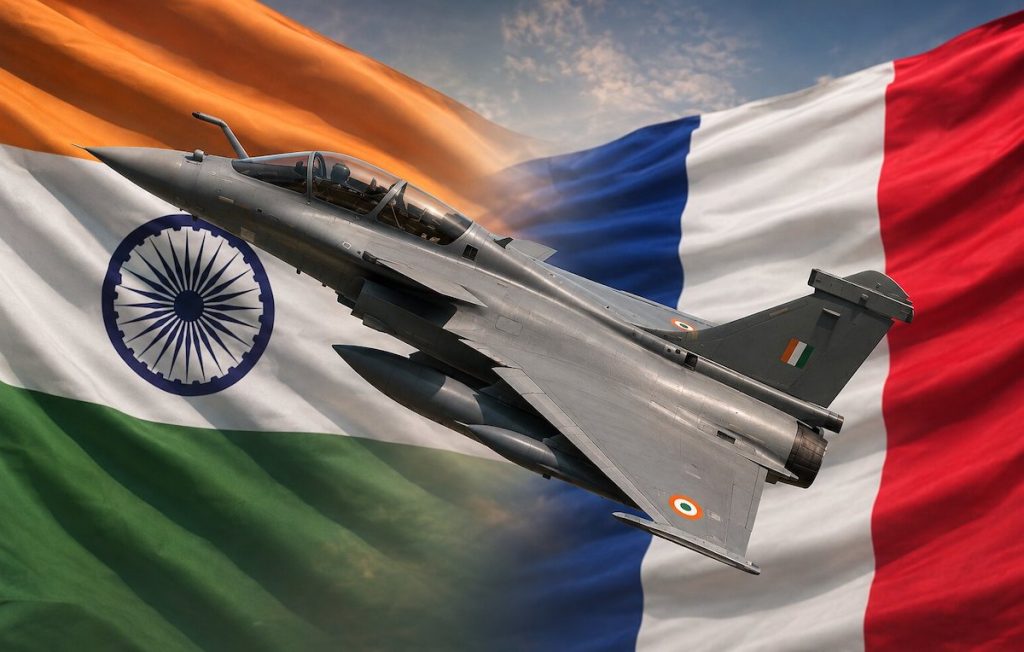
New Delhi: France has formally responded to India’s request for 114 Rafale fighter aircraft, submitting a detailed technical and commercial proposal that Indian defence officials have begun scrutinising in New Delhi. The offer, valued at approximately ₹3.25 lakh crore, is one of the largest fighter-jet transactions New Delhi has ever pursued and would cement the Rafale’s place as a mainstay of the Indian Air Force for decades to come.
Defence sources familiar with the matter said the French response, submitted by Dassault Aviation and its partners, is now with the acquisition wing of the Ministry of Defence and the Indian Air Force for detailed evaluation. Officials will examine the proposal against India’s core demands, chief among them the integration of indigenous weapons – including variants of the Astra air-to-air missile – and a substantial share of local content in the aircraft.
As New Delhi transmitted its letter of request (LoR) to Paris on June 3 after the IAF chief, Air Chief Marshal Amar Preet Singh visited the country, months after the Defence Acquisition Council formally cleared the Indian Air Force’s proposal in February 2026. The deal subsequently featured prominently when the prime minister, Narendra Modi, met the French president, Emmanuel Macron, in Nice in mid-June, ahead of the G7 summit in Evian.
Under the terms India is pressing for, 94 of the 114 aircraft would be assembled on Indian soil in partnership with a local industry player. Dassault’s principal partners on the programme – missile-maker MBDA, engine manufacturer Safran and electronics group Thales – would all be expected to establish or expand manufacturing footprints in the country.
The indigenization drive attached to the deal is expected to generate work worth around ₹1.6 lakh crore for Indian industry, with conglomerates such as Tata and Larsen & Toubro likely to be among the principal beneficiaries. French trade publications covering the negotiations have separately reported that New Delhi is seeking access to interface control documentation for the Rafale’s mission systems, a technical demand aimed at giving Indian engineers the ability to integrate the Brahmos-NG (next-generation) cruise missile and Astra without repeatedly returning to Dassault for each new weapon fit.
That push for software and systems autonomy fits within India’s broader Atmanirbhar Bharat, or self-reliance, agenda. It has also, according to French industry coverage, opened space for at least one rival pitch: Sweden’s Saab is understood to have offered India a considerably more open transfer-of-technology package for its Gripen E/F, including deeper involvement for Indian firms in design and software work, alongside the possibility of positioning India as a regional export hub for the aircraft.
Whether that alternative gains any real traction remains doubtful. The Rafale is markedly more capable and combat-proven, and the Indian Air Force already operates 36 of the jets, with the Navy having ordered a further 26 in a separate carrier-borne deal – taking the existing fleet to 62 aircraft before the new order is even signed.
Once the 114-jet contract is finalized, India’s total Rafale fleet would rise to 176 aircraft. The Navy has also signalled its intent to acquire 31 additional Rafale-Marine (Rafale-M) jets to counter maritime threats, a move that could eventually push the country’s overall Rafale holdings beyond 200 – a fleet size matched by few air forces outside the world’s major powers.
The urgency behind the acquisition is not difficult to explain. The Air Force’s squadron strength has been steadily eroded by the retirement of ageing Soviet-era MiG variants, while the indigenous Tejas-Mk1A and Tejas-Mk2 programmes have both suffered significant induction delays.
A capability review ordered by the defence secretary, Rajesh Kumar Singh, soon after he took charge in 2024 is understood to have shaped the government’s determination to move quickly on the Rafale order. That study fed directly into the push that produced February’s Defence Acquisition Council clearance and, subsequently, June’s Letter of Request.
For Dassault, the scale of the opportunity is difficult to overstate. The company closed 2025 with revenue of €7.42 billion, up 19 per cent year-on-year, and an order backlog of €46.6 billion that already included 220 Rafale and 73 Falcon business jets. It delivered 26 Rafale aircraft last year and is targeting deliveries of 28 Rafale and 40 Falcon jets in 2026, alongside revenue of €8.5 billion.
The Rafale programme has now logged 533 orders since its launch, of which 323 have come from eight export customers – Egypt, India, Qatar, the United Arab Emirates, Greece, Croatia, Indonesia and Serbia. Dassault currently builds three Rafale jets a month and is working to raise that rate to four, a target that would become considerably harder to sustain without a second production base such as the one now being negotiated with India.
That is precisely why the Indian order carries weight well beyond its price tag. Industry analysts tracking the programme believe a successful 114-jet deal could establish India as Dassault’s second global production hub for the aircraft, capable of supporting future export orders across Asia, West Asia and Africa rather than merely fulfilling domestic requirements.
Formal evaluation of France’s proposal is expected to take several months before India moves to issue a Request for Proposal and, eventually, negotiate a firm contract. Given the sums involved and the industrial commitments on both sides, few in Delhi or Paris expect the process to be rushed.