


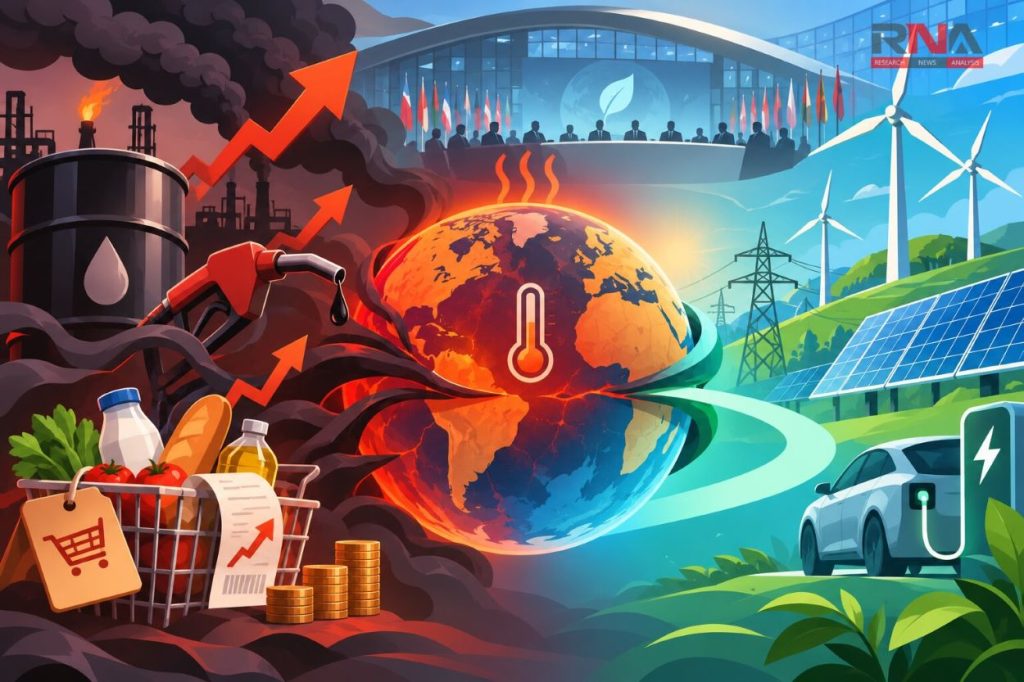
New Delhi: The United Nations has warned that the continuing turmoil in global fossil fuel markets is driving inflation, damaging economic growth and exposing countries to the financial consequences of their dependence on oil, coal and natural gas. Opening the COP31 climate summit in Turkiye, the UN’s climate chief, Simon Stiell, urged governments to accelerate electrification and renewable energy deployment, arguing that energy security and climate protection have become inseparable economic priorities.
Addressing delegates from nearly 200 countries on Monday, Stiell described the latest fossil fuel price crisis as a shock to households, businesses and governments across the world. He warned that the resulting inflation was spreading “like a cancer”, turning energy dependence into an economic vulnerability that extended far beyond environmental concerns.
The warning comes against the backdrop of the US-Iran war and disruptions to shipping through the strategically important Strait of Hormuz, one of the world’s principal maritime routes for oil exports. According to UN Trade and Development estimates cited at the summit, the crisis has contributed to a roughly 50 per cent increase in petrol prices worldwide, raising transportation, agricultural and manufacturing costs.
Higher petroleum prices also affect fertilizer production, food distribution and industrial supply chains, transmitting inflationary pressures throughout the economy. For major energy-importing countries such as India, prolonged instability in international fuel markets can complicate inflation management, increase import expenditure and place additional pressure on economic growth.
Stiell presented the transition towards cleaner electricity as an economic necessity rather than simply an environmental obligation. Speaking at the UN climate conference in Antalya, which runs from November 9 to 20, he urged governments to reduce their exposure to fossil fuel price fluctuations through renewable power, electrified transport and more efficient energy systems.
A principal proposal under discussion is an international commitment to increase electricity’s share of global final energy consumption to approximately 35 per cent by 2035, compared with slightly above 20 per cent today. The initiative, promoted by Turkiye and Australia, seeks to accelerate the replacement of fossil fuels in transportation, heating and industrial processes, although participation would remain voluntary.
Australia’s climate change and energy minister, Chris Bowen, who is leading negotiations, said discussions with participating governments had generated considerable support for faster electrification. The executive director of the International Energy Agency, Fatih Birol, similarly argued that an international commitment could encourage investment in electricity infrastructure, renewable generation and nuclear power.
However, disagreements have emerged over whether the proposed target should explicitly require electricity to come from low-carbon sources. According to the Financial Times, European negotiators are seeking stronger environmental safeguards, whereas several developing countries have questioned commitments that could impose additional costs on electricity networks and infrastructure.
The dispute illustrates a broader challenge facing climate diplomacy: increasing electricity consumption does not automatically reduce greenhouse gas emissions if additional demand is met by coal- or gas-fired power stations. Achieving meaningful emissions reductions would require governments to expand clean generation, strengthen transmission networks and invest in energy storage alongside electrification.
Meanwhile, Brazil is introducing a road map for transitioning away from fossil fuels that translates the broad commitment adopted at COP28 in Dubai in 2023 into practical policy measures. The proposals include reconsidering investment in new fossil fuel infrastructure, gradually reforming energy subsidies and helping countries develop transition strategies suited to their economic circumstances.
Climate financing remains another contentious issue, particularly for developing countries facing increasingly destructive extreme weather events. The Marshall Islands has highlighted the difficulties vulnerable nations encounter in securing international assistance, citing an eight-year process to obtain financing for a single protective sea wall.
Scientific warnings have added urgency to the negotiations, with researchers increasingly expecting global temperatures to exceed the Paris Agreement’s 1.5°C warming threshold above pre-industrial levels. The UN secretary-general, António Guterres, has called for faster emissions reductions, an equitable transition away from fossil fuels and stronger financial support for countries most exposed to climate-related disasters.
The talks are also taking place without an official United States delegation following the withdrawal of the administration of the US president, Donald Trump, from international climate negotiations. Washington’s absence creates an additional diplomatic challenge, given the country’s economic influence, energy consumption and position as one of the world’s largest greenhouse gas emitters.
For India, the negotiations carry substantial implications for energy security, industrial competitiveness and climate finance. Although expanding domestic solar and wind generation can reduce exposure to imported fuels, the transition also requires investment in electricity grids, battery storage and affordable financing without compromising the country’s growing energy requirements.
Ultimately, the success of COP31 will depend less on ambitious declarations than on whether governments can agree on credible measures to reduce fossil fuel dependence while protecting economic development. The emerging debate in Antalya reflects a significant shift in climate diplomacy, with energy affordability, geopolitical instability and inflation increasingly shaping the argument for cleaner power.