


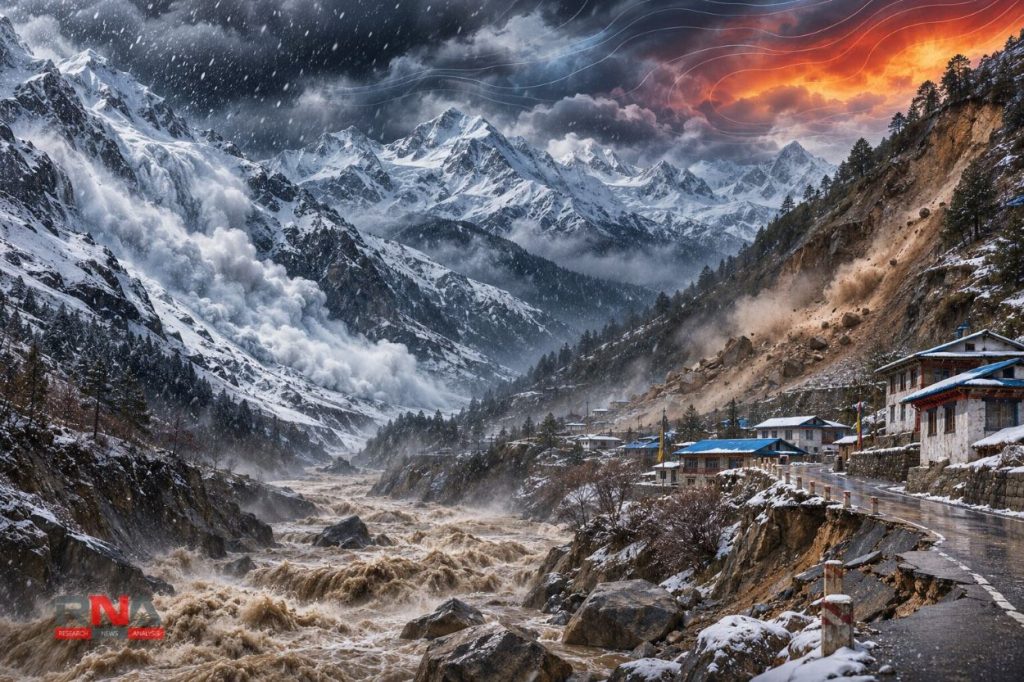
New Delhi: A powerful El Nino developing over the Pacific Ocean could expose the Hindu Kush Himalayan region to an unusually hazardous winter, with scientists warning of increased risks of flash floods, landslides and avalanches across several countries, including India and Nepal. A new international climate assessment indicates that above-normal precipitation, shifting snowfall patterns and rising temperatures could create dangerous conditions in some of Asia’s most environmentally fragile mountain ranges between November 2026 and February 2027.
The warning comes from the Hindu Kush Himalaya Winter Outlook 2026, jointly prepared by the Kathmandu-based International Centre for Integrated Mountain Development (ICIMOD), Beijing Normal University and the Institute of Atmospheric Physics of the Chinese Academy of Sciences. The assessment forecasts wetter-than-usual conditions across Afghanistan, Nepal, Bangladesh and northern Myanmar, alongside substantial variations in snowfall, temperatures and wildfire risks across the wider Himalayan region.
The projections coincide with an exceptionally strong El Nino, a climate phenomenon associated with unusually warm surface waters in the central and eastern tropical Pacific Ocean that alters atmospheric circulation and weather patterns worldwide. According to the US National Oceanic and Atmospheric Administration, the current event has approximately a 60 per cent probability of exceeding the strength of previous El Nino episodes recorded since 1950, although the precise consequences will differ considerably between regions.
Why Himalayas face greater danger
Scientists expect the changing atmospheric conditions to increase rainfall along parts of the Himalayan foothills and snowfall at higher elevations, potentially destabilizing vulnerable mountain slopes. Heavy precipitation can saturate loose soil and fractured rock, increasing landslide risks, while substantial snow accumulation can create unstable layers that become susceptible to avalanches.
The danger is particularly acute when warmer weather causes precipitation to fall as rain rather than snow, or when rainfall accelerates the melting of existing snow cover. Such conditions can rapidly increase river discharge, overwhelm drainage systems and trigger destructive floods in narrow mountain valleys where settlements, roads and hydropower installations often occupy limited space.
The assessment also identifies striking geographical differences, with northern India, Pakistan, Afghanistan and Nepal expected to receive deeper-than-normal snow in some high-altitude areas. Conversely, parts of Bhutan and eastern Tibet could experience reduced snow accumulation, raising concerns about water availability when the winter season ends.
What the forecast means for India
For India, the findings carry implications extending beyond immediate disaster management, particularly for the Himalayan states where extreme weather frequently disrupts transport, tourism, agriculture and critical infrastructure. The assessment forecasts above-normal snow depth in Himachal Pradesh and the far north, alongside wetter conditions in some northern and northeastern areas, making timely monitoring of snowfall and mountain weather especially important.
Increased snowfall can replenish natural water reserves and benefit winter tourism, but it can also block strategic roads, isolate remote communities and complicate military logistics along the northern frontiers. Heavy snow accumulation, followed by sudden warming or rainfall, can additionally heighten avalanche risks and produce abrupt increases in downstream river flows.
The implications are equally significant for river-basin management because Himalayan snow and ice help sustain major waterways that support agriculture, hydropower generation and drinking-water supplies across South Asia. Although abundant winter snow can improve water availability during subsequent months, uneven accumulation and premature melting can create serious difficulties for reservoir operations, irrigation planning and seasonal water allocation.
Nepal’s recent disaster underlines the warning
The latest assessment follows a particularly destructive period for the Himalayan region, including the catastrophic rock-ice avalanche in Nepal’s Rasuwa district in August this year that unleashed a massive debris flood along the Nepal-China border. An ICIMOD investigation subsequently identified measurable movement on the mountain slope before its collapse, highlighting both the potential and limitations of satellite-based monitoring.
According to Nepalese disaster-management figures cited by ICIMOD in October, the catastrophe killed at least 1,451 people and left another 5,745 missing, demonstrating the devastating consequences of rapidly developing high-altitude hazards. The disaster, also examined in an RNA Media report on the Nepal-Tibet floods, involved a massive collapse of rock and glacier ice rather than a conventional glacial lake outburst.
Researchers found that satellite observations had recorded significant deformation before the slope failed, but the evidence could not establish exactly when the collapse would occur. The resulting debris surge reached a vulnerable border corridor within minutes, exposing serious shortcomings in warning arrangements designed primarily around rainfall and rising river levels.
A wetter winter could still bring forest fires
The outlook also highlights an apparent contradiction: some Himalayan areas could face serious wildfire risks despite forecasts of above-normal precipitation elsewhere in the region. Prolonged dry spells, warmer temperatures and the accumulation of combustible vegetation could increase forest and grassland fire hazards, particularly in southeastern Tibet and parts of Myanmar.
For India, the report identifies pockets of elevated fire danger in the northeastern Himalayas and southern peninsula, even as several northern mountain areas prepare for increased precipitation. These contrasting projections reinforce the need for geographically specific weather forecasts rather than treating the Himalayan region as a single climatic zone.
Climate change adds to long-term concerns
The immediate warning comes against a broader pattern of Himalayan environmental instability, with rising temperatures accelerating glacier retreat and changing the behaviour of snow, ice and high-altitude slopes. Previous ICIMOD research has warned that the region can experience destructive localized rainfall and floods even during seasons when overall precipitation remains below normal.
The Hindu Kush Himalayan system stretches approximately 3,500 kilometres across eight countries and supports the food, water and energy security of as many as two billion people. Its interconnected river basins make mountain hazards a transboundary concern, requiring countries to exchange meteorological observations, hydrological information and early warnings before disasters cross national borders.
Scientists emphasize that seasonal forecasts identify broad patterns of risk rather than predicting individual disasters, making short-range weather monitoring essential for operational decisions. The findings will be discussed at an international conference on Himalayan cryospheric science in Kathmandu from November 25 to 27, where researchers and policymakers are expected to examine stronger monitoring systems, disaster preparedness and regional cooperation.
The central challenge for India and its neighbours is therefore not simply preparing for a wetter winter, but anticipating how unusually heavy snowfall, warmer temperatures and unstable mountain terrain could interact. With Himalayan river systems, transport corridors and vulnerable settlements increasingly exposed to compound hazards, the coming months will test the region’s ability to translate climate forecasts into effective early warnings and preventive action.