


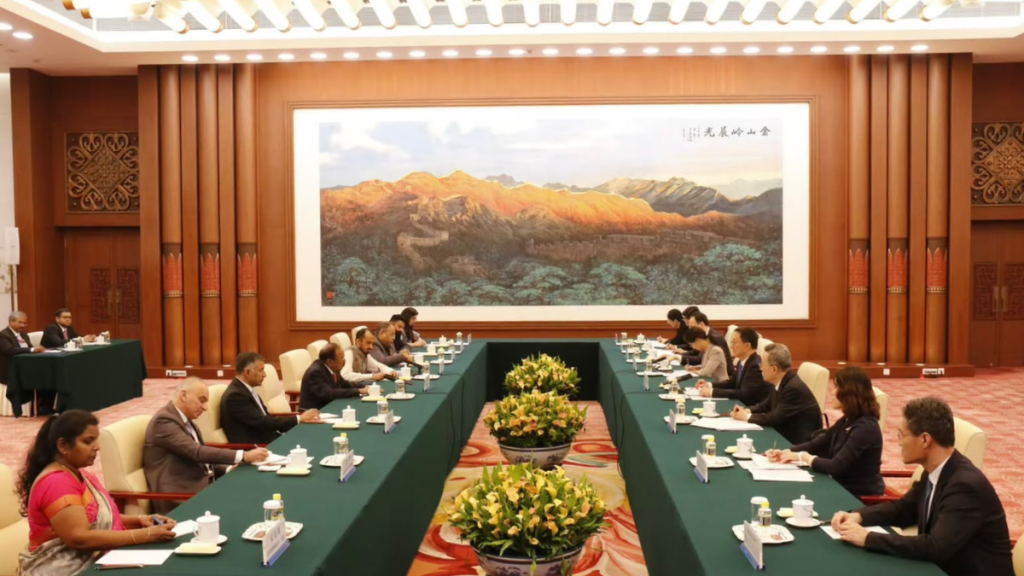
New Delhi: The national security advisor, Ajit Doval, and Chinese foreign minister, Wang Yi, held the 25th round of India-China Special Representatives’ talks on the India-China boundary question in Beijing on Tuesday, with both sides continuing high-level engagement aimed at maintaining stability along the line of actual control (LAC) and managing the boundary dispute. The talks assume added significance as India prepares to host the BRICS summit in New Delhi on September 12-13, with the Chinese president, Xi Jinping, expected to attend, although Beijing has not yet formally confirmed his visit, as RNA Media had reporter earlier.
The Chinese foreign ministry spokesperson, Lin Jian said the special representatives’ mechanism is the “main channel” for negotiations on the boundary issue and an important platform for communication on matters of mutual concern. He said the two sides would continue in-depth communication on the border issue while also exchanging views on bilateral relations and international and regional matters, with the aim of jointly safeguarding peace and tranquillity in the border areas.
Doval meets Chinese vice president Han Zheng
Ahead of his talks with Wang Yi, Doval met Chinese vice-president, Han Zheng in Beijing. According to the Indian embassy in China, the two sides discussed ways to strengthen peace in the border areas and further improve bilateral relations across economic, political and multilateral platforms, in line with the consensus reached by the leaders of the two countries.
The meeting brought the border issue and the wider relationship together in the same diplomatic engagement. For India, this is important because New Delhi’s approach to the China relationship remains centred on maintaining peace along the LAC while gradually restoring broader channels of engagement.
The Chinese account also highlighted the wider relationship. Han said China and India should view and handle their ties from a strategic and long-term perspective, strengthen strategic mutual trust, expand cooperation, enhance multilateral coordination and properly manage differences.
According to reports, Doval said India is ready to work with China to deepen mutually beneficial cooperation, properly handle the boundary question and push bilateral relations towards further progress.
What China is signalling
Global Times, described the special representatives’ talks as a sign that India-China relations are moving towards greater stability and improvement. Chinese experts quoted by the newspaper also linked the continuation of the mechanism to the broader recovery in bilateral ties.
The latest talks do not by themselves mean that the boundary dispute has been resolved. Instead, they provide a high-level channel through which the two sides can address the dispute while preventing it from derailing the wider relationship.
The latest round follows a series of diplomatic steps since the 2024 disengagement understanding that helped reduce tensions at the remaining friction points in eastern Ladakh.
The 24th round of special representatives’ talks in New Delhi in August 2025 produced a series of understandings covering boundary management, border delimitation, military and diplomatic communication, trans-border rivers and the reopening of traditional border trading markets. The two sides also agreed to hold the next round in China.
The 36th meeting of the Working Mechanism for Consultation and Coordination on Border Affairs, held in New Delhi on August 6 this year, then focused on implementing the understandings reached during the 24th round and preparing for the latest SR talks. The two sides discussed boundary delimitation, border management and cross-border exchanges and agreed to continue diplomatic and military communication while safeguarding peace in the border areas.
This means the Doval-Wang meeting is not an isolated diplomatic event. It is part of a continuing process in which India and China are trying to move from crisis management towards more regularized management of the boundary and the broader relationship.
What India stands to gain from the thaw
A relatively stable LAC reduces the risk of sudden military escalation and gives both sides greater space to use diplomatic and military communication mechanisms to address local tensions before they develop into larger confrontations. The August 6 WMCC meeting specifically reaffirmed the importance of continuing such communication.
A more predictable border environment can also create room for India to pursue wider economic and diplomatic priorities without allowing the boundary dispute to dominate every aspect of the relationship.
The potential benefits extend beyond the frontier. The understandings reached during the previous SR process included steps relating to traditional border trade, cross-border exchanges and trans-border river cooperation. These areas can provide practical gains if implementation continues alongside progress on border management.
For India, however, the objective is not simply a return to normal ties. The priority is to build a relationship in which border stability, economic engagement and political dialogue can proceed without compromising India’s security interests.
Possible Xi visit gives talks another layer
The biggest political factor surrounding the current engagement is the possible visit of Xi Jinping to India for the BRICS summit. RNA Media reported that Xi is likely to attend the September summit in New Delhi and could be accompanied by a delegation of around 400 officials. His travel plans and the agenda for any bilateral meeting with the prime minister, Narendra Modi, have not yet been finalized, and Beijing has not formally confirmed the visit.
If the visit takes place, it would be Xi’s first trip to India in seven years and could provide Modi and Xi with another opportunity to assess the direction of bilateral ties at the highest level. Reuters noted that the possible visit is being viewed as another sign of the cautious improvement between the two countries, even as the boundary remains disputed.
For New Delhi, the significance would therefore extend beyond protocol. A high-level Modi-Xi meeting could help establish whether the current improvement in relations can be translated into more predictable engagement on the border and wider bilateral issues.
New Delhi is engaging with Beijing at multiple levels, from the special representatives mechanism and WMCC to ministerial and leadership-level contacts. At the same time, the border remains central to India’s assessment of whether the relationship is genuinely improving.
That approach is reflected in the latest sequence of meetings. The August 6 WMCC talks focused on border management, while Doval’s meeting with Han Zheng also covered peace along the border. The Doval-Wang talks have now brought the boundary question back to the centre of high-level India-China engagement.
No breakthrough, but significant diplomatic opening
For India, the immediate objective is to preserve the relative calm along the LAC, strengthen mechanisms for preventing misunderstandings and create conditions for wider engagement. Over the longer term, New Delhi can benefit from a more stable relationship through greater economic engagement, improved connectivity and people-to-people exchanges, provided these developments remain consistent with India’s security interests.
The possible Xi visit could become the next major test of relation between both nations. If confirmed, his presence in New Delhi would give India and China an opportunity to assess whether the diplomatic momentum seen since the 2024 disengagement can evolve into a more stable and predictable relationship.